Tag: Film Score

  • Patrick Doyle’s Shakespeare Sound

    Patrick Doyle’s Shakespeare Sound

    “Is it not strange that sheep’s guts should hale souls out of men’s bodies?”

    This week on “Picture Perfect,” on the presumed birthday of William Shakespeare (April 23, 1564), we’ll make much ado about Patrick Doyle, with selections from his scores written for the films of Kenneth Branagh.

    In 1987, Doyle joined Branagh’s Renaissance Theatre Company, for which he provided incidental music. Two years later, Branagh – and by extension, Doyle – made a leap to the big screen, where they achieved a remarkable feat, rethinking Shakespeare’s “Henry V.” Remember, this is the play that propelled Laurence Olivier to worldwide fame in 1944, both as a filmmaker and the Bard’s most celebrated interpreter, and William Walton’s score is regarded as one of the best of all time.

    Branagh’s version is quite different. Though equally rousing, it doesn’t shy away from Henry’s more complicated nature and the grittier aspects of what it means to go to war. It was a bold gamble, but one that paid off. Not only did this revisionist “Henry” receive nearly universal acclaim, the film was a box office success, and Branagh would be nominated for two Academy Awards, like his predecessor, in the categories of Best Actor and Best Director. Certainly, the film’s score deserved to be recognized – but in the year of “The Little Mermaid,” it failed even to secure an Academy Award nomination.

    An interesting footnote: Doyle himself is the baritone who introduces “Non nobis Domine,” a prayer of thanksgiving, following the Battle of Agincourt.

    In 2006, Branagh directed an adaptation of “As You Like It.” As has become his custom, he took a celebrity approach to its casting, although perhaps not so widely uneven as some of the cameos in his big screen “Hamlet.” Kevin Kline plays Jacques; Alfred Molina the fool, Touchstone; and Branagh regulars, Brian Blessed and Richard Briers appear, as well.

    The most radical liberty taken with the play is that Branagh transplants the action to 19th century Japan. The language remains firmly rooted in Shakespeare’s text, although there are striking cross-cultural elements, including ample kimonos, kabuki theatre, ninjas, and a sumo wrestler. Still, it’s a long way off from the astounding bomb that was Branagh’s American Songbook-interpolated “Love’s Labour’s Lost.”

    While Olivier’s “Hamlet” won four Academy Awards in 1948, including those for Best Picture and Best Actor, Branagh’s 1996 version is cinema’s first adaptation of the complete text. It is, perhaps, an uneven interpretation, with some puzzling casting choices – including walk-ons by Jack Lemmon, Robin Williams, and Gerard Depardieu – but there are enough merits, certainly, to make the four-hour trek worthwhile.

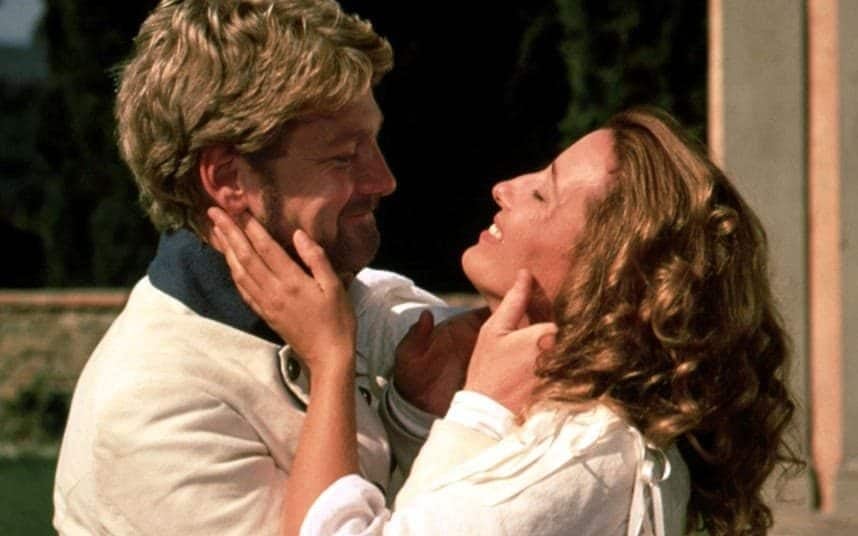
    Finally, Branagh teamed with his then-wife, Emma Thompson, for a “merry war” of wits, as Benedick and Beatrice, in his 1993 adaptation of “Much Ado About Nothing.” Again, the film features an eclectic supporting cast of classically trained actors and pop Hollywood phenomena. Briers, Blessed, and Imelda Staunton share screen time with Denzel Washington, Michael Keaton, and Keanu Reeves. Yet, somehow, despite the different nationalities, ethnicities, and accents, the entire enterprise works. There is an exuberance to the over-the-top opening sequence which sets up a momentum that carries through the rest of the film.

    Sigh no more, but join me for the Shakespeare scores of Patrick Doyle on “Picture Perfect,” music for the movies, this Saturday evening at 6:00 EDT, on WWFM – The Classical Network and wwfm.org.


    How could you not love this opening?

    Faith and sheep’s guts in “Much Ado About Nothing”
    https://www.tandfonline.com/doi/abs/10.1080/17450918.2014.968607#:~:text=In%20Benedick’s%20response%20to%20Balthasar’s,member%20of%20Shakespeare’s%20original%20audience.

  • Rózsa’s Thief of Bagdad Birthday Tribute

    Rózsa’s Thief of Bagdad Birthday Tribute

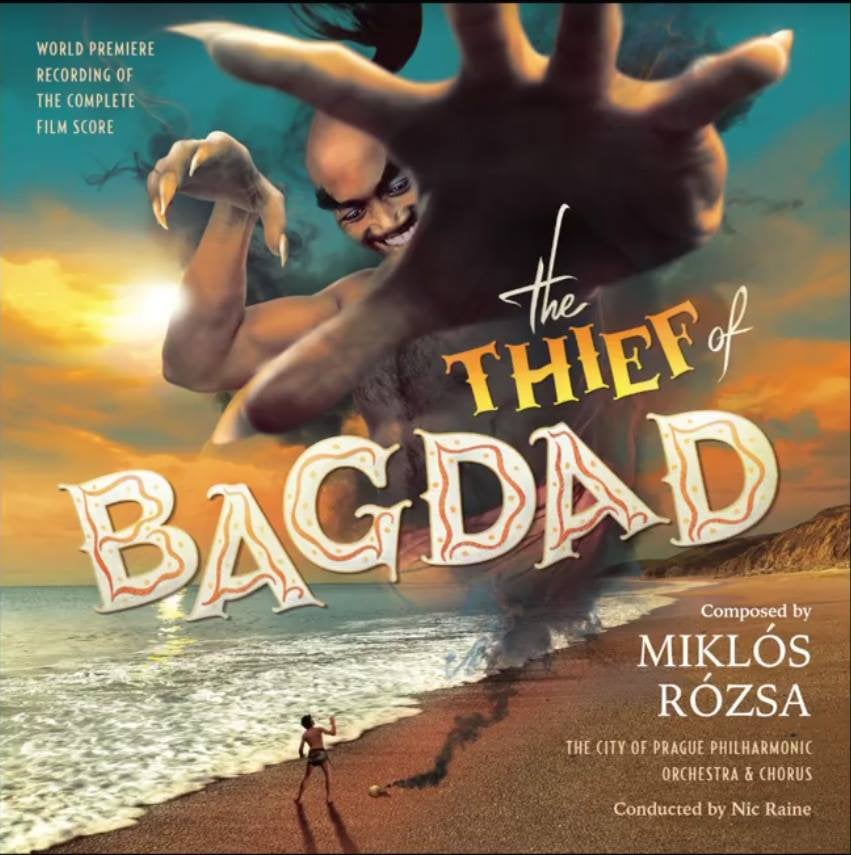
    Between Passover and Easter, Miklós Rózsa’s biblical epics may still be resounding in our ears. But he composed superb scores in most every genre. Here are two selections from one of my Rózsa favorites, “The Thief of Bagdad” (1940).

    “Love of the Princess”

    “Market of Basra”

    Both performances are from sessions for a complete recording of the work, released in 2017, a collaboration between Prometheus Records and Tadlow Music.

    If a genie would have offered to grant me three wishes, a recording of this score would have been one of them.

    Happy birthday, Miklós Rózsa.

  • Kilar’s Exodus Passover and a Klezmer Motif

    Kilar’s Exodus Passover and a Klezmer Motif

    Chag Sameach! Passover begins at sunset.

    Wojciech Kilar (1932-2013) is probably best-known in this country for his film scores. He composed music for well over 100 movies, gaining a toehold in international cinema fairly late in his career. American audiences may recognize his work for “Bram Stoker’s Dracula” (1992), “The Portrait of a Lady,” (1996), and “The Pianist” (2002).

    But in his native Poland, he was also a major concert composer, of the same generation as Krzysztof Penderecki and Henryk Górecki. My own first exposure to Kilar was on a concert of the Philadelphia Orchestra, given back in 1987, when Witold Rowicki conducted a fascinating work titled “Krzesany” (1974), a symphonic poem evocative of a Polish mountain dance that employs aleatoric elements.

    In 1979-81, Kilar composed “Exodus,” a 23-minute crescendo, after the manner of Ravel’s “Boléro,” only crowned by the entrance of a chorus, which sings “Domine ecce venit populus tuus” (“Lord, behold, your people come”), in a spirit of mounting exultation.

    Though it is by no means film music, its genesis was in Kilar’s research in writing music for Peter Lilienthal’s film, “David” (1979). The composer stumbled across a klezmer motif in a Jewish songbook, and it basically took him over. He dedicated the finished piece to Krzysztof Zanussi, another filmmaker.

    Interestingly, Kilar’s “Exodus” did enjoy a brief vogue in the movies, in trailers, such as the one for “Schindler’s List.”

    You can view a live performance of it here:

    Be sure to stick around for a golf clap from the clergy at the end (except for the guy at the far end of the pew, who seems to have genuinely enjoyed it).


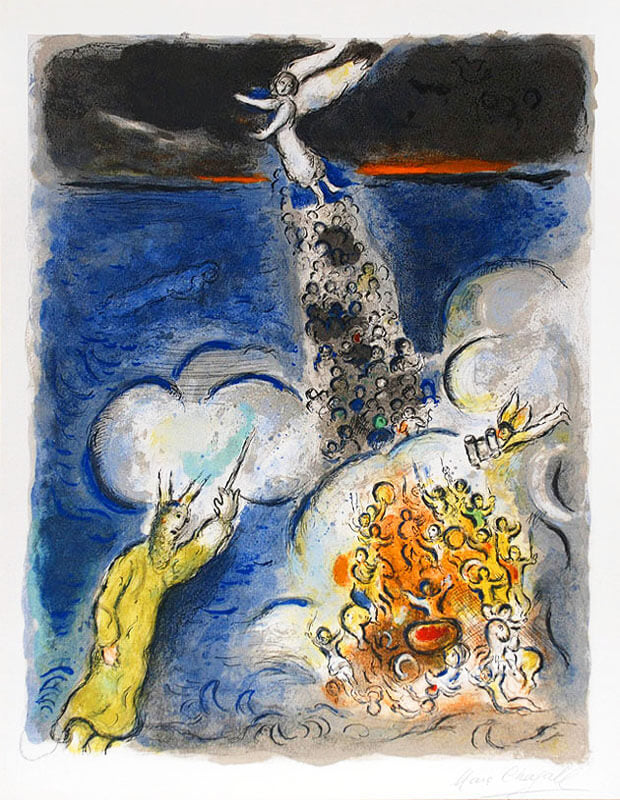
    Marc Chagall, “The Train Crossed the Red Sea” from “Exodus” (1966)

  • Elmer Bernstein A Centennial Celebration

    Elmer Bernstein A Centennial Celebration

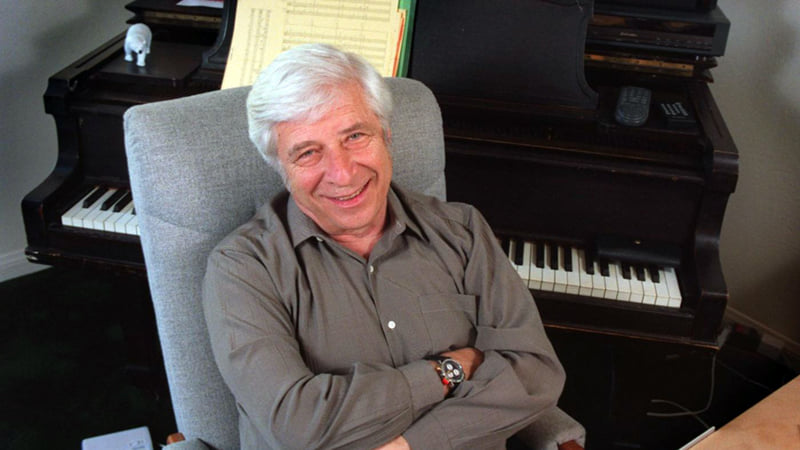
    His was an enviable career that spanned some 50 years. He composed music for over 150 movies and nearly 80 television projects, many of them still much-beloved, including “The Ten Commandments” (1956), “The Magnificent Seven” (1960), “To Kill a Mockingbird” (1962), “The Great Escape” (1963), and the iconic theme for the National Geographic television specials.

    Elmer Bernstein would have been 100 years-old today.

    Bernstein was composer-of-choice for John Wayne’s later films, including “The Comancheros” (1961), “The Sons of Katie Elder” (1965), “True Grit” (1969), and “The Shootist” (1976).

    In addition, he was one of the first film composers to incorporate jazz elements into his work for dramatic purposes, in movies like “The Man with the Golden Arm” (1955), “Sweet Smell of Success” (1957), and “Walk on the Wild Side” (1962).

    Coming out of the Swinging Sixties, a time when the industry clearly favored a more popular sound over purely orchestral music (that is, until John Williams changed everything), Bernstein kept right on working. Thanks to a generation of younger filmmakers who had grown up on his classics, he never lacked for choice. Suddenly, he found himself much in demand as a comedy composer, providing the underscores for “Animal House” (1978), “The Blues Brothers” (1980), “Airplane!” (1980), “Stripes” (1981), and “Ghostbusters” (1984).

    For Martin Scorsese, he composed music for “The Age of Innocence” (1993), “Bringing Out the Dead” (1999), and “The Gangs of New York” (2002) – although his score for the latter was ultimately rejected due to extensive tampering in post-production. He also adapted Bernard Herrmann’s music for Scorsese’s remake of “Cape Fear” (1991) and wrote the music for the Scorsese-produced “The Grifters” (1990).

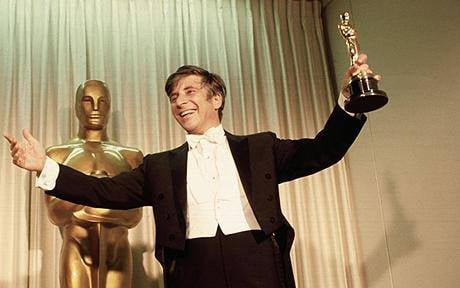
    In all, Bernstein was nominated for 14 Academy Awards, but claimed the Oscar only once, fairly early on, for his work on “Thoroughly Modern Millie” (1967), of all things. His final nomination was for his very last score, for “Far from Heaven” (2002). Elmer Bernstein died on August 18, 2004 at the age of 82.

    No relation to Leonard Bernstein (or “Bern-STINE”), Elmer pronounced his name “Bern-STEEN.” The two were sometimes further differentiated as “East Coast Bernstein” and “West Coast Bernstein.”

    In the year 2000, Elmer Bernstein composed a guitar concerto and expressed regret that he hadn’t contributed more to the concert hall. At least it was good one. David Hurwitz of classicstoday.com described it as “incontestably the finest piece ever composed for this combination” (i.e. guitar and orchestra), going so far as to hold it up to Joaquin Rodrigo’s “Concierto de Aranjuez.” I don’t know if I’d take it that far, but it is pretty damn good.

    Movement 1 https://www.youtube.com/watch?v=_mrSyhK6174

    Movement 2 https://www.youtube.com/watch?v=f072Efxnw24

    Movement 3 https://www.youtube.com/watch?v=mBi-BHZPkq4

    Keep an eye out for my webcast for this past weekend’s “Picture Perfect,” devoted to Bernstein. I’m told the audio will be up this afternoon. Once it’s posted, you can click on “listen” at the link.

    https://www.wwfm.org/show/picture-perfect-with-ross-amico/2022-03-31/picture-perfect-apr-2-elmer-bernstein-at-100

    Some of Bernstein’s music for “The Ten Commandments” will also be featured on this weekend’s show, which will be devoted to scores composed for Biblical epics, this Saturday evening at 7:00 EDT, on WWFM – The Classical Network and wwfm.org.

    In the meantime, enjoy “Elmer Bernstein: This Is Your Life,” with appearances by John Williams, John Landis, Eli Wallach, and others, offering congratulations to the composer at the age of 80.

    Happy birthday, Elmer Bernstein. Thank you for your magnificent body of work!

  • Elmer Bernstein A Centennial Celebration

    Elmer Bernstein A Centennial Celebration

    April 4 would have been the 100th birthday of Elmer Bernstein. Over a career that spanned some 50 years, Bernstein scored dozens of film and television projects, many of them now classics.

    This week on “Picture Perfect,” sample his versatility with selections from just a few of them, including “The Magnificent Seven” (1960), “The Age of Innocence” (1993), “Stripes” (1981), and “To Kill a Mockingbird” (1962).

    In all, Bernstein was nominated for 14 Academy Awards, but claimed the Oscar only once, fairly early on, for his work on “Thoroughly Modern Millie” (1967), of all things. His final nomination was for his very last score, for “Far from Heaven” (2002). Bernstein died on August 18, 2004 at the age of 82.

    Elmer will have you glued to the radio, on “Picture Perfect,” music for the movies, this Saturday evening at 6:00 EDT, on WWFM – The Classical Network and wwfm.org.

    PLEASE NOTE: If you were hoping to hear some of Bernstein’s music for “The Ten Commandments” (1956), tune in next week, as we anticipate Passover with selections from Biblical epics from the Old Testament!

Tag Cloud

Aaron Copland (92) Beethoven (95) Composer (114) Film Music (123) Film Score (143) Film Scores (255) Halloween (94) John Williams (187) KWAX (229) Leonard Bernstein (101) Marlboro Music Festival (125) Movie Music (138) Opera (202) Philadelphia Orchestra (89) Picture Perfect (174) Princeton Symphony Orchestra (106) Radio (87) Ralph Vaughan Williams (85) Ross Amico (244) Roy's Tie-Dye Sci-Fi Corner (290) The Classical Network (101) The Lost Chord (268) Vaughan Williams (103) WPRB (396) WWFM (881)

DON’T MISS A BEAT

Receive a weekly digest every Sunday at noon by signing up here


RECENT POSTS