Tag: Film Score

  • Malcolm Williamson: The Master of Queen’s Music

    Malcolm Williamson: The Master of Queen’s Music

    When Malcolm Williamson was appointed Master of the Queen’s Music in 1975, Sir William Walton quipped that they had given the job to the wrong Malcolm.

    Nevermind the fact that the other Malcolm, Sir Malcolm Arnold, could be something of a loose cannon. Alcoholism, promiscuity, manic-depression, possible bi-polar disorder. He once shot himself in the foot to get out of war service and attempted suicide several times. Still, he did manage to churn out much delightful music-to-order, often lickety-split and in an immediately accessible idiom. So who knows, maybe Arnold would have been a good choice.

    Williamson, who would have been 90 years-old today, was always an establishment outlier. Born in Sydney, Australia, he arrived in England in his late teens. His antipodean origins led to sotto voce grumblings that his Royal appointment was but a utilitarian one, “cementing the cracks in the Commonwealth,” as Walton put it.

    Whether or not a sense of alienation contributed to a kind of paralysis in the face of overwhelming pressure, Williamson developed an unfortunate reputation of being very bad with deadlines (and for that, he certainly has my sympathy). Most particularly, he failed to complete a symphony in time for the Queen’s Golden Jubilee in 1977. His ambitious “Mass for Christ the King,” also intended for the occasion, was also delivered late. Significantly, he was the first Master of the Queen’s (or King’s) Music in over a century not to be knighted.

    Following the Jubilee debacle, his output slowed, though he was seldom unproductive. In all, he completed seven symphonies, concertos for piano, violin, organ, harp and saxophone, and numerous other orchestral, choral, chamber and instrumental works.

    Williamson suffered from ill health in his later years. He too may have turned to the bottle to numb himself against stress and depression. However, those close to him assert that, at least toward the end of his life, he never drank, but rather struggled with aphasia, the effect of a series of strokes.

    What’s certain is that he was the first non-Briton to be named Master. Following his death in 2003, the parameters of the appointment were revised. The position is no longer one for life, but rather a fixed, ten-year term. Sir Peter Maxwell Davies was the first to serve under the new guidelines. He was succeeded in 2015 by Judith Weir, the first woman to hold the post (and yes, she is still referred to as “Master”).

    What’s puzzling is that, for someone with a reputation for being unable to meet deadlines, Williamson was able to write a fair amount of music for the cinema. The films were admittedly of varying quality. It’s always amusing to discover his name in the opening credits of Hammer productions like “The Brides of Dracula” and “The Horror of Frankenstein.” But it proves that he could write to order, and he could write very quickly, perhaps when he wasn’t under the microscope.

    Now that the dust settled, it is the music he left us that’s important.

    Happy birthday, Malcolm Williamson!


    Williamson performs his attractive Piano Concerto No. 2

    A rare recording of his Symphony No. 6

    Ballet music from “The Display”

    Orchestral excerpts from the opera “Our Man in Havana”

    “With Proud Thanksgiving”

    “Two Christmas Hymns”

    “Lento for Strings”

    Theme music for “The Brides of Dracula”

    End credits for “The Horror of Frankenstein”

    “Nothing But the Night,” starring Christopher Lee and Peter Cushing:

    Malcolm Williamson in conversation with Bruce Duffie:
    http://www.kcstudio.com/williamson2.html
  • David Amram Musical Polyglot Turns 91

    David Amram Musical Polyglot Turns 91

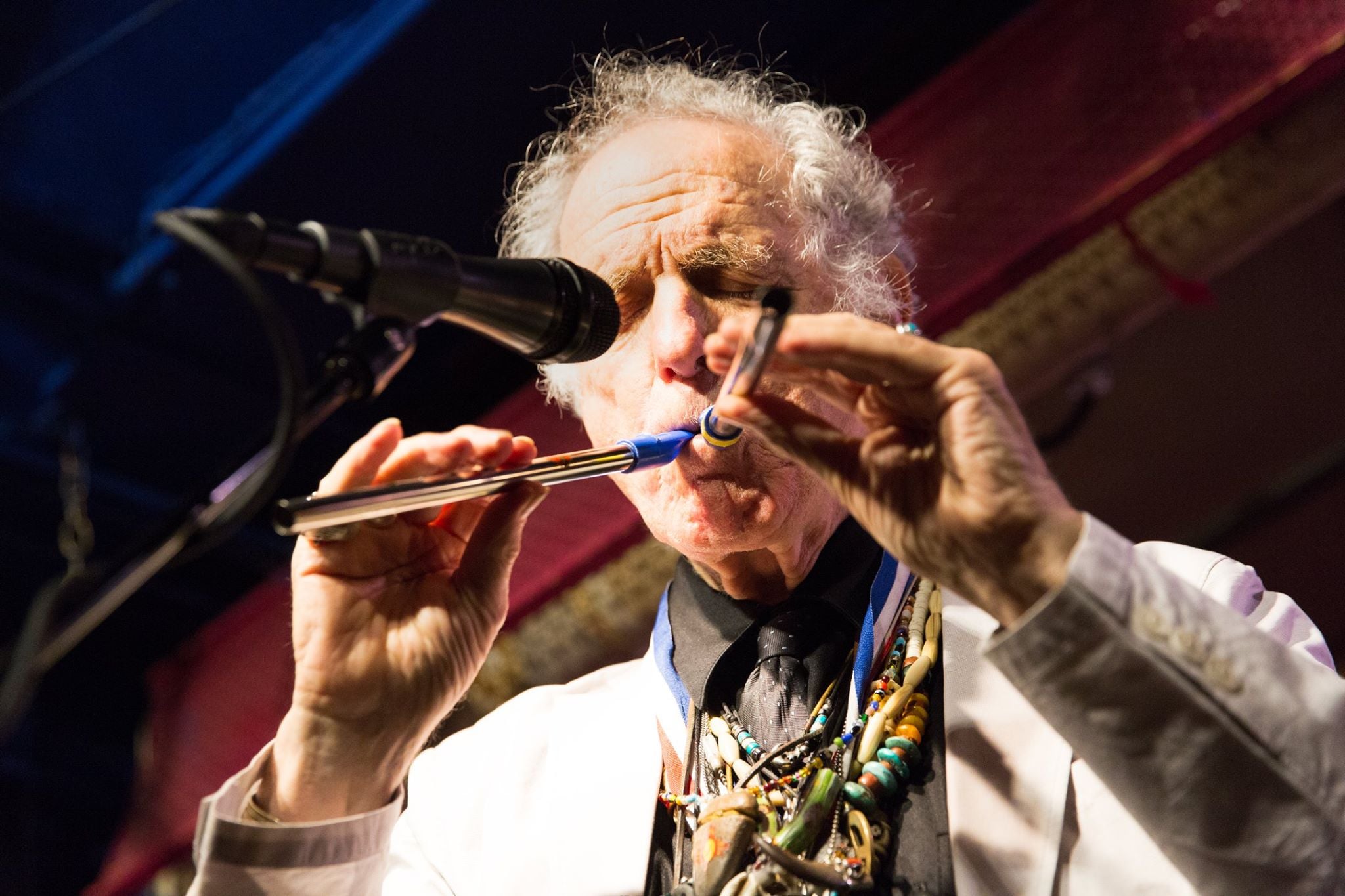
    Philadelphia’s musical polyglot is 91 today.

    David Amram, born in Philadelphia on this date in 1930, has always been equally at home in classical music, jazz, folk, and world music. The composer of over 100 orchestral and chamber works, music for Broadway and film (including the scores for “Splendor in the Grass” and “The Manchurian Candidate”), and two operas, he’s also the author of three books: “Vibrations: The Adventures and Musical Times of David Amram” (1968), “Offbeat: Collaborating with Kerouac” (2002), and “Upbeat: Nine Lives of a Musical Cat” (2007).

    Amram was raised on a farm in Bucks County. There, he was introduced to classical, jazz, and cantorial music by his father and uncle. He took piano lessons and experimented with instruments of the brass family, finally centering on the French horn. Following a year at Oberlin, he lit out for George Washington University, where he studied history. While there, he performed as a freelance hornist with the National Symphony. He also studied privately with two musicians in the orchestra.

    Amram became a pioneer of the “jazz French horn,” as well as the New York Philharmonic’s first composer-in-residence (designated such in 1966). He’s worked with artists ranging from Dizzy Gillespie to Bob Dylan to Leonard Bernstein, from Jack Kerouac to Arthur Miller, from Christopher Plummer to Johnny Depp. He’s a musician without borders, always open to new experiences.

    At 91, Amram is still cookin’. He’ll be performing tonight in Newport, RI, celebrating his birthday with a concert of his chamber music, jazz, and folk compositions. On Friday, he’ll be in Tarrytown, NY, with his jazz quartet. On December 3, he’ll be playing with pianist Dick Hyman in Sarasota, FL. And on December 5, he’ll be in Manhattan for his annual “Amram Jam” – a program of jazz and classical chamber music, the instrumentalists joined by vocalists, songwriters, actors, poets, and dancers that’s anticipated to stretch into the wee hours of the morning.

    For more information, check the Amram calendar at his website:

    https://davidamram.com/calendar.php

    If you can’t be at tonight’s concert, you might do as he suggested last year, during “stay at home,” and just take a moment to send him an ESP thought-o-gram. Happy birthday, David Amram!


    Trailer for “David Amram: The First 80 Years”:

    Amram Horn Concerto:

    Amram with Dizzy Gillespie:

    Amram’s music for “The Manchurian Candidate”
    https://www.youtube.com/watch?v=u4V0uQE-nRY

    Wonderful snapshot of the man and artist, who more and more seems a prophet of our age

    Amram jamming at the Philadelphia Folk Festival in 2011:

    “Pull My Daisy”

  • John Williams at 90 No Retirement Yet

    John Williams at 90 No Retirement Yet

    John Williams will be 90 in February. He hasn’t composed a new film score since “Star Wars: Episode IX: The Rise of Skywalker” in 2019. In fact, he kind of intimated at the time that he would be retiring, leaving the window open to future Spielberg projects, perhaps, and the odd opportunity that would be too good to refuse. Essentially, that’s the position he’s been in now for years anyway. When you’re John Williams, you can pretty much do what you want.

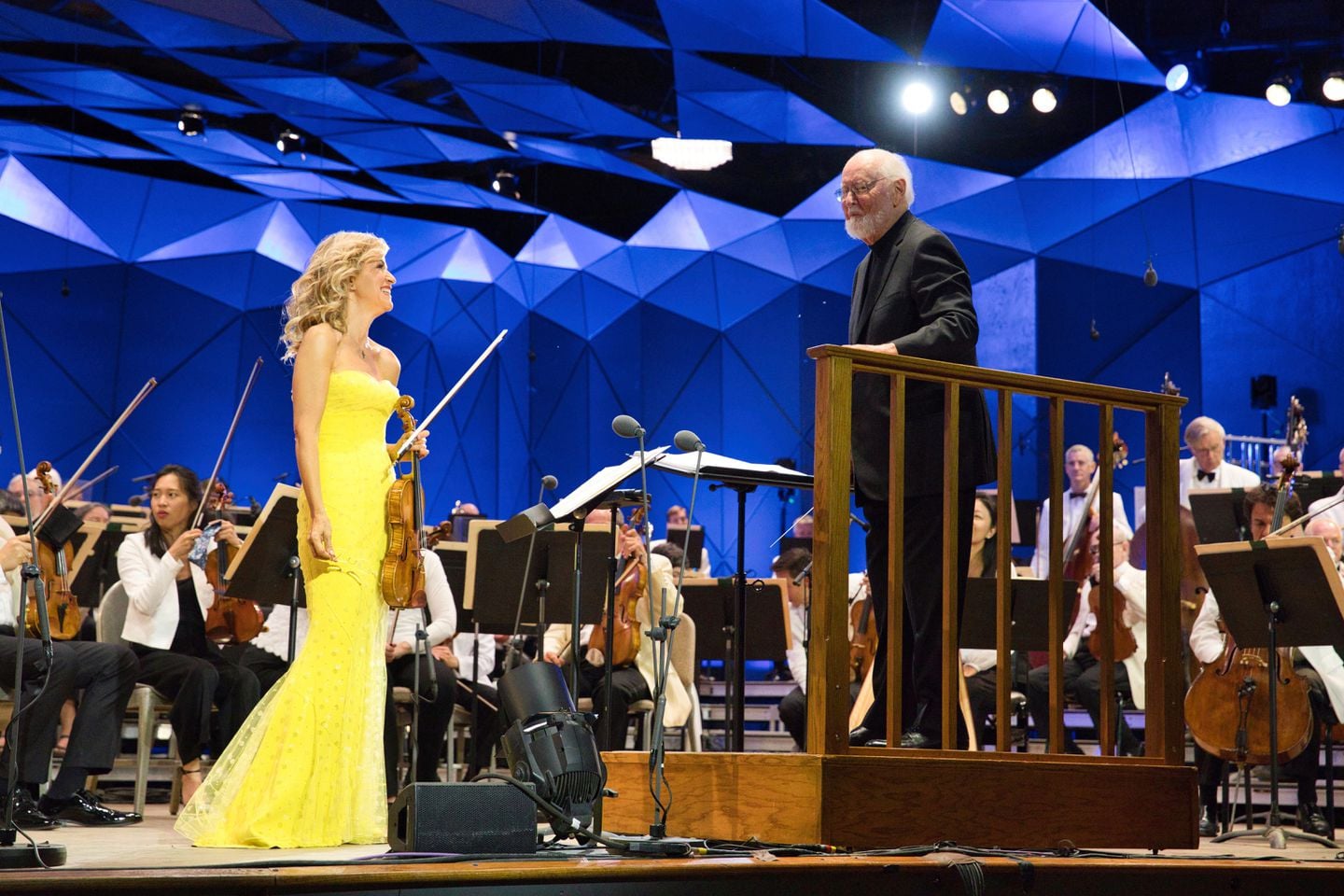
    The lack of film projects certainly doesn’t mean he hasn’t kept busy. In fact, Williams seems to be as active as ever, with a full schedule of conducting engagements and recordings. In particular, he’s being seen everywhere with Anne-Sophie Mutter, touring his new Violin Concerto (No. 2) and assorted film themes arranged for violin and orchestra. The audio for the concerto, in its Tanglewood debut (which took place on July 24), was available briefly on YouTube – long enough for me to share the link and listen to it a couple of times – but, alas, it has since been taken down. Thankfully, it’s been recorded for commercial release on compact disc, which still has not been the case for too many of Williams’ other concert works.

    If you’re interested and you haven’t heard it yet, PBS will be broadcasting the concert on “Great Performances” THIS FRIDAY EVENING AT 9:00 EST. Williams’ concerto will form the centerpiece of a program that will include Aaron Copland’s “Quiet City,” Igor Stravinsky’s “The Firebird Suite,” and Jesse Montgomery’s “Starburst,” with the Boston Symphony Orchestra conducted by Andris Nelsons. Williams will conduct the concerto with Mutter as soloist. Check your local listings. You’ll find an interview and promos here:

    Anne-Sophie Mutter Performs John Williams’ Violin Concerto

    In other recording news, Williams has been in the studio with Yo-Yo Ma and guitarist Pablo Sáinz Villegas (for whom he composed his concert piece “Rounds”). I’m hoping it will result in an album of more concert music. I know new arrangements of the film themes are popular, but I always find those types of records to be a little kitschy. (Sorry, Morricone.) Why do I need movie themes arranged for cello or violin, when I can already enjoy them as written? Regardless of my preferences, the orchestra on the new recording, whatever it contains, will be the New York Philharmonic.

    Williams was supposed to have begun scoring the latest Indiana Jones film – still being referred to simply as “Indy 5” – in the coming weeks, but now Disney has pushed the release date back a year, to 2023, to accommodate the crush of superhero movies that have been piling up, presumably, since the start of the pandemic. This means Williams may actually be scoring the film at the age of 90 or 91? Harrison Ford will be 81 at the time of the film’s new projected release date of June 30, 2023.

    On the bright side, that will take some of the pressure off Williams’ commitment to score Spielberg’s semi-autobiographical coming-of-age drama, “The Fabelmans,” which will be released next year.

    So, as he nears the end of his eighth decade, Williams is not just resting on his throne of gold, tabulating his mountains of royalties. It must be very rewarding indeed to be able to show up to packed houses all over the world and perform one’s own music to engaged listeners, paying top dollar to hear one conduct it. Well, he earned it. Have a great “retirement,” John Williams.

  • Malcolm Arnold Tormented Genius

    Malcolm Arnold Tormented Genius

    “…[T]hou was a skellum,/A blethering, blustering, drunken blellum;/That frae November till October,/Ae market-dae thou was na sober.”

    Rabbie Burns wrote those lines about Tam O’Shanter. But they just as well could have applied to Sir Malcolm Arnold. Both men were, more or less, fond of the bottle, and both were driven by demons.

    Arnold, born 100 years ago today, began his professional career as a trumpeter with the London Philharmonic Orchestra. He was appointed its principal in 1943.

    During World War II, he registered as a conscientious objector. However, following the death of his brother, a pilot in the RAF, he was moved to enlist. At least for a time. While he never saw actual combat, serving instead in a military band, he quite literally shot himself in the foot so that he could return to civilian life.

    In 1948, he retired from orchestral playing to devote himself exclusively to composition. He possessed a rare melodic gift, which served him well in his light music and film scores. He won an Academy Award in 1957 for his work on “The Bridge on the River Kwai.”

    However, Arnold also had his dark side, as can be detected in certain passages of his symphonies. He was frequently cantankerous, often inebriated, and also highly promiscuous. He attempted suicide at least twice. He was treated for depression and alcoholism, rising above both, but in the early 1980s was given only a year to live. He actually lasted another 22, during which he completed his Symphony No. 9, among other works.

    Arnold died in 2006, one month shy of his 85th birthday. He was a brilliant composer, of great facility. When Malcolm Williamson was named Master of the Queen’s Music in 1975, Sir William Walton quipped that they had given the job to the wrong Malcolm. For a man with so many personal demons, Arnold wrote reams of perfectly delightful music.

    A good example, and one of my favorite Halloween pieces, is the programmatic overture “Tam O’Shanter” (1955). On market day, Burns’ antihero tarries at a pub, in defiance of his wife, then staggers out into the night. Under ominous skies, he detects the sound of bagpipes emanating from the ruins of an old church. Pressing his face to a chink in the mortar he espies “Auld Nick,” the Devil himself, “in shape o’ beast,” presiding over a coven of high-stepping witches and warlocks. When a particularly comely witch catches Tam’s eye, in his drunkenness, he roars, “Weel done, Cutty-sark!” (a reference to her short skirt). This brings the forces of darkness down up him, and there is a hell-for-leather sprint by horseback for a nearby river, since spirits are said not be able to cross running water.

    If you’re interested in the rest, you can read it for yourself here:

    http://loki.stockton.edu/~kinsellt/litresources/ayr/tam.html

    Then listen to Arnold’s musical response:

    Also, “Four Scottish Dances” (1957):

    From the film “The Belles of St. Trinian’s” (1954), in concert:

    On a more serious note, the Symphony No. 4 (1960), a plea for tolerance following the Notting Hill race riots of 1958:

    The Guitar Concerto (1959), played by Julian Bream:

    “Three Sea Shanties” (1943) for wind quintet:

    An interview by Bruce Duffie:

    http://www.bruceduffie.com/arnold2.html

    Happy centenary, Sir Malcolm Arnold, you tormented genius!


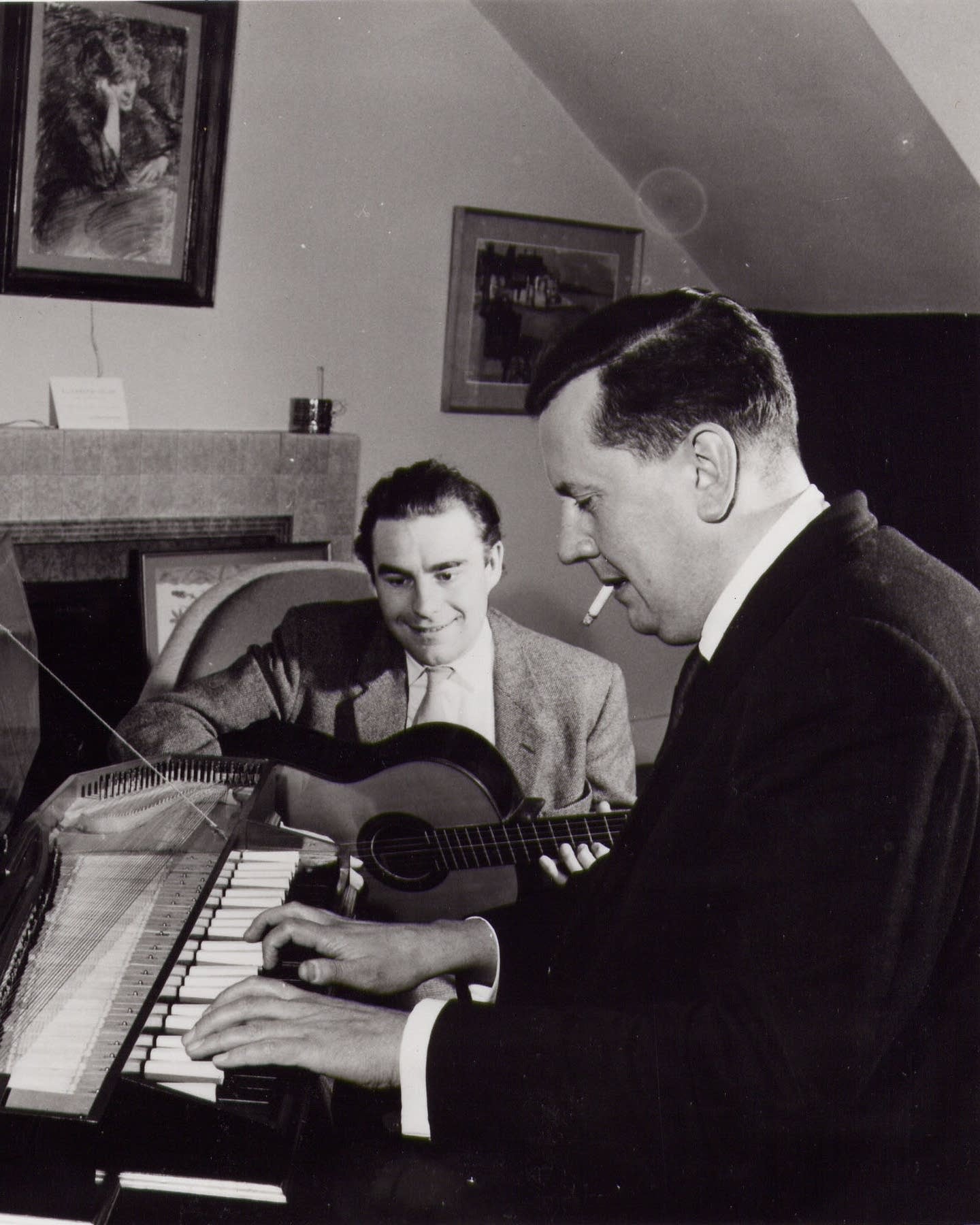
    PHOTO: Malcolm Arnold and Julian Bream

  • Paddy Moloney of The Chieftains Dies at 83

    Paddy Moloney of The Chieftains Dies at 83

    The Chieftains’ Paddy Moloney has died.

    With Sean Potts and Michael Tubridy, Moloney cofounded The Chieftains in Dublin in November 1962. He was the primary composer and arranger of much of the groups’ music, including that for the films “The Grey Fox,” “Treasure Island” (1990), “Rob Roy,” “Gangs of New York,” and Stanley Kubrick’s “Barry Lyndon.” The group also performed on the soundtracks for Michael Kamen’s “Circle of Friends” and John Williams’ “Far and Away.”

    In addition, Moloney did session work with Don Henley, Paul McCartney, Mick Jagger, Mike Oldfield, Sting, Stevie Wonder, and The Muppets.

    He was 83 years-old.


    Love Theme from “Barry Lyndon”

    “O’Sullivan’s March”

Tag Cloud

Aaron Copland (92) Beethoven (95) Composer (114) Film Music (123) Film Score (143) Film Scores (255) Halloween (94) John Williams (187) KWAX (229) Leonard Bernstein (101) Marlboro Music Festival (125) Movie Music (138) Opera (202) Philadelphia Orchestra (89) Picture Perfect (174) Princeton Symphony Orchestra (106) Radio (87) Ralph Vaughan Williams (85) Ross Amico (244) Roy's Tie-Dye Sci-Fi Corner (290) The Classical Network (101) The Lost Chord (268) Vaughan Williams (103) WPRB (396) WWFM (881)

DON’T MISS A BEAT

Receive a weekly digest every Sunday at noon by signing up here


RECENT POSTS