Tag: Film Scores

  • Friendly Alien Film Scores E.T. & Beyond

    Friendly Alien Film Scores E.T. & Beyond

    People of Earth! We come in peace!

    This week on “Picture Perfect,” we listen to scores from films about benevolent extra-terrestrials. Friendly E.T.’s have been out of fashion now for quite some time. We seem to be mired in some neo-‘50s zeitgeist, as far as paranoia and invaders are concerned. But that certainly wasn’t the case back in 1982, when Steven Spielberg’s “E.T. The Extra-Terrestrial” almost singlehandedly turned everything on its head.

    No more invaders from Mars. Spielberg would get to that a couple of decades later, when he remade H.G. Wells’ “The War of the Worlds.” No, during the Reagan Era, with the Cold War winding down and terrorism not yet so much in the news, cinematic E.T.’s were benevolent at best, or at worst, just trying to do their thing. They were there to be misunderstood and even imperiled by man until the warm, fuzzy, often poignant finale.

    Spielberg had already explored the concept of the benevolent visitor from space, of course, with 1977’s “Close Encounters of the Third Kind.” But there was an ambiguity for much of the film as to what exactly the aliens’ intentions were. In fact, there is at least one sequence that would give a child nightmares (at least by 1977 standards). Whatever tension is generated dissolves in a euphoric finale, centered around the communicative power of music. Like so many films back then and so few now, “Close Encounters” doesn’t so much exhaust the viewer as leave him or her with a feeling of hope.

    John Williams wrote the music for both “Close Encounters” and “E.T.” (winning his fourth Academy Award for the latter), and the two scores couldn’t be more different. In particular, he absorbs the avant garde syntax of composers like Gyorgy Ligeti and Krzysztof Penderecki for the eerier sequences of “CE3K” before reverting to unabashed lyricism for the transcendent finale. For “E.T.,” he takes a much more intimate approach for a moving story of friendship between a boy and a stranded space botanist. I admit to feeling mild dread when first seeing the trailer for “E.T.,” already thinking Spielberg had traveled this route before. Little did I realize that within a few weeks I would assess it as his masterpiece (John Williams’, too), as I still do today.

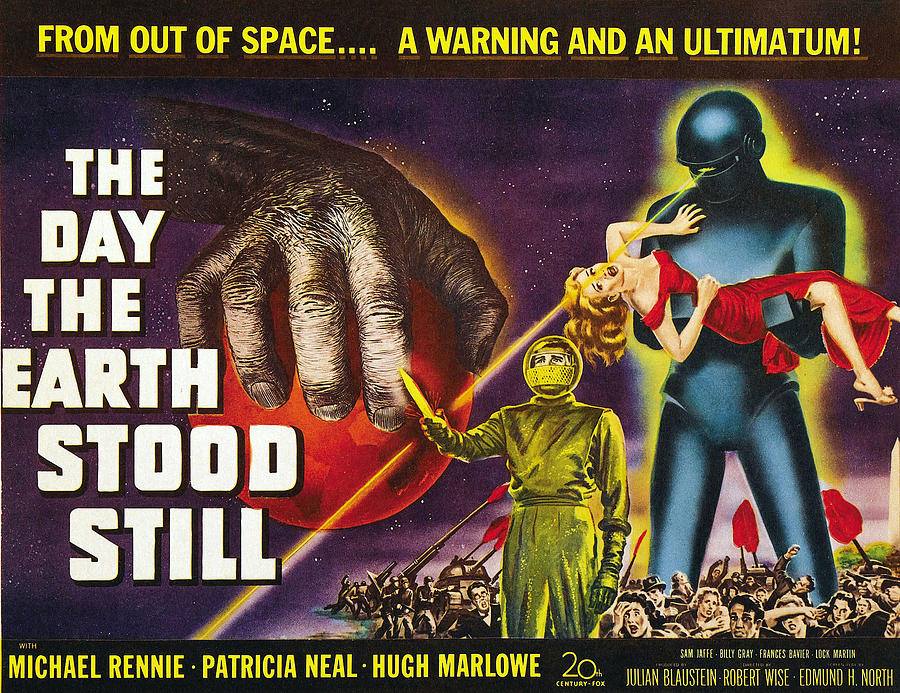
    The “friendly” alien of “The Day the Earth Stood Still,” Klaatu, may come in peace, but it is a message delivered with tough love. If mankind refuses to abide, his robot Gort will destroy the planet. At a time when Martians invariably meant trouble (1951), this was actually progressive. Bernard Herrmann’s score is one of his best, and certainly one of his most interesting. Always an eccentric orchestrator, Herrmann’s concept of extra-terrestrial music incorporates violin, cello, electric bass, two theremins, two Hammond organs, a large studio electric organ, three vibraphones, two glockenspiels, two pianos, two harps, three trumpets, three trombones and four tubas. Overdubbing and tape-reversal techniques were also employed. Now this guy was a composer!

    Finally, Ron Howard’s “Cocoon” is one of the more worthwhile of the seemingly endless procession of extra-terrestrial films to be released in the wake of “E.T.” At least this one took a different approach by bringing alien forces into contact with a Florida retirement community with the unexpected result of rejuvenating its inhabitants. A modern take on the fabled Fountain of Youth, the film is a showcase for veteran actors Hume Cronyn, Jessica Tandy, Jack Gilford and Don Ameche (who won an Academy Award). James Horner’s score is much sought after by collectors.

    People of Earth! Be there for the touchdown of friendly alien films, on “Picture Perfect” – music for the movies – this Friday evening at 6 ET. Or listen to it later as a webcast at http://www.wwfm.org.

    Klaatu barada nikto!

  • Film Scores Why Aren’t They Great Anymore

    Film Scores Why Aren’t They Great Anymore

    The Orquestra Sinfônica Brasileira strikes back with music of John Williams:

    http://www.classicfm.com/music-news/latest-news/john-williams-youtube-save-brazilian-symphony/

    Granted, the story is a year old, but clearly people still respond to this music. So why are most film scores today so anonymous, slipshod or just plain lacking in craftsmanship? I understand that a tight post-production schedule can leave little time for the film composer to do his job, but surely there must be someone of a caliber of a Jerry Goldsmith out there, who could churn out a decent score before breakfast.

    There are probably still a lot of people who don’t actively think about the fact that the music they hear in the movies is being played by very talented orchestral musicians. (That is, when it isn’t being sampled on a keyboard.) For them, perhaps, it’s just something that emanates from the screen. Exposure is key. Ironically, in an age when everything is a keystroke away, there seems to be less of that than ever before. It’s a useful endeavor to bring this music to the public and to play it with passion and commitment.

    I wonder if the day will ever come when the very best music written for film will be held on a level with incidental music written for plays by earlier masters? It would be nice to hear something more than snappy main title music dished up on pops concerts or, what seems to be the latest trend, music performed live with the actual movies. These practices have their place, but why not program a suite from “E.T.” or “Ben-Hur” or “The Bride of Frankenstein” or “The Adventures of Robin Hood” once in a while? Let the music speak for itself.

    And spare me the condescending program notes. Other folks besides Prokofiev and Walton have written great music for the screen.

    The Philadelphia Orchestra will be performing musical selections from Pixar films at The Kimmel Center for the Performing Arts this Friday at 7 p.m. and Saturday at 2 p.m. The press release promises selections from 14 films, so expect a lot of short pieces, with film clips. Still, with music by Michael Giacchino, Thomas and Randy Newman, and Patrick Doyle, why complain? They’re some of the best film composers working today, and Pixar makes some of the best movies. It seems like an ideal intro for the kids.

    http://www.philorch.org/concert/philadelphia-orchestra-pixar-concert

  • Australian Outback Film Scores Picture Perfect

    Australian Outback Film Scores Picture Perfect

    G’day! This week on “Picture Perfect,” we’re off to the antipodes for an hour of music from films set in the Australian bush.

    Ealing Studios shot several movies there – three independently, and then two in collaboration with MGM. The first was “The Overlanders” (1946), told in semi-documentary style, about a wartime push to evacuate Australia’s Northern Territory, with its 5000 settlers and a million head of cattle, before an anticipated Japanese invasion. The music was by John Ireland. Despite its excellence, it would prove to be his only film score.

    Ealing’s final independent Australian venture was “Bitter Springs” (1950). The film tells the tale of an Australian pioneer family, which encounters problems with the local Aboriginal people when its headstrong patriarch denies access to a watering hole.

    The thematic material was by Ralph Vaughan Williams, who left it to composer and conductor Ernest Irving to arrange and orchestrate what he felt needed for the various cues. Vaughan Williams wrote his friend and colleague to express his pleasure with the finished product. Irving would soon receive the dedication of Vaughan Williams’ Symphony No. 7, the “Sinfonia Antarctica” (itself derived from RVW’s film score to Ealing’s “Scott of the Antarctic”).

    Both of these films, “The Overlanders” and “Bitter Springs,” are essentially westerns set in the Australian outback. From a little closer to our own time, we’ll hear music from another film which was unapologetic in its use of American western motifs, “Quigley Down Under” (1990).

    The film starred Tom Selleck as an American cowboy, hired by an Australian rancher, played by Alan Rickman, allegedly to shoot dingoes; however, he soon finds that the rancher’s real purpose is to rid the land of Aborigines – a proposition Quigley naturally rejects, setting up the film’s conflict.

    The score is by Basil Poledouris, a composer who has achieved cult status for his work on films like “Robocop” and especially “Conan the Barbarian,” though he never really seemed to receive the recognition the deserved. He did, however, win an Emmy for his score to “Lonesome Dove.”

    (HOT TIP: We’ll be listening to Poledouris’ “Conan” scores next week!)

    Finally, we’ll have just a bit from John Barry’s haunting score to Nicholas Roeg’s “Walkabout” (1971), in which two British children find themselves stranded in the bush and survive only through the aid of a young Aborigine.

    We’re heading down under and out back this week, for “Picture Perfect” – music for the movies – this Friday evening at 6 ET. Listen to it then, or catch it later as a webcast at http://www.wwfm.org.

  • Classical Music Radio Support Elmer Bernstein Special

    Classical Music Radio Support Elmer Bernstein Special

    Thank you all for your financial and moral support yesterday. While I doubt it will do much for me in terms of ensuring regular live air shifts, it was heartening to see so many familiar names. At the very least, your contributions help maintain a classical music presence on the radio, including specialty shows like “Picture Perfect” and “The Lost Chord.”

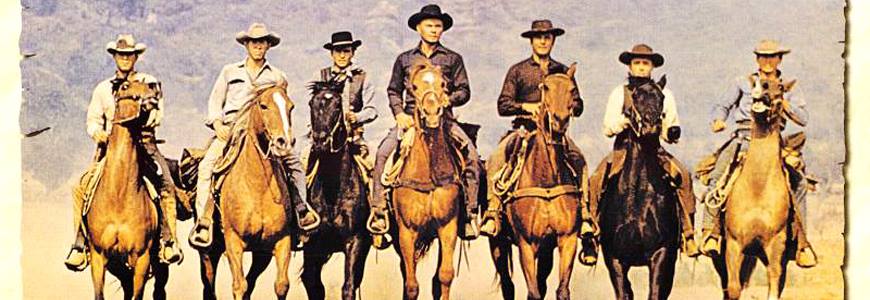
    Speaking of “Picture Perfect,” the show will air at a special time this week, on account of the pledge drive. I hope you’ll join me this afternoon at 4 ET for a selection of film scores by Elmer Bernstein, including “The Magnificent Seven,” “The Age of Innocence,” “Stripes” and “To Kill a Mockingbird.”

    Next week, “Picture Perfect” will return to its regular time, Friday evening at 6. You can always enjoy it at http://www.wwfm.org. Shows are archived as webcasts for approximately three months following broadcast.

  • CGI vs Animation A Soundtrack Showdown

    CGI vs Animation A Soundtrack Showdown

    I have been completely fed up with computer-generated imagery in alleged “live action” movies for years now. Give me a miniature in a water tank or a matte painting any day.

    However, I have to concede, when shelling out the clams for a big-budget movie, one stands a better chance these days of getting a quality ride if one banks on the solely computer-animated feature. Put an action hero in a computer-animated landscape, and everything looks incredibly fake. But integrate the characters by creating them in the computer as well, and the result is often much more absorbing, imaginative and even wittier than your run-of-the-mill blockbuster.

    Furthermore, in a day when so many films sport scores made up of droning electronics punctuated by colorless action cues, the computer-generated feature seems to attract composers who still understand how to write music.

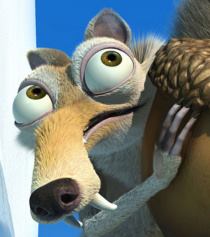
    This week on “Picture Perfect,” we’ll sample music from four computer-generated features. We’ll hear selections from the first film in the “Ice Age” franchise, by David Newman (son of Golden Age heavy-hitter Alfred Newman, brother of Thomas Newman and cousin of Randy Newman).

    We’ll also have some of John Williams’ music from “The Adventures of Tintin,” after the comic book adventurer created by artist and writer Hergé. Tintin’s popularity in Europe failed to translate into big domestic box office, comparatively speaking, but the score is Williams’ best of its kind (an exciting adventure piece full of leitmotifs and great action cues) since the first Harry Potter film.

    We’ll round out the hour with two projects scored by Michael Giacchino for Pixar Animation Studios. Giacchino’s break-out success was the sly superhero satire, “The Incredibles,” for which he composed in the swinging ‘60s espionage style popularized by John Barry when writing for the Bond films.

    We’ll also hear selections from Giacchino’s Academy Award-winning score to “Up.” “Up” was nominated for Best Picture at the 82nd Academy Awards, only the second animated feature ever to be included in the category.

    Join me for an hour of music from computer-animated features this week, on “Picture Perfect: Music for the Movies.” You can listen to it this Friday evening at 6 ET, or later as a webcast, at http://www.wwfm.org.

Tag Cloud

Aaron Copland (92) Beethoven (95) Composer (114) Film Music (123) Film Score (143) Film Scores (255) Halloween (94) John Williams (187) KWAX (229) Leonard Bernstein (101) Marlboro Music Festival (125) Movie Music (138) Opera (202) Philadelphia Orchestra (89) Picture Perfect (174) Princeton Symphony Orchestra (106) Radio (87) Ralph Vaughan Williams (85) Ross Amico (244) Roy's Tie-Dye Sci-Fi Corner (290) The Classical Network (101) The Lost Chord (268) Vaughan Williams (103) WPRB (396) WWFM (881)

DON’T MISS A BEAT

Receive a weekly digest every Sunday at noon by signing up here


RECENT POSTS