This guy had the calling, and he did something about it, building @[100063470656864:2048:Intrada] into one of the finest independent record labels devoted to film music. Intrada always puts out a first-rate product. Their restorations, reissues, and re-recordings form a colonnade in the pantheon of my collection. Thank you, Douglass Fake, for harnessing your passion and sharing your enthusiasm with so many others. Rest in peace.
If you’re reading this, you might also be interested to know that there is an Intrada Kickstarter campaign in effect through tomorrow to raise funds for a new recording of Frank Skinner’s score for “Abbott and Costello Meet Frankenstein.” A double sawbuck will guarantee a copy of the CD with free shipping! You can learn more about it here:
This week on “Picture Perfect,” we’ve got the need for speed!
With yet another Mad Max movie in theaters, we’ll revisit music from the second installment in the series, “The Road Warrior” (1981). Australian composer Brian May (no relation to the Queen guitarist) wrote the music for the first two films. The director, George Miller, specified that he was looking for a gothic, Bernard Herrmann-type mood to underscore his dystopian vision of a post-apocalyptic Australian Outback.
Maurice Jarre took over to write the music for the third installment, “Mad Max Beyond Thunderdome,” but it’s purely by coincidence that we’ll hear selections from another Jarre score built for speed, “Grand Prix” (1966). The film’s international cast includes James Garner, Eva Marie Saint, Yves Montand, and Toshiro Mifune, but the plot’s assorted relationship and business conflicts take a back seat to driver’s-eye views of lapping the track.
When we remember Steve McQueen, chances are one of the first images that springs to mind is that of McQueen behind the wheel of his Ford Mustang GT 390 Fastback, tearing up and down the streets of San Francisco in “Bullitt” (1968). The high-octane action sequence became the yardstick against which all big screen car chases were measured (at least until “The French Connection”). Lalo Schifrin provided the jazzy score.
Finally, Marty McFly and Doc Brown’s time-travelling DeLoreon needs to hit 88 miles per hour in order to get “Back to the Future” (1985). Director Bob Zemeckis had already worked with composer Alan Silvestri on “Romancing the Stone,” but the producer of “Back to the Future,” Steven Spielberg, didn’t care for the music in that film. Zemeckis’ advice to his colleague: go grand and epic, since Spielberg had a marked preference for the music of John Williams. It was a very good choice.
I hope you’ll join me for an hour of chases and races, on “Picture Perfect,” music for the movies, now in syndication on KWAX, the radio station of the University of Oregon.
Just be sure you’re not driving when you do!
Clip and save the start times for all three of my recorded shows:
PICTURE PERFECT, the movie music show – Friday at 8:00 PM EDT/5:00 PM PDT
SWEETNESS AND LIGHT, the light music program – ALL NEW! – Saturday at 11:00 AM EDT/8:00 AM PDT
THE LOST CHORD, unusual and neglected rep – Saturday at 7:00 PM EDT/4:00 PM PDT
Before John Williams, there was Erich Wolfgang Korngold.
Korngold’s music for “The Adventures of Robin Hood” (1938) was every bit as influential to me, in terms of introducing me to the wonders of orchestral music, as the score to “Star Wars.” Clearly, it also impacted John Williams, as the music for his biggest blockbusters adheres to the Korngold template of leitmotifs, lush orchestration, and swashbuckling action cues.
Williams has cited Korngold’s main title music for “Kings Row,” in particular, as one of his inspirations for “Star Wars.” The bold, opulent, classic Hollywood imprint is obvious. Listeners coming cold to “Kings Row” detect the influence immediately. Which is interesting. It’s there in the orchestration, of course, and in the bold fanfares, but it isn’t so blatant as some of the other, more brazen allusions that occur throughout Williams’ score, which I’m sure I’m not alone in contending is a post-modern masterpiece. It’s only little minds that scream theft. Good artists copy; great artists steal! (I believe Stravinsky stole that from Picasso.)
In case you are unfamiliar with his backstory, years before he came to Hollywood, Korngold was a child prodigy, the toast of Vienna. Gustav Mahler declared him a genius, and Richard Strauss claimed he was terrified by the amount of talent exhibited by one so young. His works were championed by the most esteemed musicians of the day. He was especially highly-regarded for his operas, with “Die tote Stadt” (“The Dead City”), given a double premiere in Hamburg and Cologne, the high-water mark of his success.
Korngold first came to Hollywood to assist Viennese theatrical impresario Max Reinhardt in bringing “A Midsummer Night’s Dream” to the big screen for Warner Bros. This is the version with James Cagney, Olivia de Havilland, and Mickey Rooney (as Puck). So impressed was Warner with the score, freely adapted from the music of Mendelssohn, that they didn’t want to let this world-class composer go. He was a particularly nice fit for the pageantry and swagger of the Errol Flynn classics.
Fortunately, Korngold was at work on “Robin Hood” when the Nazis marched into Austria. He and his family found refuge in the company of many other notable European exiles on the paradisal West Coast of the United States. But the luster soon dulled. Korngold vowed to compose no concert music while Hitler remained in power. After the war, he produced a Violin Concerto, which was savaged by one critic as “more corn than gold,” and a heart-breaking Symphony in F-sharp, which exudes longing for a lost world. Both assimilated themes from his film scores.
He never lived to see his reputation rebound. However, since the 1970s, the popularity of his film music and critical esteem for his concert music have been on an upward trajectory.
I’ve always loved “Kings Row,” even though the film is something of a curate’s egg. It’s actually a very grim story, anticipating the work of David Lynch, in some respects, as it gradually reveals the dark underbelly of small-town life in the Midwest. But it’s nowhere near as dark as the source material, a bleak-as-hell novel by Henry Bellamann.
“Kings Row,” the book, is a massive downer. Somehow, it also became a runaway bestseller.
Interestingly, Bellamann also had a musical background. Following his graduation from Westminster College (unrelated to the Princeton institution) in his hometown of Fulton, Missouri, he studied piano at the University of Denver. He went on to teach music at several girls’ schools in the South, while in the summers, he continued his studies in Europe with Charles-Marie Widor and Isador Philipp. Bellamann would hold several prominent administrative and teaching positions in the U.S., including director of the Juilliard Musical Foundation, dean of the Curtis Institute of Music, and professor of music at Vassar College.
As you can imagine, the book caused quite a stir in Fulton, but not because of its success. Rather, a few too many people and institutions recognized themselves in the extremely unflattering narrative! Allegedly the book was banned from the town library, and Bellamann was the target of at least one indignant editorial in the local newspaper.
“Kings Row” is one of the most subversive films of Hollywood’s golden age. How it managed to get around the Hays Code is anybody’s guess, but I’m putting my money on Korngold’s score, which breathes uplift and hope into what could have been an unrelentingly bleak story (as it is in the novel). Also, the ending was changed, such an obvious overcompensation, with the climax an almost ludicrous eruption of joy. It’s a neat trick, as somehow, in the film, not only is the wicked in human nature balanced by the good, but the whole is infused with an undercurrent of nostalgia for a passing world. It’s kind of like how people choose to remember “It’s a Wonderful Life,” even though you have to go through hell before you get to heaven.
Amusingly, from the title, Korngold thought he was being assigned yet another historical adventure, which is why the theme is so wildly over the top. By 1942, Korngold could do pomp and braggadocio in his sleep. When he learned of his mistake, he just kept it. And what a happy accident! The film is so much better – and so much more bearable – than it would have been without it. After all, how much madness, suicide, amputation, and incest can one take, especially in the 1940s? It really is quite the sleight of hand. Now I want to watch it again!
To this day, I waver as to whether Korngold or Williams is my favorite film composer. There are others I may revere more than either of them, but these two give me the most pleasure.
May I obey all your commands with equal pleasure, Sire! Happy birthday, Erich Wolfgang Korngold!
“Kings Row”
John Williams talks Korngold with Leonard Slatkin
Good nine-minute primer on E.W.K.
Violin Concerto
Music as good as spring itself: the Sinfonietta, composed at 15
Before American composers like Jerome Moross and Elmer Bernstein made the western distinctly their own, the task of scoring the genre fell largely to European émigrés. This week on “Picture Perfect,” we’ll take a look at some outside perspectives on how the West was won.
Literally the godson of Richard Strauss, Max Steiner (born on this date in 1888) came from Vienna, where he studied with Johannes Brahms and Robert Fuchs. In Hollywood, he wound up scoring such classics as “King Kong,” “Gone with the Wind” and “Casablanca.”
Among his over 300 film projects were a number of westerns. One of these was “They Died with Their Boots On” (1941), which starred Errol Flynn as George Armstrong Custer and Olivia de Havilland as Libby, the woman who becomes his wife. Steiner’s score features familiar folk material, some old-fashioned faux “Indian” music, and one of his characteristically lush love themes.
Dimitri Tiomkin (born in Ukraine on this date in 1894) was a pupil of Alexander Glazunov. He came to revolutionize the sound of the American West, when he wrote the music for “High Noon,” the first of his “ballad” scores. Advance word, based on an early screening for the press, was that the picture would be a failure. However, Tiomkin had such faith in the theme song, sung in the film by Tex Ritter, that he hired Frankie Laine to record it, and the record became a world-wide hit. In fact, his score is largely credited with having saved the film.
Tiomkin was recognized with two Academy Awards: one for Best Original Song, and one for the score itself. It was the first time a composer won two Oscars for his work on the same movie. It also changed the way western scores were done. In the 1950s, Tiomkin became THE western composer of choice. He produced a number of subsequent ballad scores, including that for “Gunfight at the O.K. Corral” (1957). Asked how it was that a composer from Ukraine could write so convincingly for the American West, Tiomkin quipped, “A steppe is a steppe is a steppe.”
Another unexpected source of classic western music, Franz Waxman was born in Upper Silesia. He arrived in the U.S. by way of Germany. Nonetheless, as part of the composer’s varied and prolific output, he did indeed score a number of films in the genre, including “The Furies” (1950), a peculiar noir-western hybrid. Walter Huston, in his final film, plays a cattle baron who remarries and throws his empire into jeopardy. Barbara Stanwyck is his strong-willed daughter.
Hungarian-born composer Miklós Rózsa scored many films with historical settings – “Quo Vadis,” “Ben-Hur,” and “King of Kings,” among them. However, to my knowledge, his only western was “Tribute to a Bad Man” (1956). James Cagney stars as a rancher who doles out some frontier justice.
Finally, we’ll hear music by Ennio Morricone, from arguably the most operatic of all spaghetti westerns, “Once Upon a Time in the West” (1968). As a reaction to Tiomkin’s ballad scores and the neo-Coplandisms of Elmer Bernstein and the rest, Morricone brings his own quirky sensibility to bear on the classic western iconography. Get ready for indelible motifs for harmonica and banjo, but also an unexpectedly moving elegiac arioso, underscoring the close of the American West with the arrival of the railroad.
Doublecheck your train tables and wind your pocket watches. Old World composers go west this week on “Picture Perfect,” music for the movies, now in syndication on KWAX, the radio station of the University of Oregon!
Remember, KWAX is on the West Coast, so there’s a three-hour difference for those of you listening in the East. Here are the respective air-times for all three of my recorded shows (with East Coast conversions in parentheses):
PICTURE PERFECT, the movie music show – Friday on KWAX at 5:00 PM PACIFIC TIME (8:00 PM EASTERN)
SWEETNESS AND LIGHT, the light music program – ALL NEW! – Saturday on KWAX at 8:00 AM PACIFIC TIME (11:00 AM EASTERN)
THE LOST CHORD, unusual and neglected rep – Saturday on KWAX at 4:00 PM PACIFIC TIME (7:00 PM EASTERN)
Stream all three, at the times indicated, by following the link!
Rejection! Any film composer of reasonable experience has, at one time or another, had his or her music replaced. It’s an occupational hazard. Poor test screenings, creative differences, interpersonal difficulties, and producer panic have all contributed to the rejection of original film scores. Since music is usually the last ingredient in the creation of a film, it is also the most vulnerable to change. This week on “Picture Perfect,” we’ll work through the pain to lavish some belated respect on the efforts of four eminently- (perhaps over-) qualified composers.
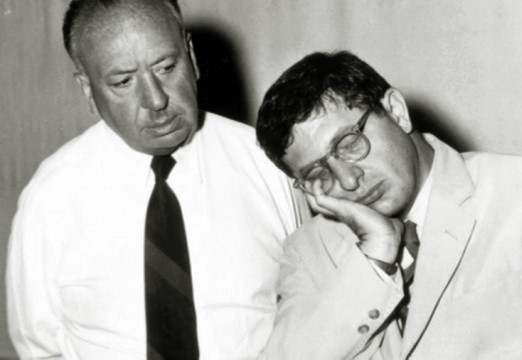
A strong argument could be made that there was no greater film composer than Bernard Herrmann. Of the eight films he worked on with Alfred Hitchcock, three are indisputable masterpieces: “Vertigo,” “North by Northwest,” and “Psycho” (Hitch’s biggest box office success).
However, things began to change within the studio system, and Hitchcock became increasingly insecure. The emphasis shifted more and more to the bottom line, and the mounting pressure extended to every aspect of his subsequent films.
After “Marnie,” only a moderate success with audiences, Hitchcock became desperate for another hit. It was the studio’s thinking that its music scores should forthwith be attuned to a younger sensibility. In particular, the suits were interested in a hit single that they could use to help promote the film. All of a sudden, Herrmann’s reliance on a symphony orchestra was perceived as terribly old fashioned.
By the time Hitchcock and Herrmann began work on “Torn Curtain,” in 1966, the tension between director and composer neared the breaking point. When Hitch learned Herrmann hadn’t produce what he had requested, the composer was fired halfway through the first day’s recording sessions. Of course, Herrmann had defied Hitch before – when the director instructed him that the shower scene in “Psycho” should play without music!
Herrmann’s replacement was John Addison, who was a hot commodity at the time, having won the Academy Award in 1963 for his music for Tony Richardson’s freewheeling adaptation of “Tom Jones.” Ironically, instead of going “popular,” as the studio wanted, save for one incongruous, Mancini-esque song at the end, Addison did what all of Hitch’s subsequent composers did – he emulated Herrmann. “Torn Curtain” failed to gain traction with younger audiences, and the film was not a success.
Herrmann and Hitchcock would never work together again. The “Torn Curtain” debacle spelled the end of one of the greatest artistic partnerships in all of cinema. Chalk it up to another boneheaded decision by management.
I hope you’ll join me for selections from Herrmann’s original, rejected score, alongside jettisoned music for “2001: A Space Odyssey” (by Alex North), “Edge of Darkness” (John Corigliano), and “The Battle of Britain” (Sir William Walton).
Take it from a guy who knows a thing or two about rejection. We’ll show some belated appreciation for these talented, seasoned professionals who got the shaft, when we savor an hour of their rejected scores, on “Picture Perfect,” music for the movies, now in syndication on KWAX, the radio station of the University of Oregon!
Remember, KWAX is on the West Coast, so there’s a three-hour difference for those of you listening in the East. Here are the respective air-times for all three of my recorded shows (with East Coast conversions in parentheses):
PICTURE PERFECT, the movie music show – Friday on KWAX at 5:00 PM PACIFIC TIME (8:00 PM EASTERN)
SWEETNESS AND LIGHT, the light music program – ALL NEW! – Saturday on KWAX at 8:00 AM PACIFIC TIME (11:00 AM EASTERN)
THE LOST CHORD, unusual and neglected rep – Saturday on KWAX at 4:00 PM PACIFIC TIME (7:00 PM EASTERN)
Stream all three, at the times indicated, by following the link!