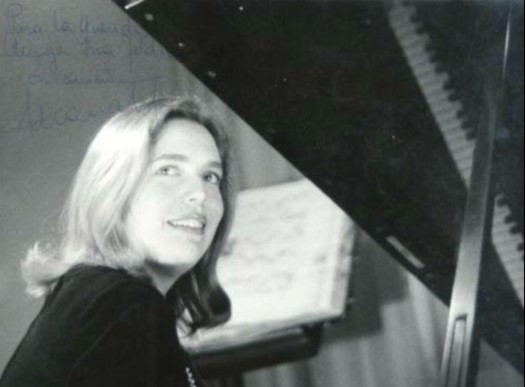
The Italian pianist Maria Tipo died yesterday at the venerable age of 93.
Her first teacher was her mother, who was a pupil of Ferruccio Busoni. Tipo also studied with Alfredo Casella and Guido Agosti.
When she first toured the United States in the 1950s, she was hailed as “the Neapolitan Horowitz.” Her classic 1955 Vox LP of Scarlatti sonatas (later reissued on CD, with two Mozart piano concertos) was declared by Newsweek “the most spectacular record of the year.” (Newsweek should go back to reviewing classical records.) Her recording of Bach’s “Goldberg Variations” is also highly-prized.
Tipo was a pianist’s pianist, admired by Martha Argerich among others, who attained her fame at a time when being a piano virtuoso was largely a man’s game. She herself was also a dedicated teacher. But all you really know is right there on the recordings. R.I.P.
Scarlatti in 1955
34 years later, playing Mozart’s Piano Concerto No. 21
For some reason, everyone seems to think August is a great time to get married. So, alas and alack, it is with much disappointment that I am unable to attend the second weekend of the Bard Music Festival, devoted to “Berlioz and His World.” However, I still have some memories and assessments to share from last weekend. Tomorrow I hope to write-up my impressions of last Sunday’s performance of Pauline Viardot’s fairy tale opera “Le dernier sorcier” (“The Last Sorcerer”).
In the meantime, here’s a follow-up to my post about Bill Osborne. Bill, you’ll recall, is my most recent Bard acquaintance, a retired organist who studied at Fontainebleau with the venerable pedagogue Nadia Boulanger. For over 40 years, he served as Distinguished Professor of Fine Arts at Denison University. Do yourself a service, if you haven’t read it, and check out my previous post about him, which is chock full of amusing anecdotes! You’ll find it at one of the links below.
Somehow, in writing about Boulanger and Bernstein and Osborne’s adventures in Princeton, I failed to share his Glenn Gould story. Bill was rehearsing an organ recital for the University of Michigan’s Ann Arbor May Festival, when he was asked if it would be all right if the now-legendary pianist might have access to the auditorium, as Gould wanted to prepare for his appearance with Eugene Ormandy and the Philadelphia Orchestra. (I learn through a search of May Festival records that the concert took place on May 4, 1958.) Anyway, even though Bill had the auditorium reserved for the afternoon, naturally he said yes. It may have been spring, but Gould, one of classical music’s great eccentrics, showed up at the appointed time, bundled, characteristically, in heavy winter clothing.
The work he was scheduled to perform was Beethoven’s Piano Concerto No. 4, but when he sat down at the keyboard, it was not Beethoven he rehearsed, but rather, from first note to last, Bach’s “Goldberg Variations.” It’s probably not necessary for me to mention that the recording Gould made of the variations only a few years before, in 1955, remains one of the all-time classics of the gramophone. With Gould’s permission, Bill sat there all by himself, out in the house, and enjoyed a command performance.
Afterward, Gould expressed interest in the venue’s organ and asked if he could try the instrument. Again, Bill said yes (naturally), and Gould sat there in his street shoes and pulled some stops and made a terrific noise. A few years later, he would record Bach’s “The Art of Fugue” on the organ in 1962.
Just after Gould’s Beethoven performance with the Philadelphia Orchestra, the pianist again encountered Bill, as he walked off stage, and what was the first thing he said? He wanted to know how Bill’s recital went. Bill told me he was incredibly touched by that.
Anyway, that’s the Glenn Gould story. I hope you enjoyed it as much as I did.
The Bard Music Festival continues through tomorrow at Bard College in Annandale-on-Hudson, NY. Tonight’s concert, featuring Louise Farrenc’s Symphony No. 3 and Joachim Raff’s Symphony 10 “Autumn” (with Berlioz’s “Les francs-juges” Overture the “William Tell” Overture” by the composer’s bête noire, Gioachino Rossini), is available for livestream. You’ll find a complete schedule at https://fishercenter.bard.edu/whats-on/programs/bard-music-festival/
Programs for the 1957 May Festival. I couldn’t locate 1958. Osborne is credited as pianist with the University Choral Union and bassoonist with the Musical Society Orchestra, conducted by Thor Johnson, then music director of the Cincinnati Symphony.