Tag: Hindemith

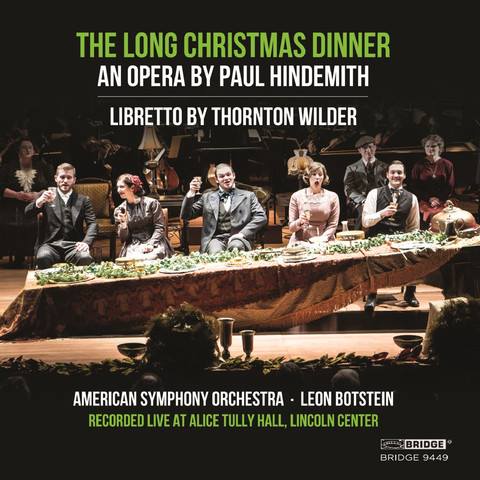
  • Hindemith’s Long Christmas Dinner Review

    Hindemith’s Long Christmas Dinner Review

    For anyone who’s ever felt like they’ve been stuck on an interminable holiday visit, composer Paul Hindemith has got you licked.

    His one-act opera, “The Long Christmas Dinner,” spans 90 years and offers musical snapshots of several generations of the Bayard family as they convene for their annual Yuletide ritual.

    The libretto is by Thornton Wilder, based on one his own plays, and shares some of the same concerns as his Pulitzer Prize-winning “Our Town.” Especially characteristic is the passage of time and the human tendency not to savor every precious moment.

    Two doors flank the stage, one representative of Birth and the other Death. Family members come and go; historical, political and economic factors impinge on familial relations and the fortunes of the family unit; the specter of war rears its head – all in a 50-minute span.

    The work is not without humor, irony, and certainly poignancy. However, it’s all presented in Hindemith’s clean, neoclassical, unsentimental syntax. The opening is a setting of “God Rest Ye Merry, Gentlemen” that suggests anything but unalloyed merriment, sounding somewhat haunted, as if conceived by the Ghost of Christmas Past.

    Bridge Records has issued the first English-language recording of the work, captured last year in live performance at Alice Tully Hall at Lincoln Center in New York, and it is satisfying in every way. Of course, seeing the piece live would greatly benefit being able to tell certain characters apart, since some of the singers assume different roles down the generations. Innovatively, it was presented on the second half of the program, preceded by an actual performance of the play.

    The conductor, Leon Botstein, has built a career on looking at music through fresh perspectives. Botstein is founder and co-artistic director of the Bard Music Festival. He has been president of Bard College since 1975. He has been music director of the American Symphony Orchestra, heard on this recording, since 1992.

    Because of his love of the piece, Maestro Botstein very generously consented to a last-minute phone interview, granted only hours before he had to be on a plane to Budapest. I’ve edited his remarks down to a five-minute spoken introduction. Check back here tonight to hear a more complete version of our conversation, which I will be posting concurrently with the broadcast of the show.

    I hope you’ll join me when “Dinner Is Served,” tonight at 10 ET, with a second helping this Wednesday evening at 6; or that you’ll listen to it later as a webcast, at wwfm.org.
  • Naughty Christmas Puppets & Holiday Horror

    Naughty Christmas Puppets & Holiday Horror

    ADVENT CALENDAR – DAY 14

    Nothing says Christmas like malevolent puppets.

    If you’ve ever had a nightmare about a grimacing nutcracker or found yourself profoundly disturbed by a Rankin-Bass Christmas special, then this one is for you.

    This Sunday night on “The Lost Chord,” we present as our centerpiece Paul Hindemith’s unusual Christmas fairy tale, “Tuttifäntchen,” written in 1922, in which a wooden figure carved out of a fir by a master woodcutter comes to life and causes all sorts of havoc. He literally robs a young girl of her good heart, thrashes children, and sends all of the Christmas trees in the world out onto the marketplace – all en route to a desired reunion with the fir of his origin. (Fortunately, his reign of terror spans only 24 hours, and everything ends well.)

    It may sound like a real horror show, but the music is disarming in its simplicity and warmth. Hindemith’s score incorporates familiar Christmas songs and a contagious foxtrot, called “Dance of the Wooden Puppets.” A delightful suite from “Tuttifäntchen” was released on the CPO label back in 1999. In 2013, CPO issued this complete recording, from which I excise most of the spoken dialogue, since it is in German.

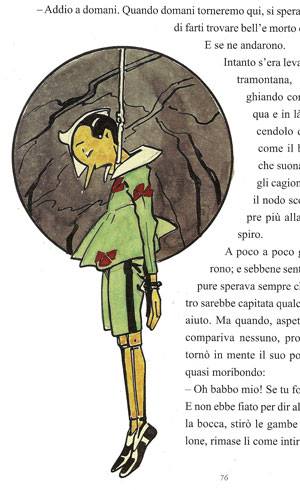
    This allows time for two additional pieces. From “Tuttifäntchen,” my thoughts travel immediately to Pinocchio. In Carlo Collodi’s original story – published in the 1880s, over a half century before Walt Disney gave him a good scrubbing up – the boy-puppet is an absolute terror. He even kills Jiminy Cricket with a hammer!

    His exploits inspired Ernst Toch, a Hindemith contemporary, to compose “Pinocchio: A Merry Overture,” in 1935. Toch was awarded the Pulitzer Prize for Music in 1956, for his Symphony No. 3.

    The hour will open with the “Punch and Judy Overture,” from 1945, by American composer Leroy Robertson. Punch, of course, is the classic murderous puppet, who outsmarts the Devil and even Death himself.

    “THAT’S the way to do it,” as he’s fond of saying. (If you’ll notice, Mr. Punch is always self-satisfied – hence the phrase “pleased as Punch.”)

    “In my opinion the street Punch is one of those extravagant reliefs from the realities of life which would lose its hold upon the people if it were made moral and instructive. I regard it as quite harmless in its influence, and as an outrageous joke which no one in existence would think of regarding as an incentive to any kind of action or as a model for any kind of conduct. It is possible, I think, that one secret source of pleasure very generally derived from this performance… is the satisfaction the spectator feels in the circumstance that likenesses of men and women can be so knocked about, without any pain or suffering.”

    – Charles Dickens (Mr. Christmas, himself), in a letter from 1849

    I hope you’ll join me for “Hindemith Branches Out” – celebrating the holidays with the naughty puppet Tuttifäntchen and friends – this Sunday night at 10 ET, with a repeat Wednesday evening at 6; or that you’ll listen to it later as a webcast at http://www.wwfm.org.

    Here’s Hindemith’s “Dance of the Wooden Dolls”:

    http://grooveshark.com/#!/search?q=dance+of+the+wooden+dolls+schenck

    PHOTO: In Collodi’s original, Pinocchio kills Jiminy Cricket, eats the Cat’s paw and pays the ultimate price. The publisher thought the ending too depressing and made Collodi change it. (The puppet still commits pesticide and maims the cat, though.)

  • Hindemith’s St Francis Ballet and Giotto’s Frescoes

    Hindemith’s St Francis Ballet and Giotto’s Frescoes

    As an animal lover, I’ve always had a soft spot for St. Francis of Assisi. (Also, I was fortunate enough to visit his hometown before the devastating earthquakes of 1997.)

    On this date in 1938, Paul Hindemith’s ballet “St. Francis” was given its first performance at Covent Garden, London, with the Ballet Russe of Monte Carlo and the composer conducting. Léonide Massine was the choreographer.

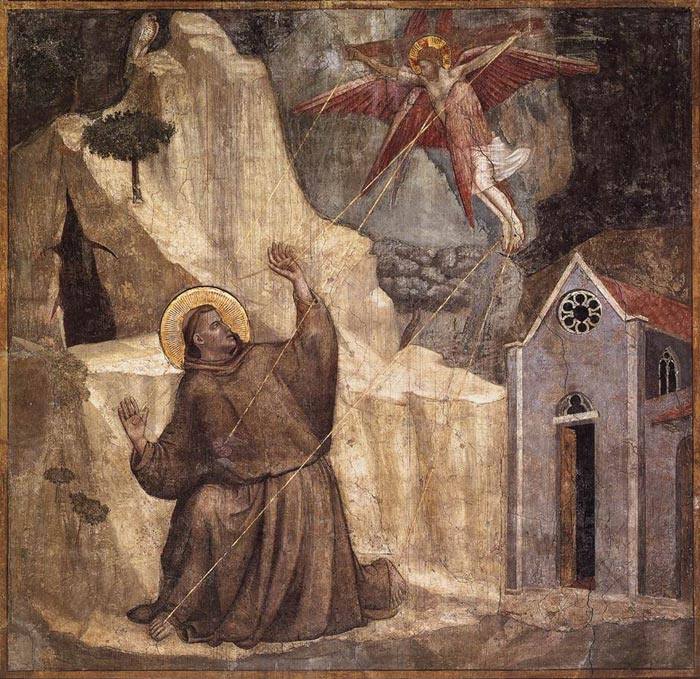
    Hindemith and his wife had recently visited the Basilica of Santa Croce in Florence, the largest Franciscan church in the world. He was so impressed with the Giotto frescoes there, which adorn the Bardi Chapel, that he determined they would form the basis for his ballet.

    Just as the familiar “Mathis der Maler” Symphony was derived from episodes from Hindemith’s opera of the same name, the symphonic suite “Nobilissima Visione” was drawn from episodes in “St. Francis.” The result is one of Hindemith’s most luminous scores.

    Here it is with the composer conducting:

    More about the frescoes:

    http://www.artble.com/artists/giotto_di_bondone/paintings/bardi_chapel_frescoes

Tag Cloud

Aaron Copland (92) Beethoven (95) Composer (114) Film Music (123) Film Score (143) Film Scores (255) Halloween (94) John Williams (187) KWAX (229) Leonard Bernstein (101) Marlboro Music Festival (125) Movie Music (138) Opera (202) Philadelphia Orchestra (89) Picture Perfect (174) Princeton Symphony Orchestra (106) Radio (87) Ralph Vaughan Williams (85) Ross Amico (244) Roy's Tie-Dye Sci-Fi Corner (290) The Classical Network (101) The Lost Chord (268) Vaughan Williams (103) WPRB (396) WWFM (881)

DON’T MISS A BEAT

Receive a weekly digest every Sunday at noon by signing up here


RECENT POSTS