I’ve been dropping birthdays all over the place recently, and having to pass over some of them really bothers me, especially those of favorites like Carl Nielsen (June 9) and Edvard Grieg (June 15); but there are only so many hours in the day, and how much is one man expected to give, anyway?!!
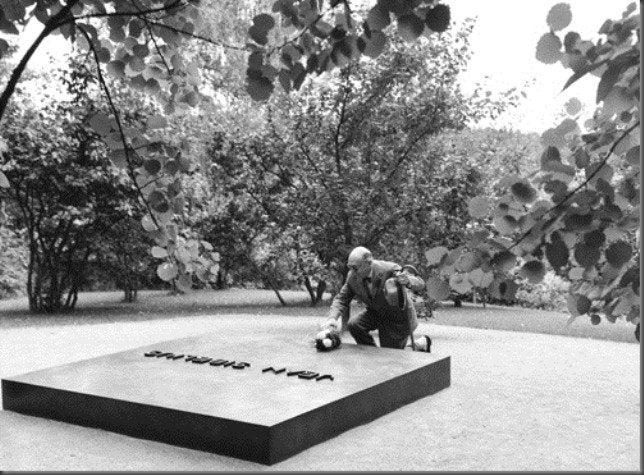
That said, one can’t draw breath on June 17 and not pay respect to the great Igor Stravinsky, who here pays it forward to Jean Sibelius, of all people. Such radically different composers! I happen to adore Sibelius, so all the more respect to Stravinsky – who I don’t think in reality was all that fond of the Finnish master’s music.
However, Stravinsky’s amanuensis Robert Craft did recall an appreciative remark made during a visit to Helsinki in 1961, in which Stravinsky praised Sibelius’ “Canzonetta” from the incidental music to “Kuolema” (“Death”). You know, the play written by Sibelius’ brother-in-law, Arvid Järnefelt, that also yielded the ubiquitous “Valse triste.”
Stravinsky commented, “I like that kind of northern Italianate melodism – Tchaikovsky had it too – which was a part, and an attractive part, of St. Petersburg culture.”
Sibelius’ original is scored for strings. Stravinsky’s version is for two clarinets, four horns, harp, and double bass.
Stravinsky won the Wihuir-Sibelius Prize in 1963. His arrangement of the “Canzonetta” was premiered on March 22, 1964, by the Finnish Broadcast Company.
Happy birthday, Igor Stravinsky, from Sibelius’ No. 1 fan.
The composer who spent most of his life driving himself to evolve, terrified of turning into a dinosaur, first became known to many of us from the dinosaur segment in Disney’s “Fantasia.”
Happy birthday, Igor Stravinsky! Fight for your “Rite” to party!
PHOTOS: (left) Disney and Stravinsky; (top to bottom) “The Rite of Spring” segment from “Fantasia;” George Balanchine, Stravinsky, and Disney with Pteranodon model; and Stravinsky caricature by Disney
It’s Saturday night! Celebrate by cutting a rug with Sergei Diaghilev. The famed ballet impresario was born on this date 150 years ago.
The company he founded, the Paris-based, world-renowned Ballets Russes, never actually performed in Russia, due to the upheaval of the Russian Revolution. However, from 1909 to 1929, the Ballets Russes performed throughout Europe, and North and South America, collaborating with some of the most-esteemed artists of the time and building a reputation as the most influential ballet company of the 20th century.
Among those commissioned or employed by Diaghilev were composers Igor Stravinsky, Claude Debussy, Maurice Ravel, Sergei Prokofiev, and Erik Satie, choreographers Marius Petipa, Michel Fokine, Vaslav Nijinsky, Bronislava Nijinska, Léonide Massine, and George Balanchine, visual artists Vasily Kandinsky, Alexandre Benois, Pablo Picasso, and Henri Matisse, and costume designers Léon Bakst and Coco Chanel.
The enterprise flourished until the double-blow of the Great Depression and the death of its founder in 1929. In 1932, the Ballet Russe de Monte-Carlo rose from the ashes, reconstituted by Colonel Wassily de Basil, a Russian émigré entrepreneur from Paris, and René Blum, ballet director of the Monte Carlo Opera.
Within four years, the organization was rent by creative differences, and a splinter group, led by Blum, emerged. This ultimately promoted itself as the Original Ballet Russe.
During World War II, the Ballet Russe de Monte Carlo spent significant time touring the Americas. As dancers retired and left the company, they began teaching or founded their own studios – Balanchine started the New York City Ballet – so that Diaghilev’s influence pervaded American dance. Tamara Toumanova, Maria Tallchief, Cyd Charisse, Ann Reinking, and Yvonne Craig were all alumni of the Ballets Russes de Monte Carlo.
Alumni of the Original Ballet Russe, which toured mostly in Europe, were influential in teaching classical Russian ballet technique there.
For the sesquicentennial of Sergei Diaghilev, get your toes tapping with 12 works written or adapted for the Ballets Russes!
MAURICE RAVEL, “DAPHNIS ET CHLOE”
Shepherds, pirates, and Pan!
NIKOLAI TCHEREPNIN, “NARCISSE ET ECHO”
Tcherepnin was actually Diaghilev’s first choice to compose “The Firebird.”
IGOR STRAVINSKY, “PULCINELLA”
Diaghilev produced Stravinsky’s three breakthrough ballets, “The Firebird,” “Petrouchka,” and “The Rite of Spring,” but this one is the most unremittingly joyous.
RICHARD STRAUSS, “JOSEPHSLEGENDE”
Poor Richard Strauss never got paid for his opulent biblical ballet on account of WWI.
MANUEL DE FALLA, “THE THREE-CORNERED HAT”
Ballet meets flamenco.
PETER ILYCH TCHAIKOVSKY, “AURORA’S WEDDING”
Stokowski conducting, at the age of 95!
LORD BERNERS, “THE TRIUMPH OF NEPTUNE”
Sailor Tom Tug’s adventures in Fairy Land.
CONSTANT LAMBERT, “ROMEO AND JULIET”
Not really an adaptation of Shakespeare’s tragedy, but a backstage romantic comedy. Just a clip, with set and costume designs by Max Ernst and Joan Miro.
OTTORINO RESPIGHI, “LA BOUTIQUE FANTASQUE”
“The Fantastic Toybox,” after melodies of Rossini.
SERGEI PROKOFIEV, “THE PRODIGAL SON”
Bad boys get the best music.
ERIK SATIE, “PARADE”
Selections, choreography by Massine and designs by Picasso.
FRANCIS POULENC, “LES BICHES”
Before you get any smart ideas, the title means “The Does,” slang for coquettish young women.
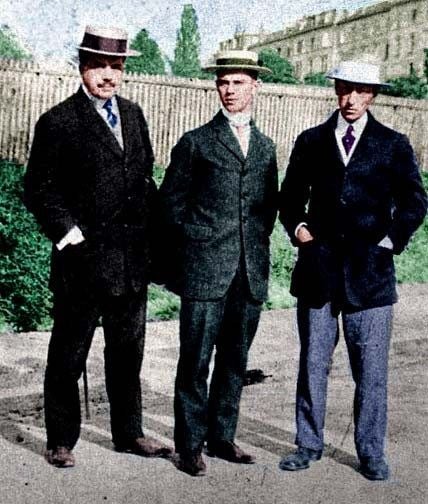
PHOTO: Diaghilev, Vaslav Nijinsky, and Igor Stravinsky
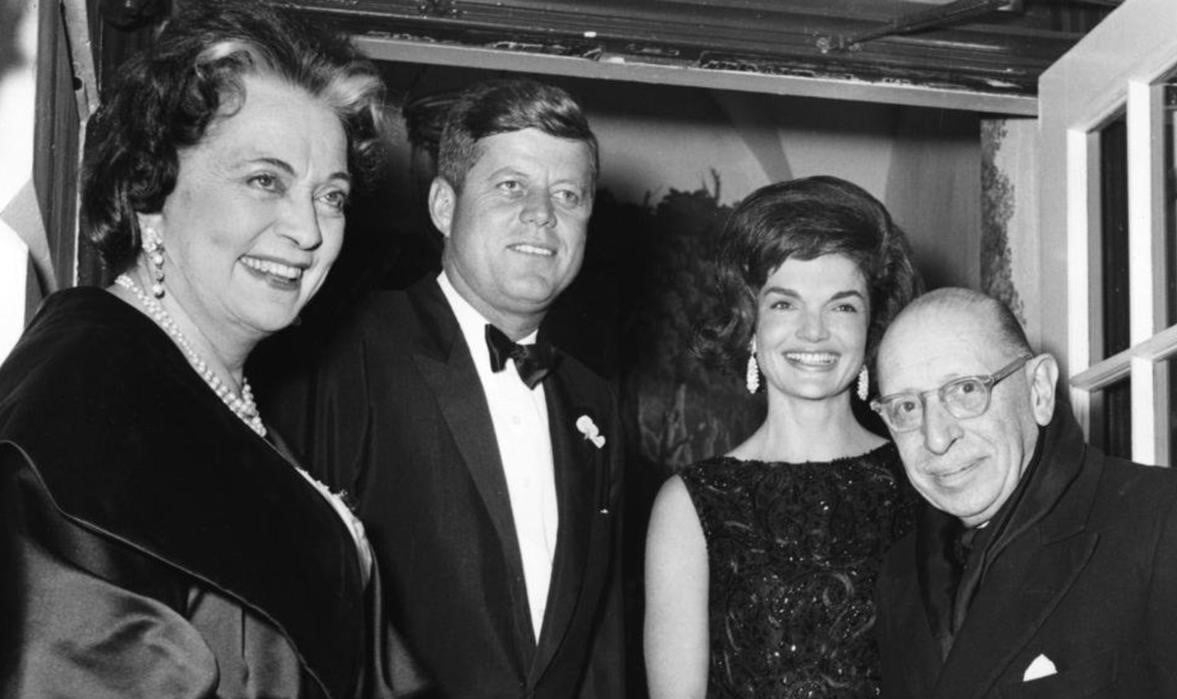
“Despite such criticism – which was entirely typical of Stravinsky’s unfiltered personality – he clearly remembered the visit with fondness and gratitude. In January, 1964 he commemorated John F. Kennedy – who had been assassinated on November 22, 1963 – by composing ‘Elegy for J.F.K.,’ a vocal piece with words by W.H. Auden. ‘I felt that the events of November were being too quickly forgotten,’ the composer told The New York Times, ‘and I wished to protest.’”
Leonard Bernstein was also in attendance at the dinner. Bernstein’s “Fanfare for JFK” was heard for the first time on the eve of Kennedy’s inauguration, also on this date, though one year earlier. It’s only 40 seconds long, so if you blink, you’ll miss it.
In 1978, Bernstein gave the opening speech at the first Kennedy Center Honors, at which the honorees included Marian Anderson, Richard Rodgers, George Balanchine, Fred Astaire, and Arthur Rubinstein:
I’ll spare you the entirety of Bernstein’s “Mass,” commissioned by Jacqueline Kennedy for the opening of the Kennedy Center in 1971, but here’s the piece’s hit tune, “A Simple Song”
Where are our Bernsteins and Stravinskys – or for that matter our Marian Andersons, Richard Rodgerses, George Balanchines, Fred Astaires, and Arthur Rubinsteins – and provided they can be identified, why are they not honored at the White House, or even on television?
And so it begins: bracing for that first step onto the greased slide through the Crazy House. January 2, where art thou?
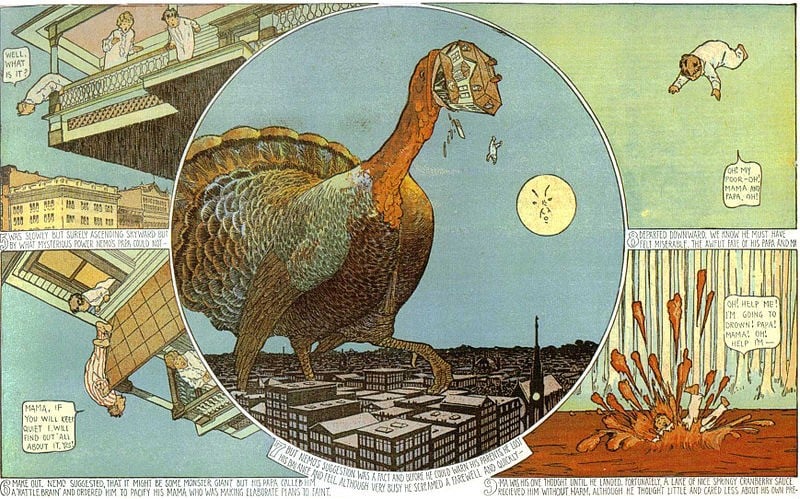
To get you in the proper mindset for Thanksgiving, here’s a rarely-heard work by Antonio Vivaldi.
The story goes that it was Igor Stravinsky who quipped that Vivaldi wrote the same concerto 500 times. Without making claim to having heard all of them, I have to say, they seem to be of uniformly high quality, if in binge-listening they do tend to become a mite indistinguishable. Would “The Four Seasons” ever have gained the traction it has without its programmatic associations?
Anyone familiar with classical music can tell you that concertos and symphonies with nicknames tend to have a better chance of getting played or at the very least remembered.
A few years ago, one of my colleagues was searching through the station’s CD library, when he stumbled across an album titled “Viva Vivaldi: The Unknown Gems” (Centaur Records #3299). From this disc, we were astonished to learn of a certain “Turkey” Concerto, RV 506.
It turns out the canny artists themselves named it such, because of the “fiendish, cascading broken third passages in the solo lines in the 3rd movement.” In any case, it’s a good way to get your disc played. On reflection, why should a nickname bestowed in the 18th century be any more valid?