Tag: Igor Stravinsky

  • Stravinsky’s Savage Wit Composer Feuds and Fireworks

    Stravinsky’s Savage Wit Composer Feuds and Fireworks

    I’m not sure Stravinsky ever had anything nice to say about anyone. I suppose when you’re lauded as the most important composer of the 20th century, you’ll do anything you can to hang on to the title. Also, a pithy putdown always makes for good copy.

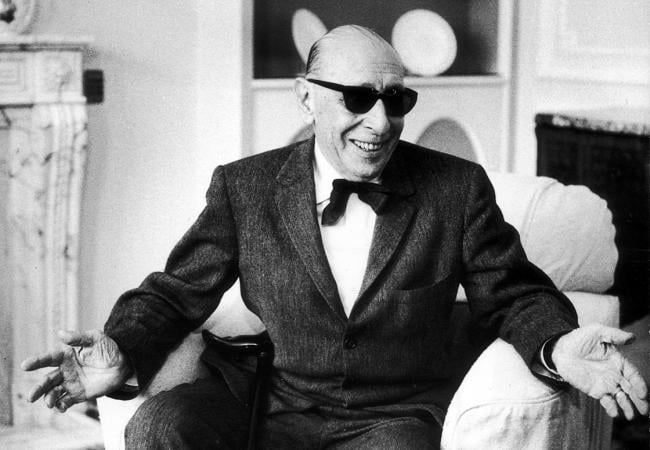
    It’s interesting then to come across so many images of Stravinsky with other composers. What was there that they could possibly talk about? Other than Stravinsky, I mean?

    Perhaps it’s true that familiarity really does breed contempt. In the world of Igor Stravinsky, if you don’t have anything nice to say, say it!


    “Why is it that whenever I hear a piece of music I don’t like, it’s always by Villa-Lobos?”

    On Rachmaninoff: “He was a six-and-a-half-foot scowl.”

    On Boulez’s “Pli Selon Pli”: “Pretty monotonous and monotonously pretty.”

    On Britten’s “A Midsummer Night’s Dream”: “It’s a mistake to conclude each act with people going to sleep.”

    On Messiaen’s “Turangalîla Symphony”: “Little more can be required to write such things than a plentiful supply of ink.”

    On Handel’s “Theodora”: “It’s beautiful and boring. Too many pieces of music finish too long after the end.”

    On Eugene Ormandy: “The perfect conductor of Strauss waltzes.”


    In fairness, he sometimes got as good as he gave:

    Ernest Newman on Stravinsky: “His music used to be original. Now it’s aboriginal.”

    Britten on Stravinsky’s “The Rake’s Progress”: “I liked the opera very much. Everything but the music.”

    Prokofiev on Stravinsky: “Bach on the wrong notes.”


    At least two of Stravinsky’s works were first performed on this date:

    In 1908, “Feu d’artifice” (“Fireworks”) was composed to celebrate the marriage of Nadezhda Rimsky-Korsakov, the daughter of his famed teacher, to rival composer-classmate Maximilian Steinberg, which must have been a bitter pill.

    In 1957, “Agon” was given its first performance on a concert to celebrate Stravinsky’s 75th birthday. The first staged performance was held at the New York City Ballet, choreographed by George Balanchine, later in the year, on December 1, 1957.

    Happy birthday, Igor Stravinsky!


    PHOTO GALLERY: Puppet master Ego Stravinsky and his marionette theater (each labeled individually)

  • Stravinsky’s Wind Symphonies A Centennial

    Stravinsky’s Wind Symphonies A Centennial

    On this date, 100 years ago, Igor Stravinsky’s “Symphonies of Wind Instruments” was given its first performance at Queen’s Hall, London, on a concert conducted by Serge Koussevitzky. Written the previous year, and dedicated to the memory of Debussy, the chorale that concludes the piece was first published in the French magazine “La Revue musicale,” alongside memorial works by Ravel, Bartók, Falla, Dukas, Satie, and others. The issue was titled “Le Tombeau de Claude Debussy.”

    However, the opening night audience found Stravinsky’s music anything but grave. They chortled inappropriately, and Koussevitzky glanced over his shoulder to share a conspiratorial grin. Even so, at the end of the performance, any cheekiness was obliterated by applause, as Stravinsky rose to take a bow.

    The work is scored for 24 wind instruments. The term “symphonies” has nothing to do with symphonic form. Rather, Stravinsky employed the word for its broader, older connotation, from the Greek, of “sounding together.” He would reorchestrate the piece in 1947.

    Three days prior to the Queen’s Hall jeers, Stravinsky had given Londoners something to cry about, as he attended the UK premiere, in the same venue, of the concert version of his riot-inducing ballet “The Rite of the Spring.”

    It’s always refreshing to look back on a time when people were actually passionate about music.


    “Symphonies of Wind Instruments”

    Riot at “The Rite”


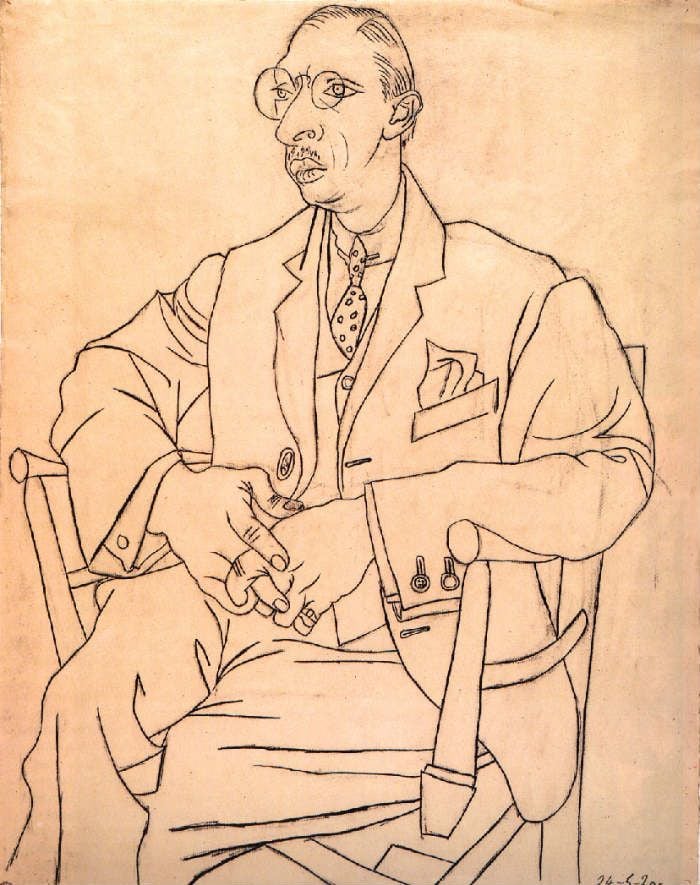
    Stravinsky as rendered by Picasso in 1920

  • Irving Penn’s Corner: Portraits of Tracy & Stravinsky

    Irving Penn’s Corner: Portraits of Tracy & Stravinsky

    Nobody puts Baby in a corner! But Irving Penn did, seemingly, just about everyone else.

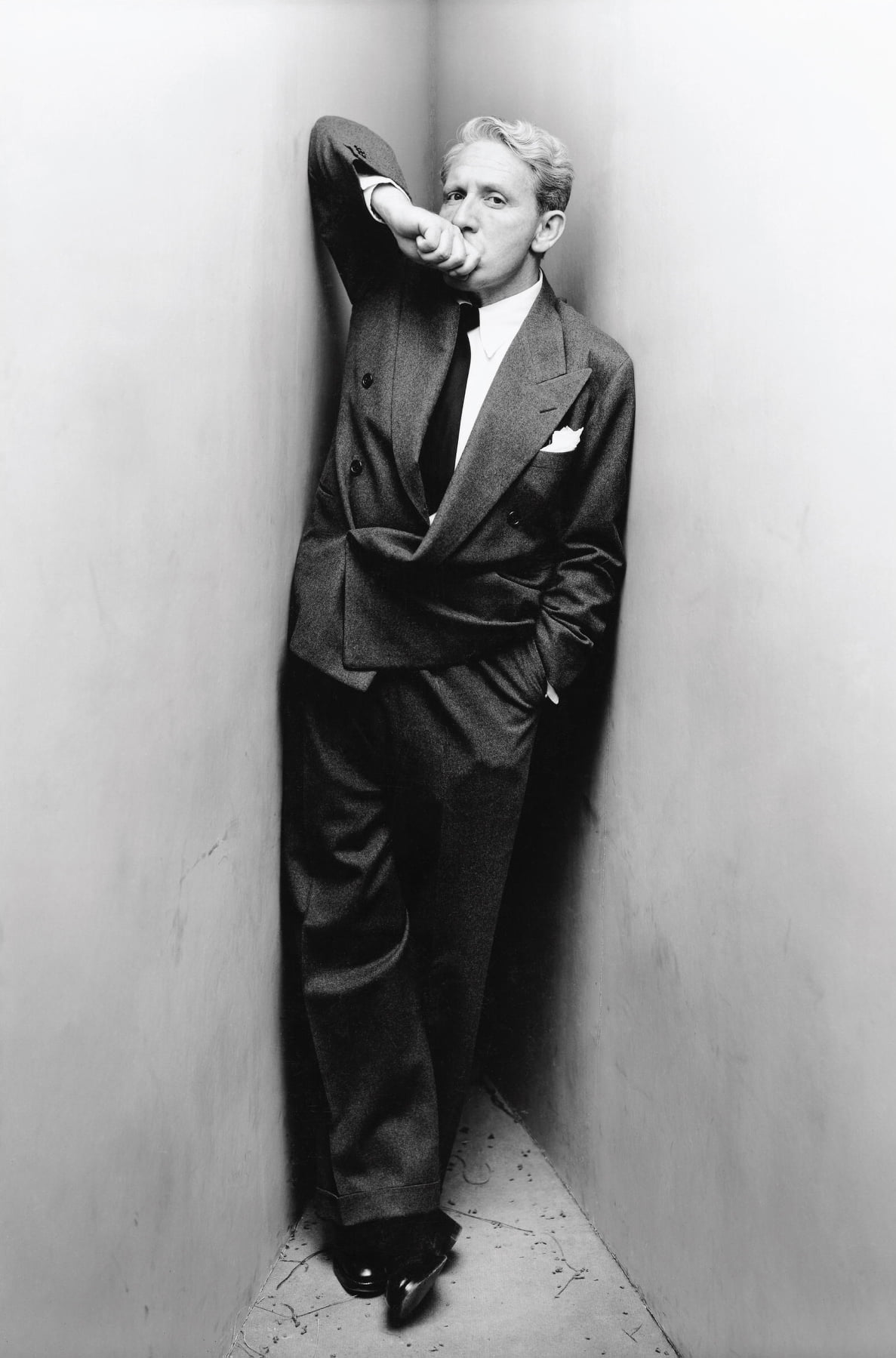
    I stumbled across a Spencer Tracy biography the other day. On its cover is a photograph of Spence, left hand in his pocket and the right in front of his mouth, elbow held high, as he leans into an unusually severe corner. Right away, I was struck by its similarity to a famous portrait of Igor Stravinsky.

    A brief search yielded Stravinsky, with legs crossed casually, hand held to a cocked ear. It wasn’t necessary to examine the two side by side. Unmistakably, it was the work of same photographer. The discovery spurred me to find out more about Irving Penn.

    Penn, born in Plainfield, NJ, in 1917, attended the Philadelphia Museum and School of Industrial Art – now the University of the Arts – from 1934 to 1938. There he studied drawing, painting, graphics, and industrial arts under Alexey Brodovitch. Brodovitch was art director at Harper’s Bazaar. He proved to be a good contact. Harper’s was publishing Penn’s work before he even graduated.

    Penn worked for a time as a freelancer, then succeeded Brodovitch as art director at Saks Fifth Avenue. Then he took off for a year to paint and take photographs in Mexico and across the U.S. When he returned to New York, he received an offer to join the art department of Vogue magazine. Before long, his photographs began to appear on the cover.

    During World War II, he was courted by the Office of War Information in London, but decided to volunteer for the American Field Service instead. His assignments took him to Italy and India. He drove an ambulance, and he took more photos.

    Throughout his career, he continued to contribute covers, portraits, still lifes, fashion photography, and photographic essays to Vogue. He also founded his own studio.

    In 1948, he began to invite famous subjects to that studio, where they would be photographed in an acute corner formed of two flats. He made portraits of writers, artists, athletes, dancers, actors, political figures, and socialites. Of course, what I find most interesting are the musicians.

    In addition to Stravinsky, there was Duke Ellington, Jascha Heifetz, Arthur Rubinstein, Yehudi Menuhin, Vittorio Rieti (with George Balanchine), Louis Armstrong, Noel Coward, Kay Thompson and the Williams Brothers (including Andy), and Maurice Chevalier.

    Irving photographed more than just these, of course. But these are the ones he put in a corner, Baby.


    Penn portraits: Speak-no-evil (Tracy) and Hear-no-evil (Stravinsky)

  • Stravinsky 50 Years On A Requiem Remembered

    Stravinsky 50 Years On A Requiem Remembered

    Igor Stravinsky died in New York City 50 years ago today.

    As per his wishes, he was buried in the Russian corner of the cemetery island of San Michele in Venice, transported there by gondola, following a service at the Basilica di Santi Giovanni e Paolo.

    His late, serial masterwork, “Requiem Canticles,” was performed at his funeral. Stravinsky described the 15-minute, six-movement piece, which is sung in Latin, as his “pocket requiem.” It was given its debut at Princeton’s McCarter Theatre in 1966, with the composer conducting.

    The event left a lasting impression. If you’re interested in some first-hand accounts, you can learn more in this article I wrote in 2016, to mark the work’s 50th anniversary, for the Trenton Times.

    https://www.nj.com/times-entertainment/2016/12/classical_music_puo_pugc_so_pe.html?fbclid=IwAR10cMEcv0Uaz4sYSGv-yX2-Xrr7tXOWpumyXcazdrnrigHpgl8rrXpquKg

    Robert Craft’s recording of “Requiem Canticles”:

    Leonard Bernstein conducts a Stravinsky memorial concert, including “The Rite of Spring,” “Capriccio for Piano and Orchestra,” and “Symphony of Psalms,” in April of 1972.


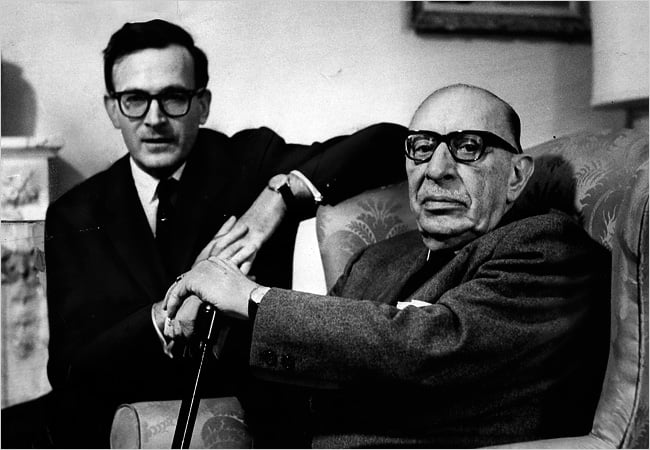
    Gone but not forgotten: Stravinsky and his assistant, Robert Craft, in 1964

  • Villa-Lobos Stravinsky Feud Brazilian Music

    Villa-Lobos Stravinsky Feud Brazilian Music

    A day after sharing Igor Stravinsky’s observation that Vivaldi composed the same concerto 500 times comes this barb about his great Brazilian contemporary, Heitor Villa-Lobos: “Why is it whenever I hear a piece of music I don’t like, it’s always by Villa-Lobos?”

    MEE-OW!

    To further agitate the catty Stravinsky, here’s the symphonic poem “Uirapuru,” named for a Brazilian bird. In short, it’s another one of Villa-Lobos’ folkloric rainforest pieces.

    Happy birthday, HVL!


    Villa-Lobos and friend

Tag Cloud

Aaron Copland (92) Beethoven (95) Composer (114) Film Music (123) Film Score (143) Film Scores (255) Halloween (94) John Williams (187) KWAX (229) Leonard Bernstein (101) Marlboro Music Festival (125) Movie Music (138) Opera (202) Philadelphia Orchestra (89) Picture Perfect (174) Princeton Symphony Orchestra (106) Radio (87) Ralph Vaughan Williams (85) Ross Amico (244) Roy's Tie-Dye Sci-Fi Corner (290) The Classical Network (101) The Lost Chord (268) Vaughan Williams (103) WPRB (396) WWFM (881)

DON’T MISS A BEAT

Receive a weekly digest every Sunday at noon by signing up here


RECENT POSTS