“The Last Repair Shop” wins Academy Award for Best Documentary Short. John Williams gets acknowledged as inspiration in acceptance speech. “John Williams inspired me to become a composer,” says co-director Kris Bowers. “Music education isn’t just about creating incredible musicians. It’s about creating incredible humans.” Watch the film here:
Tag: John Williams
-
John Williams Scores Presidents on Film
In a career that’s spanned over 60 years, John Williams has had opportunities to score just about every kind of film. Inevitably, these would include several fictionalized accounts of the American presidents. This week on “Picture Perfect,” just in time for Presidents Day, we’ll exercise our executive power and sample music from four of them.
“JFK” (1991) is one of three collaborations between Williams and director Oliver Stone. The film has more to do with conspiracy theories surrounding the Kennedy assassination than anything to do with his presidency. A controversial feature, no doubt – Walter Cronkite dressed down Roger Ebert after he gave it a positive review – still, a compelling piece of cinema. It certainly inspired an effective score.
Kevin Costner plays New Orleans district attorney Jim Garrison, Sissy Spacek, his wife, and Gary Oldman, Lee Harvey Oswald. Tommy Lee Jones and Joe Pesci are unforgettable as a pair of outlandish conspirators (if you ever wanted to see Jones painted gold, then this is the movie for you), and Donald Sutherland delivers a virtuoso 16-minute monologue as a government whistleblower who identifies himself only as “X.”
Williams and Stone had previously worked together on “Born on the Fourth of July.” Later, they would reunite for a second presidential collaboration, a character study of Richard Milhous Nixon – in a film called, well, “Nixon” (1995). Anthony Hopkins, as the president, leads another impressive cast, which includes Joan Allen, Powers Boothe, Ed Harris, Bob Hoskins, E.G. Marshall, David Hyde Pierce, Paul Sorvino, Mary Steenburgen, and James Woods.
Williams also wrote the music for Steven Spielberg’s “Amistad” (1997). The film, about a mutiny on a slave ship in 1839 and the resulting courtroom drama, features two American presidents: Nigel Hawthorne plays Martin van Buren, the sitting president; and again, Anthony Hopkins appears, in a memorable supporting turn, as aging former president John Quincy Adams. Adams argues the defense of the Africans who took part in the mutiny.
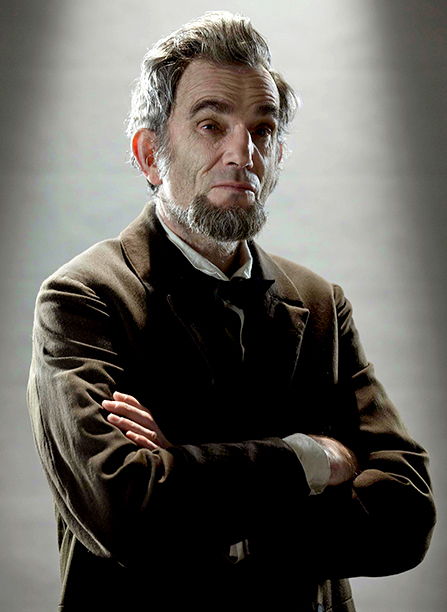
Finally, Daniel Day-Lewis plays the nation’s 16th president, in Spielberg’s “Lincoln” (2012). He’s lent strong support by Sally Field as Mary Todd Lincoln, David Strathairn as Secretary of State William Steward, and Tommy Lee Jones, this time as Thaddeus Stevens.
It’s a bold assessment, but Day-Lewis elevates “Lincoln,” the film, to greatness, with arguably one of the most amazing performances in cinematic history. Day-Lewis’ gentle but shrewd Man of Destiny would go to any lengths to hold the country together. Williams taps into America’s proud musical heritage, clearly influenced by Copland and the folksier side of Ives, to create a score of stirring nobility.
I hope you’ll join me, as the presidents take precedence this week on “Picture Perfect,” music for the movies, now in syndication on KWAX, the radio station of the University of Oregon!
Remember, KWAX is on the West Coast, so there’s a three-hour difference for those of you listening in the East. Here are the respective air-times for all three of my recorded shows (with East Coast conversions in parentheses):
PICTURE PERFECT, the movie music show – Friday on KWAX at 5:00 PM PACIFIC TIME (8:00 PM EST)
SWEETNESS AND LIGHT, the light music program – ALL NEW! – Saturday on KWAX at 8:00 AM PACIFIC TIME (11:00 AM EST)
THE LOST CHORD, unusual and neglected rep – Saturday on KWAX at 4:00 PM PACIFIC TIME (7:00 PM EST)
Stream all three, at the times indicated, by following the link!
PHOTOS: (clockwise from left) Day-Lewis as Lincoln; Hopkins as Nixon; poster for “JFK;” Hopkins as John Quincy Adams
-
John Williams Turns 92 A Film Music Legend
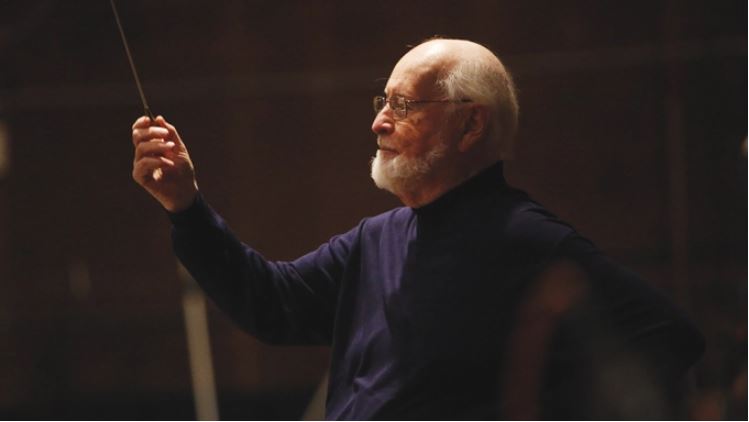
It’s 92 candles on the cake for John Williams – a suitable tribute for the brightest light among living film composers.
Williams’ career has spanned some 70 years. I know it’s trite to say, but the man is living history. No, really.
Well before he became a household name in the 1970s, with blockbusters like “Jaws” and “Star Wars,” he worked as an orchestrator and session pianist on such films as “Sweet Smell of Success,” “Bell, Book and Candle, “God’s Little Acre,” “The Big Country,” “Some Like It Hot,” “The Magnificent Seven,” “Studs Lonigan,” “The Apartment,” “Hemingway’s Adventures of a Young Man,” “To Kill a Mockingbird,” “The Guns of Navarone,” “Breakfast at Tiffany’s,” “Charade,” “The Pink Panther,” “The Great Race,” “West Side Story,” and any number of other screen musicals.
He collaborated or apprenticed with many of the greatest film composers who ever lived, including Elmer Bernstein, Jerry Goldsmith, Bernard Herrmann, Henry Mancini, Jerome Moross, Alfred Newman, Dimitri Tiomkin, and Franz Waxman.
Of course, he was also composing his own original scores. His first A-list movie assignment was “How to Steal a Million” in 1966. Prior to that, he’d scored some goofy comedies and did TV work. Eddie Cantor once quipped, it takes 20 years to become an overnight success. By the time the wider public began to sit up and take notice of John Williams, with “Jaws” in 1975, that’s about right. By then, he’d already quietly amassed a string of hits and even landed his first Oscar (for adapting “Fiddler on the Roof” in 1971).
Curious to hear Williams’ first film score? While serving in the U.S. Air Force, Williams was assigned to the Northeast Air Command Band and stationed at Fort Pepperell in St. John’s, Newfoundland, Canada. There, he was approached by a local production company, Atlantic Films, to score a tourism short in 1952, titled “You Are Welcome.” His contribution consists largely of arrangements of local folk tunes, so don’t go into it expecting the unmistakable “Williams sound” he honed in Hollywood. But it will give you a real sense of history.
Mighty oaks from little acorns grow. You’ve come a long way, baby! Happy birthday, John Williams!
PHOTOS: Williams today (top), and recording “You Are Welcome” in 1952
-
John Williams Wins Grammy for Helena’s Theme
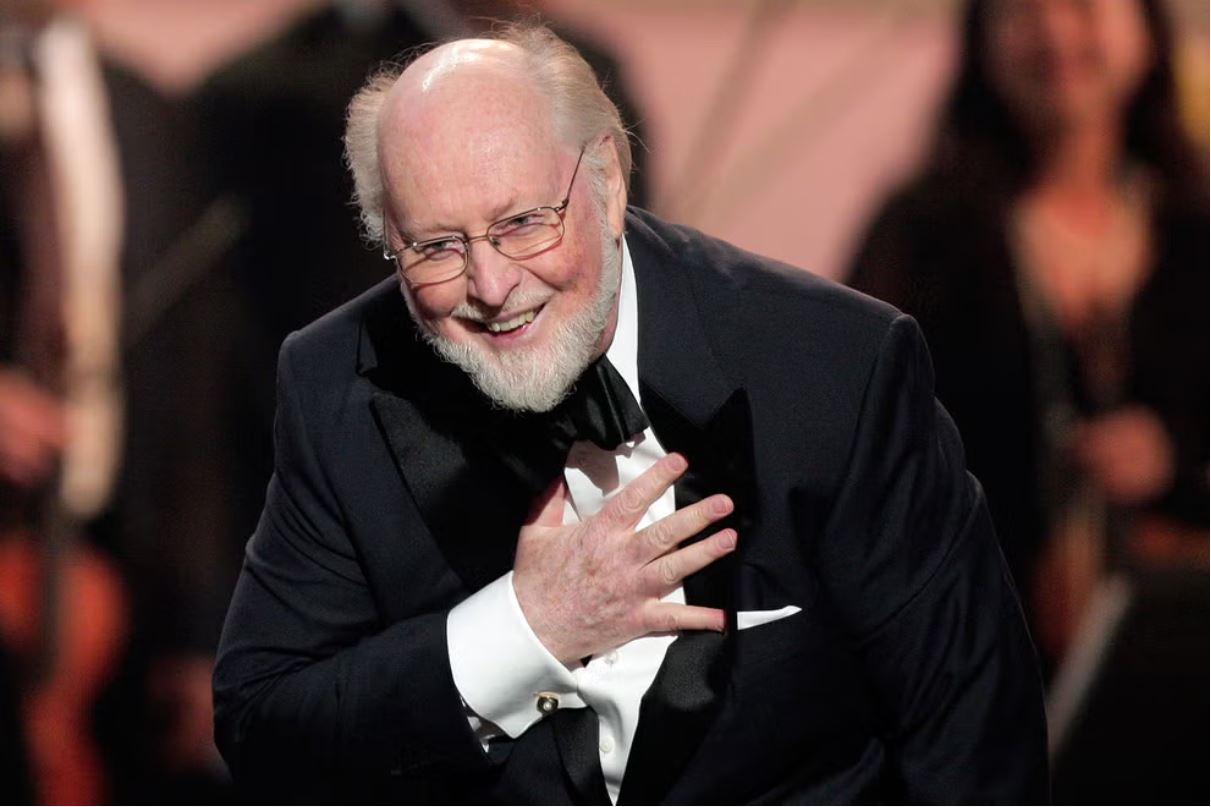
John Williams adds another Grammy to his buckling mantle, in the category of Best Instrumental Composition, for “Helena’s Theme,” the only good thing to come out of the execrable “Indiana Jones and the Dial of Destiny.”
Williams was also nominated twice in the category of Score Soundtrack for Visual Media, for both “Indiana Jones” and “The Fabelmans.” This brings the composer’s career Grammy tally to 26 wins and 76 nominations.
Ludwig Göransson won the Score Soundtrack award for his overbearing music for “Oppenheimer.” It’s not been a great year for film music, folks.
In truth, I could care less about the Grammys – as apparently the Grammys could care less about classical music – but if they can sell a few more records or bestow a little more prestige on classical artists, then good for the artists.
Feel free to Google the rest of the results.
Grammy Award-winning “Helena’s Theme,” arranged for Anne-Sophie Mutter
I prefer it in its original guise for orchestra (as if I could get any grumpier)
Congratulations, John Williams.
-
John Williams’ 54th Oscar Nomination
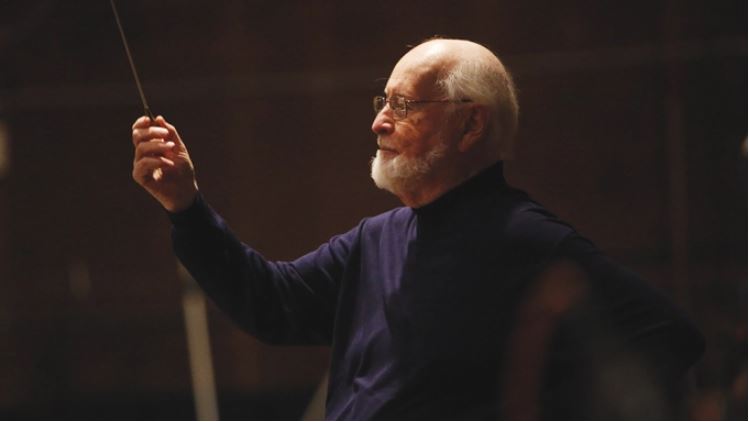
This year’s Academy Awards nominees were announced this morning, and sure enough, John Williams has earned yet another nod, for his score to “Indiana Jones and the Dial of Destiny.” Going into today, Williams was the most-nominated person alive. Now he’s even MORE the most-nominated (with the tally at 54). He also happens to be the second most-nominated person in Oscar history, after only Walt Disney (at 59).
The other nominees in the category of Best Original Score are Laura Karpman (“American Fiction”), Robbie Robertson (“Killers of the Flower Man”), Ludwig Göransson (“Oppenheimer”), and Jerskin Fenrix (“Poor Things”).
There’s a good possibility that whatever wins will do so for more than purely musical considerations. But that seems to be how it’s been for many years. The score for “Oppenheimer” is ludicrously overbearing.
In any case, it’s nice to see Williams handed another feather for his nest, even though his latest Indiana Jones music will not win. Or at least I hope it won’t. The film itself was godawful, and Disney has done all it can to be sure that your average consumer can’t get a hold of a physical copy of the soundtrack. A limited edition CD was made available for pre-order months in advance of the film’s release. If you didn’t know about it, you were welcome to spend hundreds of dollars for it on the collector’s market.
Merciful Disney has since decided to give everyone a second chance and make it available again as part of an expensive box set of all the Indiana Jones scores, duplicating the content of the previously-released soundtracks for all the other films. Thanks for nothing.
Williams should have automatically won for just about every year from at least 1975 to 1982. Nevertheless, he has been the recipient of five Oscars, for “Fiddler on the Roof” (adaptation of the stage musical by Jerry Bock & Sheldon Harnick), “Jaws,” “Star Wars,” “E.T. The Extra-Terrestrial,” and “Schindler’s List.” The last bestowed was in 1994.
It would be nice for him to get an honorary Oscar at some point – he’ll be 92 next month – but it wouldn’t be televised anyway, and Williams is doing just fine. Oscar needs John Williams more than John Williams needs him.
Tag Cloud
Aaron Copland (94) Beethoven (95) Composer (114) Film Music (149) Film Score (143) Film Scores (255) Halloween (97) John Williams (197) KWAX (232) Leonard Bernstein (105) Marlboro Music Festival (125) Movie Music (164) Mozart (91) Opera (215) Philadelphia Orchestra (90) Picture Perfect (174) Princeton Symphony Orchestra (110) Radio (90) Ross Amico (244) Roy's Tie-Dye Sci-Fi Corner (290) The Classical Network (101) The Lost Chord (269) Vaughan Williams (107) WPRB (397) WWFM (881)