Tag: Kavalier & Clay

  • Kavalier & Clay Opera: Chabon’s Szymanowski Secret

    Kavalier & Clay Opera: Chabon’s Szymanowski Secret

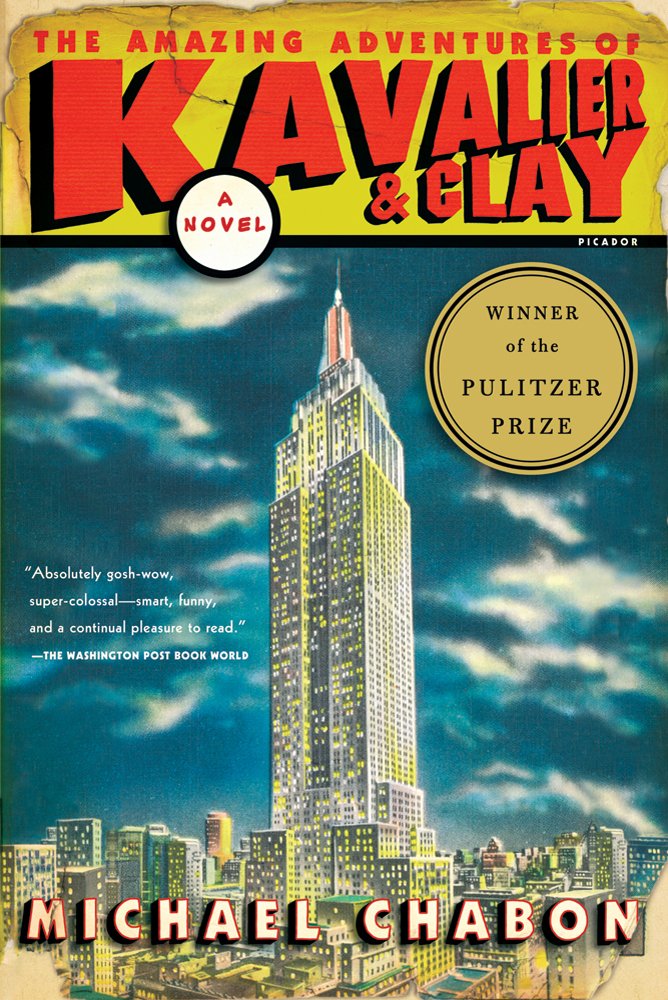
    I’ve been rereading “The Amazing Adventures of Kavalier & Klay” to refresh my memory, in advance of checking out Mason Bates’ new opera at the Met this week. A little while ago, I watched an unrelated interview with the book’s author, Pulitzer Prize winner Michael Chabon, who straddles the worlds of “serious” and pop cultural fiction (i.e. comic books, the pulps, genre pastiche) with the authority of a literary colossus. The interview was geared toward young readers, and one of the things he recommended was making an effort to read outside one’s comfort zone. By that, he means not only reading about subjects to which one wouldn’t ordinarily gravitate, but also getting to know different characters by writers who come from diverse backgrounds, as it can really expand one’s understanding and empathy for other perspectives. It’s clear that Chabon practices what he preaches, as it’s the only explanation for the richness of the world he creates and recalls in “Kavalier & Clay” (much of the book is set during the Great Depression and World War II) and the realistic characters who occupy it.

    For instance, I don’t know what kind of music Chabon enjoys, but clearly he’s an intellectual omnivore. His curiosity about the classics may not extend very deeply into opera (the premiere of “Kavalier & Klay” was the first time he ever set foot in the Met), but it drove him far enough beyond Bach and Beethoven to turn up no less than Karol Szymanowski. Szymanowski, one of Poland’s foremost composers, was born on this date (according to some sources) in 1882. Szymanowski is referenced multiple times throughout “Kavalier & Clay,” and I’m not entirely sure why. It could just be that the author enjoys his music, or perhaps he simply likes the sound of his name (Shim-an-OFF-ski). Or it could be that he is trying to demonstrate, as he lets drop several times throughout the narrative, that many of these characters who are caught up in the pulp, comic, and novelty business are actually very talented people, immigrants who perhaps abandoned their higher aspirations when they settled in the United States and determined to improve their lot. Which would explain why long-suffering publisher Sheldon Anapol is a member of the Szymanowski Society.

    Later in the book, Szymanowski is not mentioned by name when we are told that a portrait of the composer of “Songs of an Infatuated Muezzin” hangs on the wall behind his desk. Holy moly, Chabon! “Songs of an Infatuated Muezzin” isn’t even one of Szymanowski’s better-known works! I wonder if, thematically, the author might also have found the subject matter – a Muslim holy man who, in the execution of his sacred duty to call the faithful to prayer five times a day, finds himself increasingly distracted by erotic thoughts of his beloved – apposite to the situation of one of Chabon’s protagonists, Joe Kavalier, who succumbs to his guilt over the distraction from his primary mission, to get his family out of Nazi-occupied Czechoslovakia. In the meantime, he’s been engaged in a serious affair. Two affairs, actually – one with a free-spirited Greenwich Village bohemian and another, his artistic devotion to comic books – and the reader wonders which passion outstrips the other. In his way, he too is distracted from his sacred duty by a beguiling mistress.

    I don’t know that Chabon had this in mind, but the parallel is there. Or, as I say, it could be that he just likes the music.

    Looking forward to “Kavalier & Clay.” Also, happy birthday, Karol Szymanowski!


    “Songs of an Infatuated Muezzin”

    “The Amazing Adventures of Kavalier & Clay” at the Met

    https://www.metopera.org/season/2025-26-season/the-amazing-adventures-of-kavalier–clay/

    Szymanowski’s Violin Concerto No. 2, recorded by Henryk Szeryng

    Michael Chabon interview geared to young readers


    CLOCKWISE FROM LEFT: The novel, a still from the opera, and Karol Szymanowski

  • Kavalier & Clay Opera A Comic Book Masterpiece Revisited

    Kavalier & Clay Opera A Comic Book Masterpiece Revisited

    I’ve been revisiting Michael Chabon’s “The Amazing Adventures of Kavalier and Clay,” which I finally got around to reading for the first time only within the past decade. (The book won the Pulitzer Prize for Fiction in 2001.) I wanted it to be fresh in my mind when I see Mason Bates’ new opera at the Met next week. I’m a little over halfway through (I was hoping to knock it out before the first of October so that I can get on with my Halloween reading), and I’m loving it all over again.

    First of all, I sense in the author a kindred spirit, as he obviously adores all the pop cultural detritus that I myself have been lapping up since childhood. He also has an enviable grasp of the history and the social history of New York, a mindboggling eye for detail, and a real flair for crafting playful similes that makes Ray Bradbury seem positively drab by comparison.

    Of course, there’s a lot of comic book lore, both real and fabricated, as the dynamic duo of Joe Kavalier and Sammy Clayman, cousins, one European and one native, are brought together in a Brooklyn tenement to pool their talents in the creation of an unapologetically antifascist superhero, The Escapist. (Recall when Jack Kirby had the temerity to draw Captain America punching out Hitler a year before Pearl Harbor.) The team is also, I assume, inspired in part by Siegel and Shuster of “Superman” fame, both in terms of a crafting one of the first comic book superheroes and also getting screwed by their publishers.

    But the story is lent a whole other, higher-stakes dimension through Joe’s plight, his separation from his family in his own escape from Nazi-occupied Prague, and later his efforts to have his younger brother to join him in safety in the United States. Joe’s passage is lent a touch of magical realism in the inclusion of a genuine Golem (folkloric protector of the Jews). Quite the ponderous symbol! Golems and escapists and explorations of the true nature of heroism pervade the narrative. The backdrop of the war, the Holocaust, and the tragedy that propelled so many immigrants to the United States haunts the American dream at a time when the U.S. is about to emerge – thanks in no small part to the ingenuity and hard work of European refugees – as the mightiest and most vibrant force in the history of the world.

    Chabon shuffles a magic card deck, interleaving characteristics of the American Jewish experience and those of their displaced brethren with the worlds of classic comics, escape artists, magicians, strong men, surrealists, pulp writers, radio actors, Greenwich Village bohemians, the Empire State Building, the 1939 World’s Fair, “Citizen Kane,” and too many other subjects to catalogue. There’s even mention of a Karol Szymanowski Society (and Szymanowski’s “Songs of the Infatuated Muezzin”)!

    It’s the rare modern novel that I wish I had written. We’ll see what Mason Bates does with it. I’m happy to see that some of The Escapist’s exploits will be brought to life through choreography and projections. If nothing else, it will be a spectacle. But it will be the music, especially idiomatic, ingratiating writing for voice, that will determine whether or not the opera will have legs. I can’t for the life of me imagine how one can cram so much incident into an opera. I assume librettist Gene Scheer worked with the composer to pare down the novel to what they believe is its essence. I am amused to find Salvador Dali, at least, made the final cut.

    “The Amazing Adventures of Kavalier and Klay” runs at the Metropolitan Opera through October 11.

    https://www.metopera.org/season/2025-26-season/the-amazing-adventures-of-kavalier–clay/


    Photos taken during my recent trip to Lincoln Center to see Gustavo Dudamel conduct the New York Philharmonic, with the exception of the one of The Escapist cleaning Hitler’s clock, borrowed from the Met’s Facebook page

Tag Cloud

Aaron Copland (92) Beethoven (95) Composer (114) Film Music (123) Film Score (143) Film Scores (255) Halloween (94) John Williams (187) KWAX (229) Leonard Bernstein (101) Marlboro Music Festival (125) Movie Music (138) Opera (202) Philadelphia Orchestra (89) Picture Perfect (174) Princeton Symphony Orchestra (106) Radio (87) Ralph Vaughan Williams (85) Ross Amico (244) Roy's Tie-Dye Sci-Fi Corner (290) The Classical Network (101) The Lost Chord (268) Vaughan Williams (103) WPRB (396) WWFM (881)

DON’T MISS A BEAT

Receive a weekly digest every Sunday at noon by signing up here


RECENT POSTS