It is a truth universally acknowledged that a radio host in possession of a weekly film music show must be in want of a good theme. This week on “Picture Perfect,” we eschew the usual fare of Vikings, pirates, and dinosaurs, to enter the world Jane Austen, in anticipation of the 250th anniversary of her birth (on December 16, 1775).
We’ll hear Rachel Portman’s Academy Award winning score for “Emma” (1996), Patrick Doyle’s music for “Sense and Sensibility” (1995), and selections from two versions of “Pride and Prejudice,” with music by Dario Marianelli (2005) and Carl Davis (1995).
Not only do Austen adaptations sport amazing casts, the scores attract some of classical music’s star performers. Listen in for contributions by soprano Jane Eaglen, pianist Jean-Yves Thibaudet, and fortepianist Melvyn Tan.
A large income is the best recipe for happiness I ever heard of – at least according to “Mansfield Park.” The next best thing is a playlist assembled from Jane Austen movies. There’s an urgency for Regency this week on “Picture Perfect,” music for the movies, now in syndication on KWAX Classical Oregon!
——–
Clip and save the start times for all three of my recorded shows:
PICTURE PERFECT, the movie music show – Friday at 8:00 PM EST/5:00 PM PST
SWEETNESS AND LIGHT, the light music program – Saturday at 11:00 AM EST/8:00 AM PST
THE LOST CHORD, unusual and neglected rep – Saturday at 7:00 PM EST/4:00 PM PST
Stream them, wherever you are, at the link!
https://kwax.uoregon.edu/
——–
If you’re an Austenite, feel free to let me know which novel or film adaptation is your favorite!
Tag: Movie Music
-

Jane Austen at 250 on “Picture Perfect”
-

Destination Movie Magic? Due North
Where has the magic of the movies gone? Are there any composers or filmmakers working today that would be capable of creating anything as beguiling as the love theme from “Spartacus?”
Its creator, musical mage Alex North, was born in Chester, Pennsylvania (just outside of Philadelphia), on this date in 1910. His journey took him from a working-class background, to the Curtis Institute of Music, the Juilliard School, and the Moscow Conservatory. He also studied with Aaron Copland and Ernst Toch.
He became involved with the Federal Theatre Project. He worked in ballet, especially with Martha Graham and Anna Sokolow. He accompanied the latter to Mexico, where he had an opportunity to study with Silvestre Revueltas. Perhaps not coincidentally, his three North American teachers, Copland, Toch, and Revueltas, had all worked in film.
North wrote his first film score as far back as the 1930s, around the time he met up with director Elia Kazan. North was drafted during the war, and put his talent to use writing music for the Office of War Information documentaries.
With the cessation of hostilities, he returned to the theater. He also composed some concert pieces. It was his incidental music for plays such as “A Streetcar Named Desire” that earned him an invitation to Hollywood, where he wrote the score for Kazan’s classic film adaptation. It would be the first time jazz would be fully integrated into the drama, forming the basis for the film’s underscore, as opposed to being simply diegetic, or “source music,” played by a band or on a turntable in the background of a given scene. Its success opened the door to a new film score sensibility, paving the way for composers like Elmer Bernstein, Henry Mancini, and North’s beloved Duke Ellington.
In all, North wrote 50 film scores, racking up 15 Academy Award nominations, yet never taking home the prize. In 1986, he received lifetime achievement recognition from the Academy, the first composer to be so honored.
There were times, during the course of his career, when his music took on an independent life, distinct from the films for which it was written. He scored major hits with “Unchained Melody” (originally written for the film “Unchained” and recorded some 500 times) and the love theme from “Spartacus.” The original soundtrack to “A Streetcar Named Desire” also sold extremely well.
His acclaimed contribution to “Spartacus” didn’t keep the film’s director, Stanley Kubrick, from rejecting North’s score for “2001: A Space Odyssey” – without bothering to tell him. North found out only after the lights went down at the film’s premiere. Director John Huston was more appreciative. Later in his career, North became Huston’s composer of choice, for films like “The Misfits,” “Under the Volcano,” “Prizzi’s Honor,” and “The Dead.”
It’s especially poignant, in 2025, to view North’s acceptance speech for his honorary Oscar. (You’ll find a link to the clip below.) At around the 4:50 mark, he says: “I would like to make a humble plea to all of us involved in the movies, and that is to encourage and convey hope, humor, compassion, and adventure, and love… as opposed to despair, synthetic theatrics, and blatant, bloody violence. And sex, sex, sex, by all means, indeed… but with a bit of mystery, a touch of charm and elegance, and lots of imagination.”
Amen to that. It’s a shame that it’s a plea that’s been almost wholly ignored. We would be in a better place today, psychologically, as morale colors everything, were we not buffeted by an aggressively crass and downbeat popular culture. Had filmmakers only heeded his advice.
Happy birthday, Alex North.
———
The Righteous Brothers sing “Unchained Melody”In the movie “Ghost”
Love theme from “Spartacus”
Cover by Yusef Lateef
“A Streetcar Named Desire”
Rejected score for “2001: A Space Odyssey”
Honorary Academy Award, presented by Quincy Jones, with an intro by Robin Williams
John Williams talks North, reedited to include extended musical examples
-
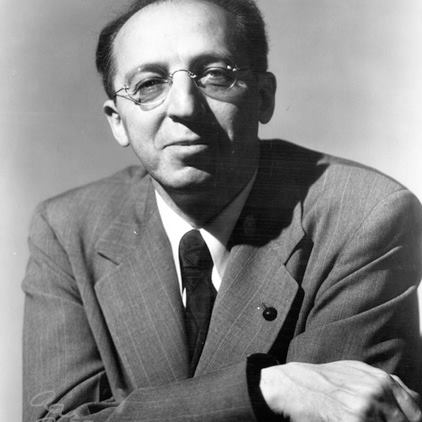
A Cinematic Birthday Cake for Aaron Copland
If you want to work in Hollywood, you’ve got to expect once in a while somebody’s going to mess with your things – even if you’re a Pulitzer Prize winner, lauded as the “Dean of American composers.”
Aaron Copland was not very happy when his music for “The Heiress” was chopped to ribbons, dialed down and rescored without his approval.
This week on “Picture Perfect,” on Copland’s birthday anniversary, we’ll hear a suite from “The Heiress,” with the main title music restored by Arnold Freed in 1990 to what the composer originally intended.
William Wyler (“Wuthering Heights,” “Friendly Persuasion,” “The Big Country,” “Ben-Hur”) was a brilliant director, but he had a tin ear. His films consistently sported the best scores of their era, and yet he mostly underappreciated, if not outright disliked them.
“The Heiress” was made fresh off Wyler’s runaway success with “The Best Years of Our Lives.” The film, based on Henry James’ “Washington Square,” was nominated for eight Academy Awards, winning four, including Oscars for Olivia De Havilland and for Copland’s score, which is so strong it manages to maintain its integrity despite all of the studio tinkering.
Wyler insisted Copland work the song “Plaisir d’amour” into the fabric of his music, which he artfully did in three cues. But that wasn’t good enough. Without his knowledge, the main title was replaced with a garish arrangement of “Plaisir,” which was also looped in for some of the love music. André Previn, in 1949 already one of Hollywood’s bright young talents, likened the return of Copland’s original thoughts following the interpolations to “suddenly finding a diamond in a can of Heinz beans.”
When Copland’s contribution was recognized by the Academy, it was the only instance up to that time of a score being honored after being shorn of its main title, the part of a score that generally makes the biggest impression. Copland never bothered to collect his award. “The Heiress” would be the last time he would work in Hollywood.
He did compose one more film score, however, for the 1961 independent film, “Something Wild,” which contains some of his most insistently non-commercial music. Occasionally brutal and often thrilling, its character is worlds away from the pastoral tranquility of “Appalachian Spring.” It’s a brilliant piece of work, yet it did not receive a commercial release until 2003.
Copland’s music for “Our Town” and “The Red Pony” is fairly well-known, thanks to the widely performed and recorded concert suites. We’ll focus on lesser-heard music from “The Heiress” and “Something Wild,” as well as from the controversial pro-Soviet film “The North Star,” and even a little bit from the 1939 World’s Fair documentary “The City.”
It’s a cinematic birthday cake for Aaron Copland, on “Picture Perfect,” music for the movies, now in syndication on KWAX, the radio station of the University of Oregon!
——–
Clip and save the start times for all three of my recorded shows:
PICTURE PERFECT, the movie music show – Friday at 8:00 PM EST/5:00 PM PST
SWEETNESS AND LIGHT, the light music program – Saturday at 11:00 AM EST/8:00 AM PST
THE LOST CHORD, unusual and neglected rep – Saturday at 7:00 PM EST/4:00 PM PST
Stream them, wherever you are, at the link!
https://kwax.uoregon.edu/ -

Sherlock Holmes Movie Music Picture Perfect
The game is afoot! This week on “Picture Perfect,” it’s an hour of music from movies inspired by the world’s greatest detective.
“Sherlock Holmes” (2009) stars Robert Downey Jr. and Jude Law, in Michael Ritchie’s post-“Matrix” take on the master detective. While some of the film adaptations over the years may have glossed over the character’s physicality, Ritchie’s revisionist Holmes perhaps errs a mite too far in the other direction. Hans Zimmer (whose birthday it is today) wrote the music, he too going against received wisdom, and in the process coming up with one of his more interesting scores, if only for the quirky instrumentation, which includes a Hungarian cimbalom, accordion, fiddles, and a broken-down pub piano.
Admittedly, it’s unfair to put Zimmer up against an old pro like Miklós Rózsa. Rózsa wrote the music for Billy Wilder’s melancholy portrait of the great detective, “The Private Life of Sherlock Holmes” (1970). Wilder requested that the composer adapt his lovely Violin Concerto for the project, a recording of which the director had listened to repeatedly during the writing of the screenplay. Rózsa and Wilder had previously collaborated on “Double Indemnity” and “The Lost Weekend.”
The Sherlock Holmes comedy “Without a Clue” (1988) represents a missed opportunity of sorts. The hope had been for Sean Connery to play Watson opposite Michael Caine’s Holmes, a much-longed-for reunion between the two, who had worked so well together in “The Man Who Would Be King.” In the end, it was Ben Kingsley who assumed the role.
The fun conceit that sets “Without a Clue” apart is that Holmes is the fictional creation of mastermind Watson, who is in reality the gifted crime-solver. By way of necessity, Watson hires a second-rate actor to play the part of Holmes. Of course, the actor turns out to be a bumbling idiot. Henry Mancini provides the British Light Music style score, with a nod to Edward White’s “Puffin’ Billy” (familiar stateside as the theme to “Captain Kangaroo”).
Finally, the Steven Spielberg-produced “Young Sherlock Holmes” (1985) offers a conjectural origins story, including Holmes and Watson’s first meeting as teenagers (ignoring the particulars laid out by Arthur Conan Doyle in his stories, with Watson already a war veteran who had served in Afghanistan). It’s all for fun, though it’s unfortunate the filmmakers felt the need to interject ‘80s-style special effects, rather than simply trust in the inherent magic of the subject matter. “Young Sherlock Holmes” features the first photorealistic, fully computer-generated character (a stained-glass knight). Also, some Indiana Jones B-movie antics involving an Egyptian cult seem especially out of place.
Interestingly, the film’s screenwriter, Chris Columbus, went on to direct the first two Harry Potter films. By my recollection, “Young Sherlock Holmes,” with its boarding school setting, has some of that same feel.
The music, by Bruce Broughton, is certainly buoyant and beautiful, in the best John Williams tradition. Broughton scored a handful of big screen hits, notably “Silverado” and “Tombstone,” though arguably it is in the medium of television that he’s made his greatest impact. Thus far, his work has been recognized with a record 10 Grammy Awards.
It’s elementary, my dear Watson. I hope you’ll join me for “Picture Perfect,” music for the movies, now in syndication on KWAX, the radio station of the University of Oregon!
Clip and save the start times for all three of my recorded shows:
PICTURE PERFECT, the movie music show – Friday at 8:00 PM EDT/5:00 PM PDT
SWEETNESS AND LIGHT, the light music program – Saturday at 11:00 AM EDT/8:00 AM PDT
THE LOST CHORD, unusual and neglected rep – Saturday at 7:00 PM EDT/4:00 PM PDT
Stream them, wherever you are, at the link!
-
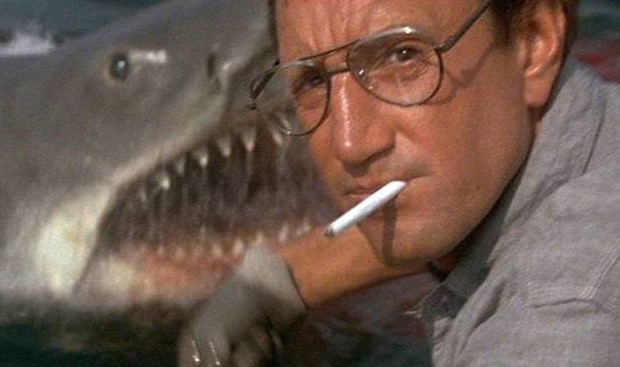
Jaws at 50 Dive into Aquatic Movie Music
Just when you thought it was safe to go back in the water, this week on “Picture Perfect,” we mark the 50th anniversary of “Jaws.”
“Jaws” opened on June 20, 1975. The film’s balance of terror, wit and adventure, with a perfectly-calibrated trio of central characters and a young Steven Spielberg eager to please, propelled it to unprecedented box office glory, the first film to glide past the $100 million mark. Needless to say, the studios sat up and took notice. “Jaws” is widely credited as having laid the foundation for what became recognized as the summer blockbuster season. When it was surpassed by “Star Wars” two years later, there was no looking back. With so much chum in the water, the shareholders went into a frenzy and everyone wanted a bite.
Given the film’s ultimate influence on the industry, with superheroes and computer animation long dominating the year’s major releases in a quest for ever-higher profits, it seems only proper now to honor “Jaws” with an hour of aquatic traumas.
“Beneath the 12-Mile Reef” (1953) stars Robert Wagner, Terry Moore, and Peter Graves in a Romeo and Juliet story about two families of competing fishermen along the Gulf coast of Florida, one working class and of Greek origin, and the other a family of privileged WASPs. Gilbert Roland is the Greek patriarch who runs afoul of an improbably large octopus. Bernard Herrmann wrote the music, which employs no fewer than nine harps (one for each arm, and a spare).
A young Henry Mancini was one of three composers to work on “Creature from the Black Lagoon” (1954). Mancini, soon to be world famous for “Moon River,” “Baby Elephant Walk,” and “The Pink Panther,” was teamed with veteran film composer Hans J. Salter and Herman Stein. None of the three were credited on screen – typical of what was then considered just another low-budget B-movie.
What can I say about John Williams’ masterful music for “Jaws” (1975)? It’s right up there with “Psycho” and “The Good, the Bad and the Ugly,” in terms of most recognized and most frequently parodied. Everyone remembers the primal shark theme, but what is sometimes overlooked is that “Jaws” is also one of the great adventure scores, the music effortlessly navigating the choppy waters of suspense, horror, and seafaring swashbuckler. The composer was recognized with a richly-deserved Academy Award (his second of five).
The conflict in “The Swimmer” (1968) is not a giant octopus, nor a great white shark, nor a prehistoric gill man, but rather the progressive psychological breakdown of an upper middle class Connecticut man who believes he’s living the American Dream.
Adapted from a short story by John Cheever, “The Swimmer” stars Burt Lancaster as the man, who acts on a quixotic impulse to travel all the way home, across county, by way of a network of suburban swimming pools. The adventure starts out well enough, with Lancaster and everyone he encounters full of optimism and fun; but the further he moves along his allegorical journey, the more the enterprise, the climate, and the people begin to grow cold.
“The Swimmer” is a decidedly downbeat tale which could make the viewer as reluctant to dip a toe into a chlorinated in-ground swimming pool as the shark-infested waters of Peter Benchley’s Amity Beach. The score is by Marvin Hamlisch, of all people, and it suits the film brilliantly.
Better stick to the bath. Dreams of aquatic refreshment are all wet this week, on “Picture Perfect,” music for the movies, now in syndication on KWAX, the radio station of the University of Oregon!
Clip and save the start times for all three of my recorded shows:
PICTURE PERFECT, the movie music show – Friday at 8:00 PM EDT/5:00 PM PDT
SWEETNESS AND LIGHT, the light music program – Saturday at 11:00 AM EDT/8:00 AM PDT
THE LOST CHORD, unusual and neglected rep – Saturday at 7:00 PM EDT/4:00 PM PDT
Stream them, wherever you are, at the link!
Tag Cloud
Aaron Copland (94) Beethoven (95) Composer (114) Film Music (149) Film Score (143) Film Scores (255) Halloween (97) John Williams (197) KWAX (232) Leonard Bernstein (105) Marlboro Music Festival (125) Movie Music (164) Mozart (91) Opera (215) Philadelphia Orchestra (90) Picture Perfect (174) Princeton Symphony Orchestra (110) Radio (90) Ross Amico (244) Roy's Tie-Dye Sci-Fi Corner (290) The Classical Network (101) The Lost Chord (269) Vaughan Williams (107) WPRB (397) WWFM (881)