
March is Early Music Month. While the concept may seem somewhat remote from the world of film music, this week on “Picture Perfect,” we’ll set the Wayback Machine and enjoy four scores that employ melodies and modes of the Middle Ages.
We’ll hear selections from “Becket” (1964), by Laurence Rosenthal. In the film, based on a play by Jean Anouilh, Richard Burton plays the Archbishop of Canterbury, and Peter O’Toole, King Henry II. The music is reliant on chant, with a quotation from the familiar Gregorian melody “Dies Irae” (“Day of Wrath”), occurring fairly early in the action.
Then we’ll hear music from “The Hunchback of Notre Dame” (1939), by Alfred Newman. This time based on a novel – “Notre Dame de Paris,” by Victor Hugo – the film features Maureen O’Hara as Esmeralda and Charles Laughton as Quasimodo, with Cedric Hardwicke, Thomas Mitchell, Edmond O’Brien, and Harry Davenport in the supporting cast. The project was one of nine scored by Newman that year, which many historians regard as Hollywood’s finest. Again, the composer evokes the era through sacred choral passages and secular dances.
“The Warlord” (1965) starring Charlton Heston, Richard Boone, and Rosemary Forsyth, is the tale a knight who falls in love with a peasant woman, and in order to keep her, claims his right of “droit du seigneur” – his prerogative to spend the first night with any bride among his serfs. Unfortunately, she falls in love with him, and all hell breaks loose.
It was an unusual project for the composer, Jerome Moross, who is best-known for the kind of breezy Americana sound employed in his best-known music, that for “The Big Country.” Here, he evokes the 11th century with an underscore that, again, finds inspiration in authentic music of the era.
Finally, we’ll turn to “The Lion in Winter” (1965), adapted from a play by James Goldman, an historical drama set at the Christmas court of Henry II – again, as in “Becket,” played by Peter O’Toole. Henry spars with his estranged wife, the temporarily paroled Eleanor of Aquitaine (played by Katherine Hepburn), in a familial power struggle, which also involves their three sons, played by Anthony Hopkins, John Castle, and Nigel Terry. Timothy Dalton appears as Philip II of France.
The film was the winner of three Academy Awards, including one for Best Original Score. The composer was John Barry. Yet again the music is steeped in that of the Middle Ages, yet given a distinctly modern twist.
Plentiful intrigue and funny haircuts are guaranteed. However, there’s nothing Middling about the music. Film composers make history, on “Picture Perfect,” music for the movies, now in syndication on KWAX Classical Oregon!
——–
Clip and save the start times for all three of my recorded shows:
PICTURE PERFECT, the movie music show – Friday at 8:00 PM EST/5:00 PM PST
SWEETNESS AND LIGHT, the light music program – Saturday at 11:00 AM EST/8:00 AM PST
THE LOST CHORD, unusual and neglected rep – Saturday at 7:00 PM EST/4:00 PM PST
Stream them, wherever you are, at the link!
https://kwax.uoregon.edu
Tag: Movie Music
-
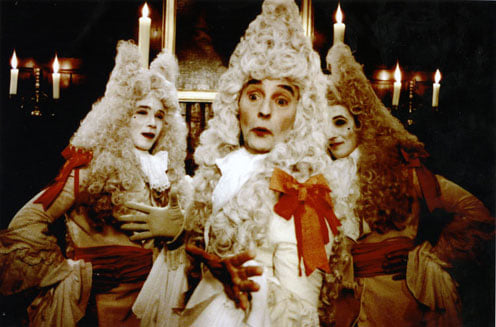
Cinematic Beauty Patches on “Picture Perfect”
Beauty patches are back!
This week on “Picture Perfect,” it’s an hour of lace and licentiousness, with music from movies set during the reign of Charles II.
“Restoration” (1995) features quite the cast, with a pre-“Iron Man” Robert Downey, Jr. as a young doctor torn between duty and debauchery. He succumbs to the latter at the court of Charles, played by Sam Neill, before finding redemption as he battles the Great Plague and braves the Fire of London. The film also stars David Thewlis, Polly Walker, Meg Ryan, Ian McKellen, and Hugh Grant. The main title of James Newtown Howard’s score takes its impetus from Henry Purcell’s “The Fairy Queen.” And indeed there are baroque inflections throughout.
George Sanders plays Charles in “The King’s Thief” (1955). Edmund Purdom is a highwayman who pilfers an incriminating book from David Niven. An aristocratic schemer, Niven will stop at nothing to get it back. The swashbuckling score is by Miklós Rózsa.
I don’t recall Charles making an appearance in “The Draughtsman’s Contract” (1982), Peter Greenaway’s saucy, though strangely aloof, Restoration opus. However, there is plenty of licentiousness and an abundance of outlandish wigs. And, it being a Greenaway film, it is certainly strange in more ways than one. Michael Nyman’s score puts a minimalist spin on baroque sources.
Finally, “Forever Amber” (1947) is based on a then-scandalous novel by Kathleen Winsor, about an ambitious young woman’s rise through the bedchambers of the Royal Court. The film was directed by Otto Preminger. Linda Darnell is Amber. Once again, George Sanders plays Charles, eight years before reprising the role for “The King’s Thief.” Cornel Wilde, Richard Greene, and Jessica Tandy are also in the cast. Philadelphia-born composer David Raksin, he of “Laura” fame, plays fast and loose with music of the era.
Bwoo-hoo-hoo-hoo! It’s so naughty! Everyone, giggle into your handkerchiefs and wear ribbons on your shoes. We’ll be powdering our faces and going heavy on the rouge, on “Picture Perfect,” music for the movies, now in syndication on KWAX Classical Oregon!
——–
Clip and save the start times for all three of my recorded shows:
PICTURE PERFECT, the movie music show – Friday at 8:00 PM EST/5:00 PM PST
SWEETNESS AND LIGHT, the light music program – Saturday at 11:00 AM EST/8:00 AM PST
THE LOST CHORD, unusual and neglected rep – Saturday at 7:00 PM EST/4:00 PM PST
Stream them, wherever you are, at the link!
https://kwax.uoregon.edu -
Music Propels the Action on “Picture Perfect”
This week on “Picture Perfect,” we take flight with music from movies about airports and airplanes.
In the original “Airport” (1970), producer Irwin Allen established the prototype for disaster movies of all stripes by placing an all-star, aging cast in spectacular peril. Burt Lancaster! Dean Martin! George Kennedy! Jean Seberg! Jacqueline Bisset! Helen Hayes! The list goes on and on, longer than the longest runway. The bongo-laden theme is by veteran film composer Alfred Newman,” from the last of his over 200 scores.
Another movie with something of the same feel is “The V.I.P.s” (1963), allegedly inspired by the real-life love-triangle of Vivien Leigh, Laurence Olivier, and Peter Finch. The story is set at London Heathrow Airport, where flights are delayed because of a dense fog. The film was written by Terrence Rattigan and the parts cast from another laundry list of stars, including Elizabeth Taylor, Richard Burton, Louis Jourdan, Maggie Smith, Rod Taylor, and Orson Welles, with Margaret Rutherford in an Academy Award-winning performance. The music is by Miklós Rózsa.
By contrast, Steven Spielberg’s “The Terminal” (2004) is an (intentionally) comic take on the predicament of a hapless Eastern European who finds himself in a kind limbo, trapped in an international arrivals terminal in New York, after his country erupts into civil war, so that his passport and other documentation are no longer valid. His plight mirrors that of real-life Mehran Karimi Nasseri, an Iranian who lived for 17 years in a terminal at Charles de Gaulle Airport.
Tom Hanks plays the unfortunate traveler, who makes the terminal his home, and Catherine Zeta-Jones the airline attendant with whom he strikes up a relationship. The music is by regular Spielberg collaborator John Williams (whose 94th birthday it is on Sunday), and I think you’ll find it quite different from the Williams known for his work on “Star Wars” and “Indiana Jones.”
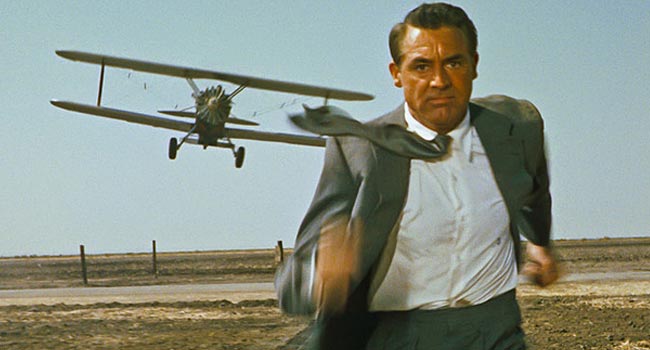
Finally, we’ll turn to the Alfred Hitchcock thriller “North by Northwest” (1959), a film in which Cary Grant encounters love and danger in, on, and from a variety of planes, trains, and automobiles. Planes are particularly significant. During the course of the film, it’s revealed that the title is in reference to a Northwest Airlines flight; Eve Kendall (Eva Marie Saint) must do all she can to avoid getting on a plane with Phillip Vandamm (James Mason); and of course, Roger Thornhill (Grant) flees from a strafing crop duster. Bernard Herrmann’s opening fandango propels us into the adventure.
FUN FACT: The film’s most iconic scene (pictured) is actually played without music.
Rush more to Rushmore! Music propels the action on “Picture Perfect,” music for the movies, now in syndication on KWAX Classical Oregon!
——–
Clip and save the start times for all three of my recorded shows:
PICTURE PERFECT, the movie music show – Friday at 8:00 PM EST/5:00 PM PST
SWEETNESS AND LIGHT, the light music program – Saturday at 11:00 AM EST/8:00 AM PST
THE LOST CHORD, unusual and neglected rep – Saturday at 7:00 PM EST/4:00 PM PST
Stream them, wherever you are, at the link!
https://kwax.uoregon.edu -

Fantastic Adventures in the 18th Century on “Sweetness and Light”
The Enlightenment isn’t exactly remembered for its flights of fancy. If the odd novel embraced a fantastic tone, it was frequently in the service of satire, an entertaining means to send-up contemporary mores and pursuits or to mock authority figures and good old reliable human frailty. This week on “Picture Perfect,” we’ll explore a few of these fantastic adventures of the 18th century.
“The Surprising Adventures of Baron Munchausen” (1785) pokes fun at one Hieronymus Karl Friedrich, Freiherr von Münchhausen, a German nobleman and veteran of the Russo-Turkish War, whose reputation for telling outrageous tall tales is lampooned by Rudolf Erich Raspe. Raspe, looking to avoid a libel suit, published the work anonymously, with the result that it was commonly believed that the Baron actually dictated the tales himself. Naturally, the real-life Munchausen was upset by the unwanted attention. Thanks to Raspe, his very name came to be associated with feigned illness and pathological lying.
The book has been adapted to film several times, beginning with a silent version by Georges Méliès, all the way back in 1911. We’ll be listening to music from two subsequent adaptations. The first, “Münchhausen” (1943), is undeniably entertaining and exceptionally well-made. However, undermining one’s enjoyment is a sense of unease in the knowledge that the film was a pet project of Joseph Goebbels, who wanted to celebrate the 25th anniversary of the UFA film studio by producing a lavish spectacle worthy to stand toe-to-toe with foreign efforts like “The Wizard of Oz” and “The Thief of Bagdad.”
Considering the source, one would have to look awfully hard to come up with anything resembling Nazi propaganda. The entire exercise comes across as a pastoral escape from the horrors of totalitarianism, total war, and the Final Solution. The elegant music, by Georg Haentzschel, would not be out of place in the concert hall. Haentzschel is regarded as perhaps the last representative of a generation of Middle European light music composers.
More than 40 years later, director Terry Gilliam undertook another production design-driven adaptation that resembles nothing if not a series of Doré illustrations brought to life. Contrary to received wisdom, “The Adventures of Baron Munchausen” (1988) managed to pull in a respectable amount of per-screen capital. The film was a casualty of a management turnover at Columbia Pictures, with the new regime eager to bury the projects of the old. Hence, it was never seen theatrically beyond a very limited release. The score, by Michael Kamen, while in a romantic heroic style, wittily contains abundant allusions to music of the 18th century.
“The Manuscript Found in Saragossa” (1805) is a transitional work, with its ecstatically lurid opening chapter – replete with gypsy storytellers, highwaymen, dueling skeletons, lesbian vampires, and a couple of corpses dangling in a gibbet – dragging the Enlightenment kicking and screaming into the Romantic age. It starts out as a masterpiece of surrealism, by way of Gothic convention, but the spell is eventually broken, sadly, by a large, cold bucket of Enlightenment water, in the form of a perfectly rational explanation at the end. But until then, the author, Jan Potocki, gets an A for effort. The interlocking structure, with stories inside stories inside stories looks ahead to postmodern experiments by writers like Italo Calvino and John Barth, to say nothing of Jorge Luis Borges.
The book was made into an acclaimed Polish film, “The Saragossa Manuscript,” in 1965. Its cult status led to a restoration financed by Jerry Garcia, Martin Scorsese, and Francis Ford Coppola that was released on VHS and DVD in 2001.
Who else could provide the perfect soundtrack to such a hallucinogenic experience but Krzysztof Penderecki? Penderecki intersperses spooky passages with neo-classical and baroque interludes.
Finally, we’ll hear music from one of the many adaptations of Jonathan Swift’s “Gulliver’s Travels” (1726). “The Three Worlds of Gulliver” (1960) simplifies the book’s narrative and dispenses with a great deal of the misanthropic humor in favor of children’s fantasy. You won’t catch Gulliver extinguishing a fire in the Lilliputian Emperor’s palace with his urine in this version. What you will find is a good deal of technical wizardry and a delightful score by Bernard Herrmann.
What, you doubt my veracity? Then surely the music must speak for itself. Join me for fantastic adventures in the 18th century, now in syndication on KWAX Classical Oregon!
——–
Clip and save the start times for all three of my recorded shows:
PICTURE PERFECT, the movie music show – Friday at 8:00 PM EST/5:00 PM PST
SWEETNESS AND LIGHT, the light music program – Saturday at 11:00 AM EST/8:00 AM PST
THE LOST CHORD, unusual and neglected rep – Saturday at 7:00 PM EST/4:00 PM PST
Stream them, wherever you are, at the link!
https://kwax.uoregon.edu
——–
PHOTO: A fancy flight with Baron Munchausen -

Bustin’ Out of the Joint on “Picture Perfect”
This week on “Picture Perfect,” get yourself free. It’s an hour of music from movies about prison breaks.
Indomitable Steve McQueen does hard time on Devil’s Island in “Papillon” (Jerry Goldsmith); Paul Newman sticks it to The Man in “Cool Hand Luke” (Lalo Schifrin); Tim Robbins makes good use of a Rita Hayworth poster in “The Shawshank Redemption” (Thomas Newman); and an all-star cast, led by a barbed-wire hopping McQueen, flee their Nazi captors in “The Great Escape” (Elmer Bernstein).
Let’s face it, nobody looks good in orange. Grab a shank and a file. We’re bustin’ out of the joint, on “Picture Perfect,” music for the movies, now in syndication on KWAX Classical Oregon!
——–
Clip and save the start times for all three of my recorded shows:
PICTURE PERFECT, the movie music show – Friday at 8:00 PM EST/5:00 PM PST
SWEETNESS AND LIGHT, the light music program – Saturday at 11:00 AM EST/8:00 AM PST
THE LOST CHORD, unusual and neglected rep – Saturday at 7:00 PM EST/4:00 PM PST
Stream them, wherever you are, at the link!
https://kwax.uoregon.edu
Tag Cloud
Aaron Copland (94) Beethoven (95) Composer (114) Film Music (149) Film Score (143) Film Scores (255) Halloween (97) John Williams (197) KWAX (232) Leonard Bernstein (105) Marlboro Music Festival (125) Movie Music (164) Mozart (91) Opera (215) Philadelphia Orchestra (90) Picture Perfect (174) Princeton Symphony Orchestra (110) Radio (90) Ross Amico (244) Roy's Tie-Dye Sci-Fi Corner (290) The Classical Network (101) The Lost Chord (269) Vaughan Williams (107) WPRB (397) WWFM (881)