Tag: Obituary

  • Peter Schickele, P.D.Q. Bach Creator, Dies

    Peter Schickele, P.D.Q. Bach Creator, Dies

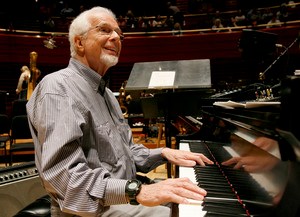
    Composer and parodist Peter Schickele has died.

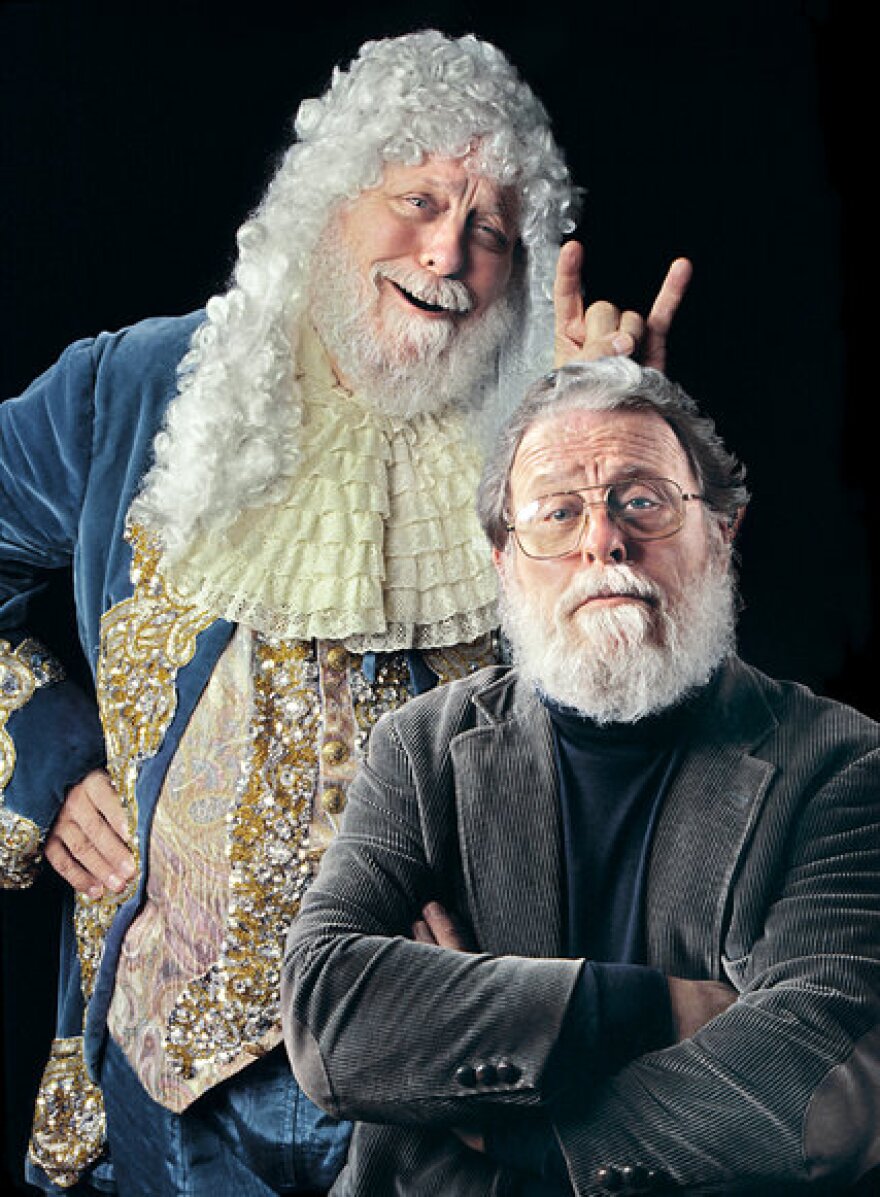
    Schickele was best known for his “discovery” of P.D.Q. Bach, whom he slyly promoted as the last and least of Johann Sebastian Bach’s progeny – “the 21st of Bach’s 20 children.” P.D.Q.’s manuscripts invariably turned up in the most undignified of places (leaky-ceilinged castles, the bottoms of bird cages, and as coffee maker filters). The music was introduced in performance and on record by “Professor” Peter Schickele, an equally amusing, unreliable source. The combination entertained for more than 50 years, a veritable automat of freewheeling parody, excruciating puns, and good old-fashioned, pie-in-the-face slapstick.

    Some of the gags flirted with tedium, but there was always a diamond or two in the rough. If nothing else, you could always count on Schickele’s Jekyll-and-Hyde act to skewer the solemn conventions of classical music.

    Frustratingly, his comic success undermined Schickele the “serious” composer. He studied with two of America’s most respected symphonists, Roy Harris and Vincent Persichetti. Under his own name, he produced over 100 works. These could be wildly pluralistic in nature, drawing on folk, jazz, blues, or rock influences. A number of his contemporaries pursued similar impulses (William Bolcom, for one, and it didn’t keep him from winning a Pulitzer), but Schickele never escaped the long shadow of low humor. Which is a shame, as his music is ceaselessly vital, conveying exuberance, invention, and a kind of genial wit.

    Schickele also wrote scores for film (“Silent Running”) and songs for Broadway (“O Calcutta!”). For 15 years, he hosted his own syndicated radio show, “Schickele Mix.”

    I interviewed him once and met him at a concert at the College of New Jersey in 2014. By that time, he was no longer swinging onto stage by a rope, as he did at Carnegie Hall. Instead, his comic creations were executed by others as he oversaw the shenanigans like something of a dignified lion – albeit a wry lion – providing commentary by way of brief and informal exchanges with Wayne Heisler, TCNJ Associate Professor of Historical and Cultural Studies in Music.

    P.D.Q. was classical music’s most prolific dad joke, perpetrating groaners like “No-No Nonette,” “Unbegun Symphony,” and “Pervertimento for Bagpipe, Bicycle and Balloons.”

    An obituary in the New York Times encapsulates it very well: “In creating P.D.Q.’s oeuvre and putting it onstage, Mr. Schickele cannily deconstructed the classical music of Mozart’s time and just as cannily reassembled it in precisely the wrong configuration.”

    It was humor that could engage on two levels, appealing to anyone who ever laughed at someone slipping on banana peel, but also to those who understood the enormity of his musical crimes.

    He was rewarded with five Grammy Awards (one for him, and four for P.D.Q.) and by audiences full of chortling fans for over five decades.

    Schickele died on Tuesday at the age of 88 – coincidentally the number of keys on a short-tempered clavier.

    R.I.P.


    On “The Tonight Show”

    With Itzhak Perlman and John Williams

    Part 1

    Part 2

    In better definition, and still entering on a rope in Houston in his 70s

    Playing it straight: Quartet for Clarinet, Violin, Cello and Piano

    String Quartet No. 1 “American Dreams,” etc.

    Joan Baez sings Schickele in “Silent Running”

    The composer interviewed by Bruce Duffie

    https://www.bruceduffie.com/schickele.html

  • Alice Parker Celebrated Choral Composer Dies

    Alice Parker Celebrated Choral Composer Dies

    In eulogizing composer Ron Nelson and hornist Hermann Baumann earlier today, I failed to notice Alice Parker has also died. Parker, the eminent choral composer, director, and teacher, wrote more than 500 arrangements and original compositions. With her music in the repertoire of churches and choral societies everywhere, she was one of the most frequently performed and heard of contemporary composers, with weekly auditors in the thousands.

    A native New Englander, Parker largely ignored contemporary trends in composition, instead often drawing inspiration from folk music and hymn tunes. As a composer for voice, she was also attracted to poetry. Her musical output was enormous. Among her original works were 11 song-cycles, 11 works for chorus and orchestra, 33 cantatas, 47 choral suites, and more than 40 hymns. She also composed four operas and authored at least five books.

    Parker saw music as a unifying force. Her final work, “On the Common Ground,” completed in 2020, was an appeal to a country deeply divided by politics and values.

    “Beauty awakens the sense, in us, of our vulnerability as human beings,” she commented in 2017. “It’s why you feel like crying when you see a gorgeous sunset, or hear a Bach solo cello suite, or a gorgeous melody, or a little kid singing.”

    “When we sing something perfectly lovely together… and it really clicks, you have this marvelous feeling of brotherhood in the room,” she stated elsewhere. “We are all human beings. We are all feeling this emotion together at the same time. And this is uniting us. We are not separate.”

    Parker died on Christmas Eve. She was 98 years-old.

    I borrowed some of this information from an appreciation in today’s Washington Post.

    https://www.washingtonpost.com/obituaries/2023/12/29/alice-parker-composer-choral-dies/

  • Remembering Ron Nelson and Hermann Baumann

    Remembering Ron Nelson and Hermann Baumann

    On January 2, I breathe a sigh of relief, as things are poised to settle down. Glancing over my shoulder at the past two or three weeks, I really don’t know how I made it through the holidays. I’m aware that there’s real suffering in the world, and by comparison I am very lucky, and I should just suck it up, but for me sustained frenzy is not the true meaning of Christmas! I need some quiet. So I’ll keep the tree up a while longer and build in some time for reflection and maybe listen to some of the music I never got around to enjoying during the month of December.

    Sadly, two prominent musicians will not have that luxury, as neither made it through the holidays for real.

    I suppose, like many, I first encountered Ron Nelson’s music in Howard Hanson’s classic Mercury recording of his “Savannah River Holiday.”

    His sarabande “For Katherine in April” is also quite lovely.

    Those who played in wind bands may have broader familiarity with his work, because of pieces like “Rocky Point Holiday.”

    Leonard Slatkin once described him as “the quintessential American composer,” noting his “ability to move between conservative and newer styles with ease. The fact that he’s a little hard to categorize is what makes him so interesting.”

    I was just thinking about Nelson the other day, believe it or not, probably because of his birthday (which fell on December 14). I can’t imagine I was thinking of him on Christmas Eve, the day of his passing.

    Nelson was 94 years-old.

    We also lost legendary hornist Hermann Baumann. I know it’s terrible to say, but I confess I assumed Baumann died long ago. I remember an on-air announcement on Philadelphia’s WFLN that he had suffered a paralyzing stroke – and WFLN has been off the air since 1997!

    But apparently he recovered sufficiently to resume performing and teaching. Good for him. I have no idea whether or not he was able to attain his former excellence. An often disorienting effect of recordings is that we are exposed to the same performances again and again, as if the artists are preserved in amber. So it’s especially shocking when the illusion is shattered and suddenly we realize how much they have aged or even passed away. For those of us still spinning records from decades ago, these artists exist forever in their prime.

    Baumann’s recordings have given me much pleasure over the years. I find it interesting that he began his career as a singer and a jazz drummer, before switching to the French horn at the age of 17. He certainly made up for lost time, as he landed principal positions with several German orchestras over a period of about 12 years.

    He began his solo career in 1964 – a bold move, as how many horn concertos are there, next to those written for the piano and the violin? But Baumann was also a prolific chamber music artist. In addition, he was a pioneer in performance of music from the Baroque and Classical eras on the natural horn, a valveless instrument.

    Baumann died on December 29. He was 89 years-old.

    The holidays are a time we should be counting our blessings. R.I.P., gentlemen, and thanks for all the music.


    Baumann, seemingly of able body, talking about singing and the French horn

    Playing Bach on the natural horn

    A selection from Beethoven’s Sextet for 2 Horns and String Quartet

    A selection from Strauss’ Horn Concerto No. 1

    Ron Nelson interview with Bruce Duffie

    https://www.bruceduffie.com/ronnelson.html

  • Remembering Peter Nero Philly Pops Legend

    Remembering Peter Nero Philly Pops Legend

    This Nero didn’t play as Philly burned.

    Peter Nero, who conducted the Philly Pops for 34 years, is dead. At the orchestra’s founding in 1979, it was Nero’s intention to take on Arthur Fiedler and the Boston Pops. For decades, Boston had been ensconced as the very model of a modern major pops orchestra. With a touch of hubris, Nero stated at the time, “I’d like to beat the pants off them.” Granted, by then, Fiedler was tottering into the homestretch of a 50-year career as Boston’s music director. Nevertheless, the pants stayed on. Nero left the Philly Pops in 2013, when the orchestra could no longer afford his salary.

    A multifaceted musician, Nero started out as a piano prodigy. He earned the respect of no less than Vladimir Horowitz, and Roy Charles would cite him as one of his favorite pianists, alongside Art Tatum.

    It was hearing Tatum that changed the course of Nero’s life. He fell in love with jazz and determined not to be pigeonholed, instead embracing and often combining music from a variety of genres. His enthusiasms would carry him from piano competitions to smoky jazz clubs to posh concert halls to open-air band stands before audiences numbering in the thousands.

    He performed “Rhapsody in Blue” with Paul Whiteman, who had introduced the piece with George Gershwin at the piano. Nero was celebrated as a premier interpreter of Gershwin’s music.

    His first album for RCA, “Piano Forte” (1961), was a hit, earning him a Grammy for Best New Artist. The next year, he would garner another, for Best Performance by an Orchestra or Instrumentalist with Orchestra – Primarily Not Jazz or for Dancing (what a cumbersomely named category!), for “The Colorful Peter Nero.” He would be nominated ten more times.

    In all, he released 67 albums. His instrumental version of Michel Legrand’s “Summer of ‘42” became a million best seller. He appeared on “The Ed Sullivan Show” 11 times, and made numerous appearances on “The Tonight Show” with Johnny Carson. He also worked with Frank Sinatra, Mel Tormé, Andy Williams, Dizzy Gillespie, Diane Schuur, Johnny Mathis, Roger Kellaway, Elton John, and his bête noire, Arthur Fiedler.

    In the 1970s, Nero’s focus shifted to conducting and composing. He performed up to a hundred concerts a year, often at the piano, playing with one hand, while conducting the orchestra with the other.

    He wrote a cantata after Anne Frank’s “The Diary of a Young Girl.” It’s said to have been the first musical treatment of the material, and the work embraced rock, symphonic, and traditional Jewish music. He conducted the piece in several cities, including with the Greater Trenton Symphony in 1973.

    During his decades with the Philly Pops, Nero made his home in Media, PA. The orchestra’s repertoire was a mix of orchestral arrangements of popular jazz, swing, Broadway, and blues, with a smattering of light classical.

    His departure from Philly was not an amicable one. Even then, in 2013, the Philly Pops was experiencing choppy waters. The orchestra filed for bankruptcy and asked Nero to take a salary cut. Nero declined.

    The orchestra continues to struggle. The 2022-23 season was a particularly dramatic chapter in its turbulent history. But that’s for another post, one I don’t particularly feel like writing!

    Intriguingly, following the death of Marvin Hamlisch in 2012, it was revealed that the latter was poised to take over the orchestra’s reins. David Charles Abell was named principal conductor and music director in 2020.

    In the 1990s, Nero served concurrently as Pops Music Director of the Florida Philharmonic Orchestra. He also played with his jazz trio. Post-Philly, Nero returned to concertizing with his longtime bassist, Michael Barnett.

    At the time of his death, he was 89-years-old. R.I.P.


    Nero plays “Rhapsody in Blue” with Fielder and the Boston Pops

    “Fiddler of the Roof” on “The Ed Sullivan Show”

    “Tea for Two” (for three)

    Million-selling “Summer of ’42”

    “Rocky” at Independence Hall

    “Rhapsody in Blue” in Philly

  • David Fetler Orchestra Leader Dies at 96

    David Fetler Orchestra Leader Dies at 96

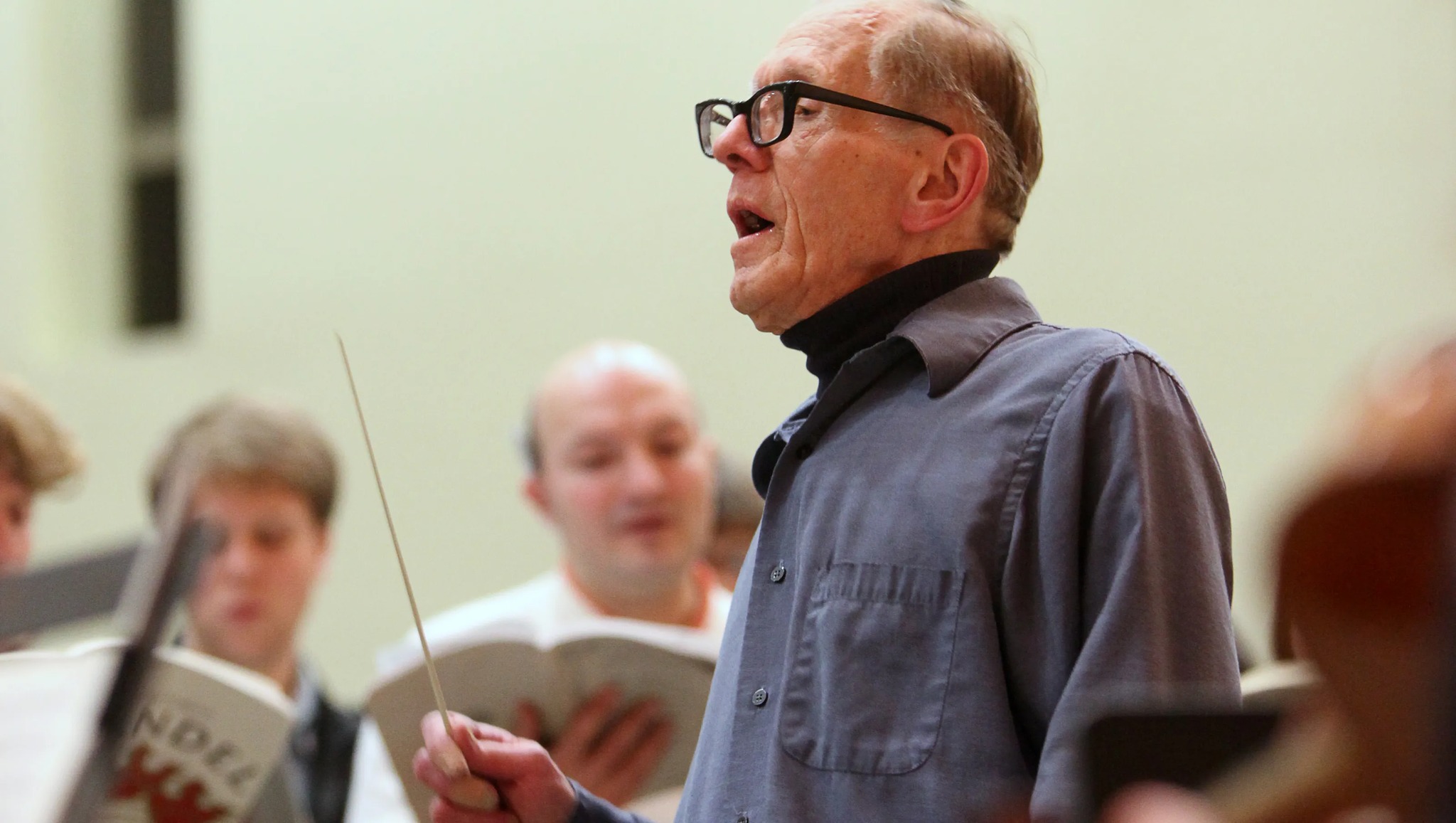
    David Fetler, alleged to be America’s longest-serving music director of an orchestra, has died. Fetler directed the Rochester Chamber Orchestra for over 50 years, surpassing Arthur Fiedler’s record of 49 with the Boston Pops. (On the world stage, there have been longer.)

    Fetler was born in Riga, Latvia, the tenth of a family of thirteen children. He came to the United States at the age of 12. He studied at Juilliard, Westminster Choir College in Princeton, and the Eastman School of Music in Rochester, NY, as well as with conductors Pierre Monteux and Leopold Stokowski.

    His available recordings are few, but I recognized his named immediately from a lovely album of Howard Hanson’s music. Fetler conducted the premiere of Hanson’s ballet “Nymphs and Satyr” (1979). I’ve always been especially fond of the infectious scherzo, based on a melody the composer whistled to his Irish terrier, Molly, while feeding her biscuits. Hanson, best known for his Symphony No. 2, the “Romantic,” served as the Eastman School’s director for 40 years, beginning in 1924.

    From the same album, here’s Fetler’s recording of Hanson’s Concerto for Organ, Harp and Strings (1926):

    It was Hanson who invited Fetler to join the conducting faculty in Rochester. In that capacity, Fetler presented a wide variety of instrumental and choral music with the Eastman Collegium Chamber Orchestra and Singers. Fetler’s programs frequently juxtaposed composers from different eras and included plenty of new music.

    He founded the Rochester Chamber Orchestra with musicians from the Rochester Philharmonic. Also written for the group was David Diamond’s “Lilac Festival Overture.”

    He also founded and conducted Rochester’s Greece Symphony Orchestra. For many years, he was choral director at St. Paul’s Episcopal Church.

    Fetler died on Sunday. He was 96 years-old.

Tag Cloud

Aaron Copland (92) Beethoven (95) Composer (114) Film Music (123) Film Score (143) Film Scores (255) Halloween (94) John Williams (187) KWAX (229) Leonard Bernstein (101) Marlboro Music Festival (125) Movie Music (138) Opera (202) Philadelphia Orchestra (89) Picture Perfect (174) Princeton Symphony Orchestra (106) Radio (87) Ralph Vaughan Williams (85) Ross Amico (244) Roy's Tie-Dye Sci-Fi Corner (290) The Classical Network (101) The Lost Chord (268) Vaughan Williams (103) WPRB (396) WWFM (881)

DON’T MISS A BEAT

Receive a weekly digest every Sunday at noon by signing up here


RECENT POSTS