Tag: Pianist

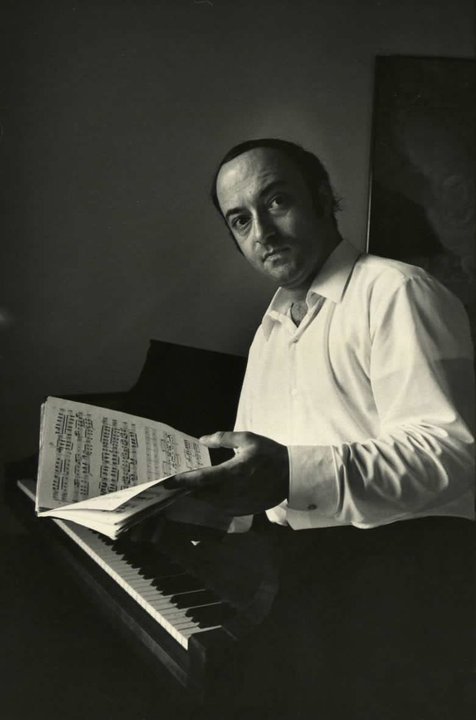
  • José Iturbi Hollywood’s Forgotten Maestro

    José Iturbi Hollywood’s Forgotten Maestro

    In my Leopold Stokowski post on April 18, I wondered (not for the first time) what the hell happened to my country. This was while reflecting on how classical music, while perhaps never entirely mainstream, was once heard and recognized by the populace, and the most celebrated musicians were household names. Toscanini, Paderewski, Caruso, Paganini. Some of these were already in the grave, but thanks to radio and cinema, in the 1940s, they were names everyone knew. The sextet from “Lucia” was familiar enough that it could be parodied. A lot. Then came television, which continued to keep everyone culturally literate, or at least aware. For a few decades, anyway.

    At a point, José Iturbi entered the conversation, in a comment beneath my post, with a lament that today he is nearly forgotten. Which is probably true, except for classic movie buffs. But wouldn’t you know it, just a few months ago, Sony Classical reissued Iturbi’s recordings made for the RCA label.

    Here’s a post I wrote in 2015 on Iturbi and how classical music was once an expected – and accepted – part of our culture. I’ve included a link to the new Iturbi set at the very end.


    Once again, you’ve got to love the Golden Age of Hollywood. In terms of music, movies from that era just seemed so… inclusive.

    On the one hand, you could have crooner Rudy Vallée acting in Preston Sturges comedies (and not singing a note); on the other, you could have Leopold Stokowski shaking hands with Mickey Mouse. There seemed to be a wider acceptance of musicians of all stripes as equally valid entertainers, and an assumption that the general public would understand (or at least not be put off by) a line of dialogue about Delius or Sibelius. When the Three Stooges weren’t flipping fruit into opera singers’ mouths, that is.

    This is especially fascinating when viewed from the perspective of the present, when seemingly the bar is set lower and lower all the time, with everyone racing to the lowest common denominator so as not to seem too pointy-headed. Wouldn’t it make sense that people of any era would want to aspire to be more? That they would want to be led, represented and entertained by the most talented, most intelligent people? It’s a very strange world we live in.

    José Iturbi (1895-1980) was one of the seemingly unlikely cinematic superstars of the 1940s. Like Oscar Levant, Iturbi was a serious pianist. In the ‘20s, he had made a name for himself as a barnstorming virtuoso who toured Europe, Asia, Africa and South America. He made his North American debut with the Philadelphia Orchestra under Stokowski.

    Eventually, he made the transition to conducting, which had long been his dream. He led the great symphony orchestras of Philadelphia and New York, the London Symphony, the orchestra of La Scala Milan, and the Concertgebouw Orchestra of Amsterdam. He would serve as music director of the Rochester Philharmonic.

    Iturbi generally played himself in Hollywood musicals, including “Thousands Cheer” (1943), “Anchors Away” (1945) and especially “Three Daring Daughters” (1948), in which he was actually the lead.

    For all his talent and charisma, however, Iturbi was always churning up controversy, making provocative remarks and losing his temper. Ironically, for a musician who owed so much of his fame to his absorption into popular culture, he made a big hullabaloo about appearing on concert programs that included both classical and popular music. It wasn’t popular music he objected to, particularly; it was the mixing of the two. This is especially puzzling from a pianist who studied at the Valencia and Paris Conservatories, yet played jazz and boogie-woogie in innumerable film shorts.

    His private life was equally turbulent, perhaps even more so, with tragic results. His wife died of accidental poisoning. He sued his daughter, claiming she was an unfit mother to his grandchildren. The daughter later committed suicide.

    Iturbi could be a brilliant pianist, though he sometimes drew criticism that he was diluting his talents through his involvement with Hollywood, and a number of his concerto recordings, which he conducted himself from the keyboard, don’t really seem to take flight. Even so, there are gems among his recorded repertoire, and the part he played in keeping classical music in the mainstream is to be lauded.

    It’s a vine that is now severely withered. I wonder if Luciano Pavarotti’s “Yes, Giorgio” (1982) was the last in the line of dubious movies featuring great classical musicians.


    Iturbi in “Holiday in Mexico” (1946)

    Insane take on Liszt’s “Hungarian Rhapsody No. 2” from “Anchors Aweigh” (1945)

    Iturbi plays Mozart with his sister, while conducting the Rochester Philharmonic, in 1946

    Iturbi plays Albeniz, Granados and Navarro, from 1933

    Oscar Levant in “The Barkleys of Broadway” (1949)

    Lauritz Melchior with Esther Williams and Van Johnson in “Thrill of a Romance” (1945)

    “Unfaithfully Yours” (1948): “No one handles Handel like you handle Handel!”

    The Three Stooges, “Voices of Spring,” and “Lucia di Lammermoor” in “Micro-Phonies” (1945)

    https://www.youtube.com/watch?v=l6HSu6I8hBg

    The pie fight from “Yes, Giorgio” (1982)

    Website of the José Iturbi Foundation

    https://www.joseiturbifoundation.org/index.php

    Recent Iturbi box set

    The Rediscovered RCA Victor Recordings / José Iturbi


    PHOTO: Iturbi accompanying the MGM lion
  • Happy 80th Birthday Daniel Barenboim

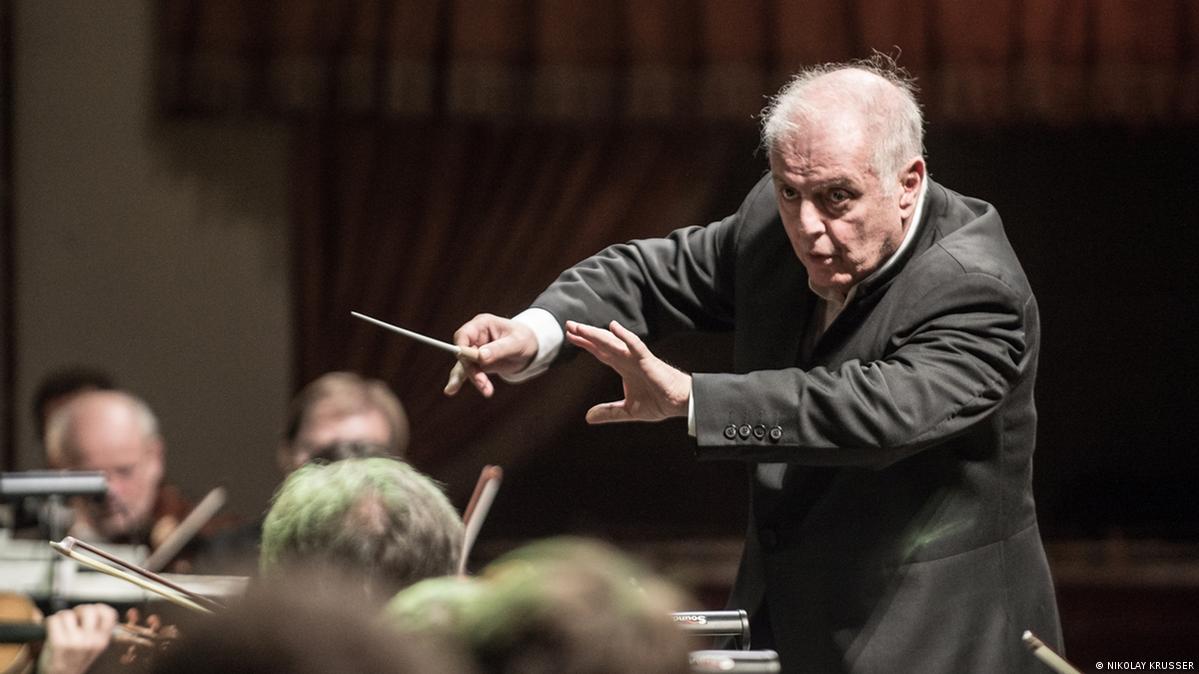
    Happy 80th Birthday Daniel Barenboim

    Pianist, conductor, and humanitarian Daniel Barenboim is 80 today. Only within the past weeks did Barenboim announce that he would have to scale back on his concertizing, due to health reasons (citing a “serious neurological condition”). Let’s hope the hiatus is merely temporary.

    Happy birthday, Maestro. Get well soon, and many happy returns!


    Barenboim at 12 (playing Scarlatti, Chopin, and Kabalevsky)

    Superstar “Trout” Quintet, with Barenboim, Itzhak Perlman, Pinchas Zukerman, Jacqueline du Pré, and Zubin Mehta (on the double bass!)

    Playing Mendelssohn’s “Songs without Words,” complete

    With Jackie, off the cuff – and on the piano

    https://www.youtube.com/watch?v=ZOok22pCErM

    Barenboim plays Beethoven

    Barenboim conducts Bruckner

    “Tristan und Isolde,” complete

    https://www.youtube.com/watch?v=IdjFBW-S3z0

    Encores at Carnegie Hall, with the West-Eastern Divan Orchestra

    https://www.youtube.com/watch?v=L1uBLxEmes4

  • Remembering Pianist Michael Ponti

    Remembering Pianist Michael Ponti

    Back in the day when the big labels recorded standard repertoire and not much else, Michael Ponti was like a seismic disturbance.

    Now the volcano has gone quiet. Ponti died on Monday at the age of 84.

    Sure, Ponti recorded Beethoven and Scarlatti and Tchaikovsky and Rachmaninoff. But he will always be dearest to my heart for the material he exhumed for his groundbreaking, barnstorming Romantic Piano Concerto series on Vox.

    Predating by decades a similar venture on the Hyperion label, Ponti showed what he was made of, in a time before digital trickery. AND he did it all himself. (The Hyperion series draws on a bullpen of capable pianists.)

    The orchestras that accompanied him could be a little rough-and-ready, but often, in its way, this just made the recordings all the more thrilling. In at least one of the concertos, Ponti, caught up in his own bravura, starts doubling the orchestra and adds a flourish or two to the coda. I still return to the series (reissued as seven double-compact discs), with my personal favorites including piano concertos by Anton Rubinstein, Josef Rheinberger, Christian Sinding, Joachim Raff, and Sergei Lyapunov. Also on Vox, Ponti broke more than a few lances for the solo piano works of Carl Tausig and Charles-Valentin Alkan.

    Somehow, he was never picked up by a major label – a rare exception being a recording he made with Dietrich Fischer-Dieskau of the songs of Charles Ives for Deutsche Grammophon – but he did enjoy an active career, especially in Europe. He appeared with such conductors as Sir Georg Solti, Wolfgang Sawallisch, Stanislaw Skrowaczewski, Kirill Kondrashin, and Kurt Masur, and performed in some of the world’s great concert venues, including Carnegie Hall, the Sydney Opera House, and the Teatro Colón.

    He also formed, with violinist Robert Zimansky and cellist Jan Polasek, the Ponti-Zymansky-Polasek Trio (from a marketing standpoint, perhaps not the catchiest name).

    In his 60s, calamity struck, when he suffered a massive stroke. But he was able to revive his career somewhat by drawing from the vast catalogue of music composed for the left hand.

    In all, he made over 80 recordings, most of them for Vox. For some reason, perhaps because he was recorded on smaller labels, often paired with minor league orchestras, he was often overlooked in surveys of important pianists. He is conspicuously absent, for instance, from New York Times critic Harold C. Schonberg’s bestseller “The Great Pianists.”

    Ponti was also a baseball fanatic, who possessed an encyclopedic knowledge of the sport. I saw a picture of him being interviewed later in life, and there are baseball books stacked all the way up the side of his couch. This obituary does a great job of a putting a human face on a super-virtuoso.

    https://www.legacy.com/us/obituaries/washingtonpost/name/michael-ponti-obituary?id=36842554

    It’s a shame Hyperion Records wasn’t around in the ‘60s and ‘70s, because Ponti could eat fire with the best of them. He played with greater Romantic temperament than most of the pianists in the latter’s Romantic Piano Concerto series (again, no relation to the Vox set).

    Admittedly, Ponti’s recordings weren’t always as polished as those in the top tier. I get the impression that, unlike with the majors, there was no room in the budget for retakes or first-class orchestras. These days, when even the most modest professional orchestras are crammed with hungry graduates of the world’s top conservatories, Ponti would mop the floor with much of the competition. He had talent and exuberance to burn.


    Michael Ponti talks to David Dubal, now host of WWFM – The Classical Network’s “The Piano Matters”

    Josef Rheinberger, Piano Concerto in A-flat major

    Joachim Raff, Piano Concerto in C minor

    IN CONCERT: Franz Liszt, “12 Transcendental Etudes”

  • Nyiregyházi: Lost Genius of the Silver Screen

    In “The Beast with Five Fingers” (1946), Peter Lorre plays an unstable musicologist, haunted by the disembodied hand of a murdered pianist, which exhibits a marked predilection for Brahms’ arrangement of Bach’s “Chaconne.”

    Max Steiner, who is said to have studied piano with Brahms as a child, makes the “Chaconne” the basis of his score, to the extent of orchestrating it for several key sequences. I fail to mention, Brahms wrote the piece for left hand alone. Get it?

    It’s possible the piano is played on the film’s soundtrack by Victor Aller, the brother-in-law of Felix Slatkin (that is, Leonard Slatkin’s uncle). But many sources also credit Ervin Nyiregyházi.

    I venture to guess, you are probably unfamiliar with Nyiregyházi, and perhaps even more so at a loss as to how to pronounce his name. (It’s said kind of like “Nyeer-edge-ha-zee.”)

    Nyiregyházi was a child prodigy, born in Budapest in 1903. He studied with Ernő Dohnanyi and Frederic Lamond, a pupil of Franz Liszt. At 15, he played Liszt’s Piano Concerto No. 2 with the Berlin Philharmonic, conducted by Arthur Nikisch. His Carnegie Hall debut two years later drew mixed reviews, with critics lauding his “brilliant technical equipment,” “originality” and “white heat of sincerity, conviction of faith,” but notably less enthusiastic about his “erratic” conceptions and “arbitrary disregard of the obvious intentions of the great composers.”

    Oh, please. Nyiregyházi was obviously a pianist in the great Romantic tradition. Parallels have been drawn between his technique and that of the great Liszt himself.

    No less than Arnold Schoenberg, high priest of dodecaphonic music, who philosophically disagreed with many of the pianist’s interpretive choices, fairly gushed about him in a letter to Otto Klemperer: “What he plays is expression in the older sense of the word…. The sound he brings out of the piano is unheard of… although he appears to be a man of intelligence and not just some flaccid dreamer…. Such fullness of tone I have never encountered before…. One never senses that it is difficult, that it is technique – no, it is simply a power of the will, capable of soaring over all imaginable difficulties in the realization of an idea.”

    Unfortunately, Nyiregyházi was hobbled by a traumatic childhood. That he hated his mother is no understatement. (As a result of her coddling, he literally did not know how to tie his own shoes.) Whether or not she was the underlying cause of his lack of confidence, I leave it for others to divine, but by his early 20s, he started to self-combust.

    First, he sued his concert manager, alleging that he was being treated as an inferior artist. Nyiregyházi lost the suit, which led to his being blackballed in the industry. On some level, his lashing out was likely a reflection of his own insecurity. He avoided playing the standard repertoire out of fear of being compared to other pianists. By the time Schoenberg heard him, he was nearing a dead end.

    Nyiregyházi would marry ten times. One of his wives attacked him with a knife; he divorced another because she yawned during one of his concerts. He lived most of his life in poverty, and was reduced to sleeping in subway stations and on park benches.

    In 1928, at the age of 25, with six dollars in his pocket, he moved to Los Angeles. There he found work playing piano reductions of film scores. Eventually, he worked as a hand double in movies like “A Song to Remember” (the Chopin biopic starring Cornel Wilde), “Song of Love” (about the Schumanns and Johannes Brahms, with Katharine Hepburn, Paul Henreid, and Robert Walker – and Henry Daniell as Liszt), and possibly “The Beast with Five Fingers.”

    But Nyiregyházi was bad with finances, had taken to drink, and had little clue how to manage his own career. In 1946, he appeared in concert wearing a black hood and billed himself as “Mr. X – Masked Pianist.” It’s said that he didn’t own a piano for 40 years.

    Late in life he reemerged, both in concerts and on studio recordings. By that point, he was in his 70s, and critics were still divided, praising him on the one hand as “Franz Liszt reincarnated,” and on the other deriding him as “slipshod” and “amateurish.”

    He declined a lucrative offer to return to Carnegie Hall. Instead, his last concerts were given in Japan. He died of cancer in L.A. in 1987 at the age of 84.

    Among his own original compositions (he composed over a thousand) were works with titles like “Goetz Versus the Punks,” “It’s Nice to be Soused,” “Shotgun Wedding,” and “Vanishing Hope.”

    Tormented and self-destructive, Nyiregyházi nevertheless earned many notable fans, including Bela Lugosi, Gloria Swanson, Jack Dempsey, Theodore Dreiser, Rudolf Valentino, and Harry Houdini.

    He made some Ampico piano rolls in the 1920s, and as mentioned, some studio recordings 50 years later. But the latter were made at the far end of a rough life. Beyond anything he may have done for the movies, there were no recordings made when Nyiregyházi would have been in his prime. Written accounts of his concerts and critical discernment of his technique, filtering out the imperfections of those late records, offer frustrating glimpses of what might have been.

    If you’re interested to learn more about this most eccentric pianist, there was a book written about him in 2007, “Lost Genius: The Curious and Tragic Story of a Musical Prodigy,” by Kevin Bazzana.

    In the meantime, you’ll find more – much more, and sufficiently lurid – here:

    THE FALL AND RISE OF ERVIN NYIREGYHAZI, L.A.’s SKID ROW PIANIST

    1924 piano roll of Franz Liszt’s Transcendental Etude No. 4 in D minor, “Mazeppa”

    “Nyiregyházi Plays Liszt,” from 1974

    1978 Canadian Television documentary

    “The Beast with Five Fingers” trailer

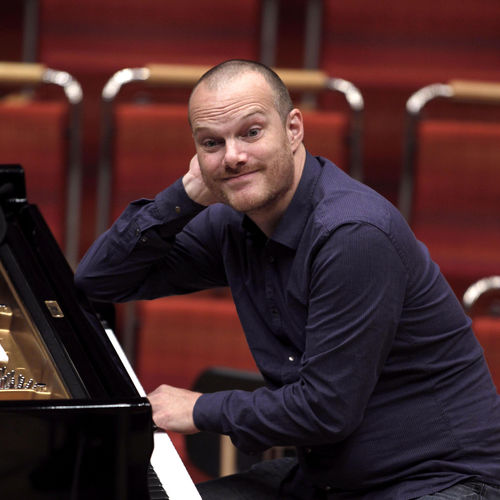
  • Lars Vogt, Pianist & Conductor, Dies at 51

    Lars Vogt, Pianist & Conductor, Dies at 51

    Cancer has claimed the pianist Lars Vogt.

    At what should have been middle age, Vogt was also in the process of branching out into conducting. He served as music director of the Royal Northern Sinfonia from 2015. In 2020, he took up the directorship of the Paris Chamber Orchestra. In June, his contract there was extended through 2025.

    Vogt received his diagnosis in February 2021. Sad enough for such a talented musician to be cut down in the prime of life – he was only 51 years-old – but he also leaves behind a wife and three children.

    The courage and optimism he conveyed in interviews over the past 18 months is to be admired. R.I.P.


    Vogt plays Beethoven, beautifully

    With a poignant Brahms encore

    Vogt singles out the solace to be found in Brahms, following his diagnosis, here

    The Time Remaining

Tag Cloud

Aaron Copland (92) Beethoven (95) Composer (114) Film Music (123) Film Score (143) Film Scores (255) Halloween (94) John Williams (187) KWAX (229) Leonard Bernstein (101) Marlboro Music Festival (125) Movie Music (138) Opera (202) Philadelphia Orchestra (89) Picture Perfect (174) Princeton Symphony Orchestra (106) Radio (87) Ralph Vaughan Williams (85) Ross Amico (244) Roy's Tie-Dye Sci-Fi Corner (290) The Classical Network (101) The Lost Chord (268) Vaughan Williams (103) WPRB (396) WWFM (881)

DON’T MISS A BEAT

Receive a weekly digest every Sunday at noon by signing up here


RECENT POSTS