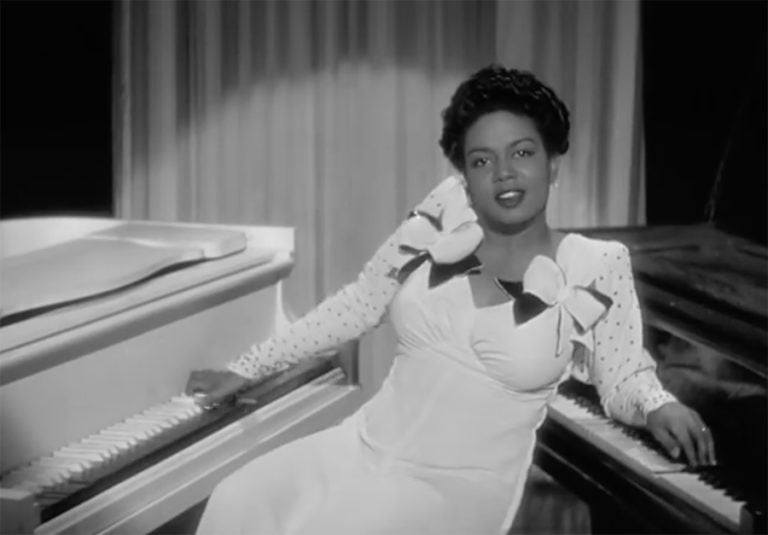
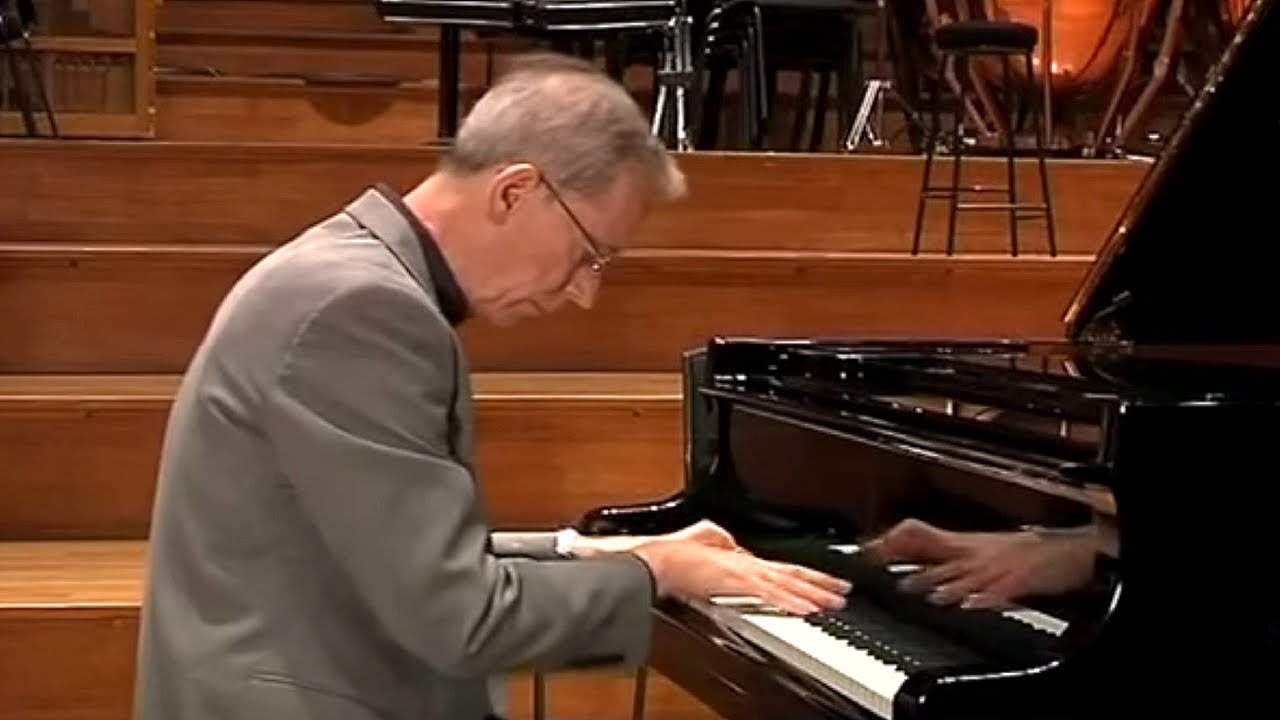
In 1950, Juilliard-trained pianist Hazel Scott became the first Black American to host her own television show. A born performer, she excelled in jazz, blues, boogie-woogie, ballads, Broadway, and classical music. It was by “swinging the classics” that she first achieved fame.
Unusual for any performer in Hollywood, she had complete control over her image and music. She always spoke up, and she never backed down. When she criticized the House Un-American Activities Committee, doors began to close. Happily, she was able to reinvent herself with a glorious third act in Paris.
You’ll find lots of great footage in this fascinating 20-minute documentary:
Scott swings Liszt:
Scott stops the show, playing black and white grand pianos, in “The Heat’s On” (1943):
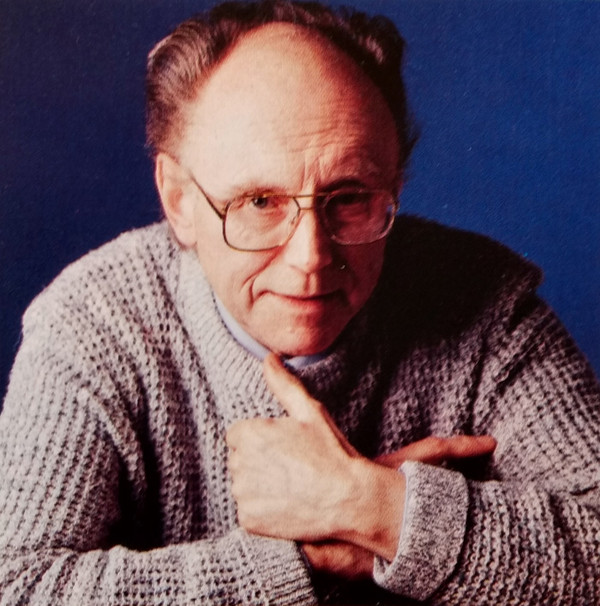
So sorry to learn of the death of Eric Parkin, one of Chandos Records’ stable of pianists. As such, Parkin recorded much English music. In particular, I have him to thank for introducing me to Billy Mayerl, sometimes described as the English Gershwin. What fun, joyous music his is!
Parkin also did much to champion the works of Sir Arnold Bax, John Ireland, and E.J. Moeran, alongside those of many others in even greater need of championing.
I can’t believe he was 96 years-old at the time of his death. I guess many of the recordings I’ve been listening to all these years were made 30-35 years ago. His performances have given me countless hours of pleasure.
R.I.P., Eric Parkin, and thank you for making my world a brighter place!
Perhaps appropriate for the Halloween season, Eric Parkin performs Billy Mayerl’s transcription of Guy Desslyn’s “The Pompous Gremlin”:
Personally, I prefer Mayerl’s “Bats in the Belfry,” but I can’t find Parkin’s recording online.
Parkin performed John Ireland’s Piano Concerto on several of his numerous appearances at the BBC Proms. The second movement is especially beautiful. Or at least I find it so. And the last movement is suitably jaunty.
Interestingly, the third movement seems to recall Ravel’s Concerto in G, written at approximately the same time, though Ravel’s concerto didn’t appear until after Ireland’s had already been published. Ireland did meet Ravel once in Paris. Could he have seen the score?
The work was dedicated to Helen Perkin (one letter off from Parkin!), a pianist Ireland happened to be sweet on. Unfortunately, the attraction was not reciprocated. But no one can fault Ireland for not trying. The slow movement of his concerto contains an allusion to Perkin’s own “Phantasy String Quartet,” though she described it as “more a reminiscence than an exact quotation.”
Earlier, Ireland had been in attendance as Perkin played Prokofiev’s Third Piano Concerto. So in that case, yes, he was definitely “borrowing.” You can hear the influence especially at the very end of his piece.
But all of this is getting very far away from Eric Parkin. I hope you will enjoy his recording of Ireland’s concerto.
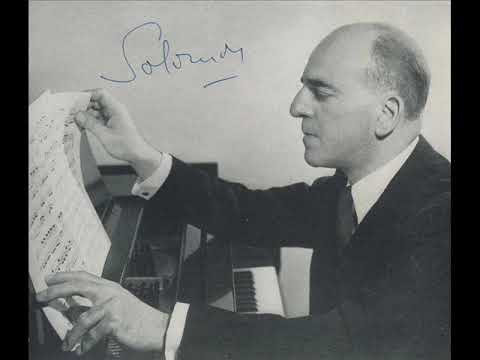
While no doubt wise, this is really Solomon the poet. Solomon of the Song of Songs.
Solomon Cutner was one of those rare classical musicians to be recognized by a single name. A child prodigy who studied with Mathilde Verne, herself a pupil of Clara Schumann, Solomon made his London debut at the age of eight. Verne pushed him hard – perhaps too hard – so that at nine, he was playing Beethoven’s Piano Concerto No. 3 and Liszt’s “Hungarian Fantasy.” At twelve, he appeared on no less than six Prom concerts, as soloist in concertos by, among others, Grieg and Tchaikovsky. The concertos of Schumann and Brahms followed.
Eventually, Verne’s motives were called into question. As the head of her own piano school, she stood to profit from the boy’s preternatural success. However, the relentless pace drove Solomon to exhaustion, anxiety, and a nervous breakdown. Once his five-year contract with her expired, he refused to have any contact with her ever again. In his 70s, he would reflect on how miserable his childhood had been.
Simon Rumschinsky, a pupil of Theodor Leschetizky, helped Solomon to rebuild his technique – and his confidence – so that he was able to pursue further studies in Paris and relaunch his adult career. Solomon’s acclaimed recitals took him far from his native London, to the United States, Australia, South Africa, South America, and Japan. Perhaps he never totally shook the specter of Verne, since he continued to practice for eight or nine hours a day.
Solomon gave the world premiere of Sir Arthur Bliss’ Piano Concerto at Carnegie Hall in 1939 (on the same program that introduced Vaughan Williams’ “Five Variants of Dives and Lazarus” and Sir Arnold Bax’s Symphony No. 7). The concert was presented in conjunction with “British Week” at the New York World’s Fair. He also entertained British troops throughout World War II, in such far-flung locations as North Africa, Palestine, India, Singapore, and Bangkok.
As an interpreter, he was particularly renowned for his Beethoven. Sadly, while in the midst of recording a complete cycle of the sonatas, in 1956, he suffered a stroke that deprived him of the use of his right arm. Though he lived another 32 years, Solomon never recorded or performed in public again. For a pianist who died as recently as 1988, it’s sobering to reflect, little of his repertoire was documented in stereo.
Broadly speaking, Solomon’s was a non-interventionist approach. It was his desire not to place himself too much between the composer and the audience. Therefore, his interpretations can sometimes come across as having more polish than personality. But at his best, he was a great poet of the keyboard.
Here, Solomon performs possibly my favorite Beethoven piano sonata, and an appropriate one, I think, for a late-summer afternoon. I’ve always been particularly fond of the exquisite third movement.
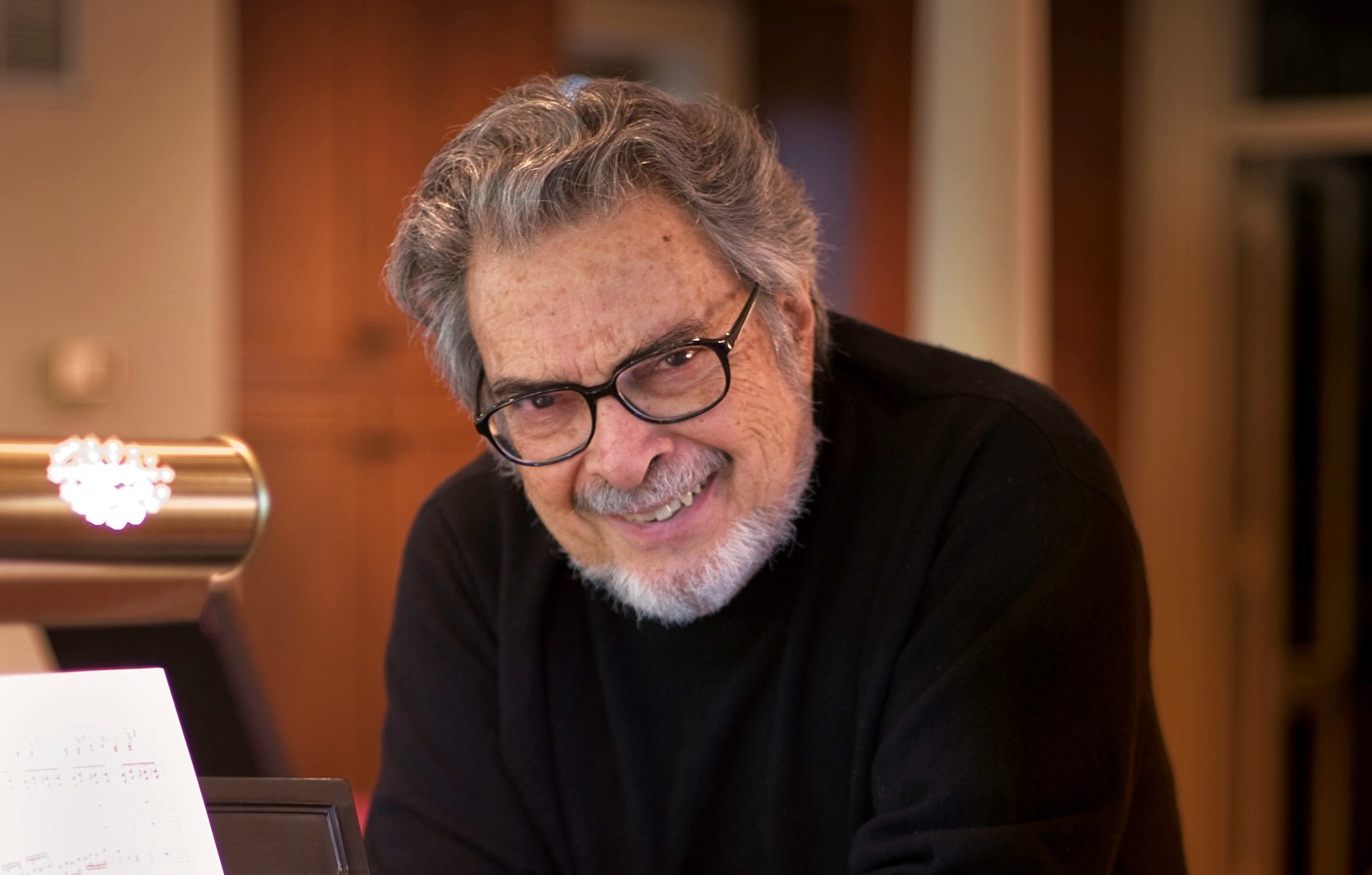
The word legend gets bandied a lot at times like these, but rarely has it been so completely deserved. Leon Fleisher has died at 92. He leaves us not only as one of the greatest pianists of his time, but also as one of the greatest all-around artists. The man exuded music, and he did so with genuine humility and unusual generosity.
Fleisher’s career as an interpreter of the standard, two-handed repertoire may have been cut short by focal dystonia at the age of 37 – by the mid-1960s, it had caused two of his fingers on his right hand to curl into his palm – but already he had distinguished himself as a lion of the keyboard. His prowess as a young man is preserved in benchmark recordings of works by Brahms, Beethoven, Rachmaninoff, and others.
But even with his dexterity diminished, Fleisher’s intelligence remained unimpaired. His recordings of music for the left hand alone, again, are some of the finest in existence. By the late ‘60s, he also turned to conducting – he became associate conductor of the Baltimore Symphony Orchestra and music director in Annapolis – but it was his generous spirit as a teacher that perhaps best reflected the man. Fleisher taught at the Peabody Institute since 1959. He also had ties to the Curtis Institute, the Royal Conservatory of Music in Toronto, and the Tanglewood Music Center, and he oversaw countless master classes.
He himself had been a pupil of Artur Schnabel, who had been a student of Theodor Leschetizky, who in turn had studied with Carl Czerny, who had learned directly from Beethoven. And Fleisher gave as good as he got. His benign influence sent off tendrils that now circle the globe. In his life’s work, Fleisher realized Schnabel’s maxim, that music came first, piano second.
As a performer, whenever Fleisher came near a piano in the middle of his career, it was to champion music for the left hand. Fortunately, the repertoire is substantial, and Fleisher added to it, as composers flocked to write new pieces for him.
Then, three decades after he was forced to give it up, suddenly he resumed performance of the two-handed repertoire, to an extent, thanks to Botox injections. He went on to record several more acclaimed albums, of both left-hand and two-handed works, later in life.
I had the privilege to hear him perform several times, including at the East Coast premiere of Paul Hindemith’s “Piano Music with Orchestra” at Philadelphia’s Kimmel Center for the Performing Arts. The work was written for Paul Wittgenstein, of Ravel concerto fame, who had lost his right arm during the First World War. Wittgenstein, who had somewhat conservative tastes, never played Hindemith’s concerto publicly, but it remained in his possession and was rediscovered, among his widow’s belongings, in a Pennsylvania farm house only in 2002! Fleisher gave the world premiere of the work, with the Berlin Philharmonic, in 2004.
Our delayed face-to-face meeting occurred several years after we had chatted by telephone. An earlier attempt had been thwarted by illness, but we finally got to shake hands and say hello following a recital at the Kimmel’s Perleman Theater. For a figure of his stature, you couldn’t have found a humbler, nicer man. At the time of our earlier interview, in 1987, when I called at the appointed hour, Fleisher – the legend – was only just driving home from work at Peabody, and he couldn’t have been more apologetic. The man who had studied with Schnabel, who at 16 was proclaimed by Pierre Monteux “the pianistic find of the century,” the artist who fearlessly collaborated with George Szell in some of the most revered music in the entire repertoire, was sorry to be late for our interview. Clearly, he was a person who put on no airs.
But judge for yourself. Here’s the raw audio of that interview, which came to pass about a half hour later. The occasion was the release of his new album of left-hand piano works, “All the Things You Are,” on the Bridge Records, Inc., that remains one of the finest of his later years. Keep in mind that the conversation would be edited into sequence for use, with musical interludes, on my Sunday night program, “The Lost Chord.”
Needless to say, I am very sorry to be cut off by COVID-19 from access to WWFM – The Classical Network’s production studios, or I would re-edit this material for a posthumous tribute.
Leon Fleisher was one of the most genuine people I ever met, totally without pretense – a great artist, yes, but also a gracious and lovely man.
Fleisher plays Beethoven with Szell and the Cleveland Orchestra:
Erich Wolfgang Korngold, “Suite for 2 Violins, Cello, and Piano Left-Hand;” the fourth movement “Lied,” about 25 minutes in, must be one of the loveliest things I’ve ever heard:
The West Coast premiere of Hindemith’s “Klaviermusik mit Orchester” (for piano left-hand):
Brahms’ left-hand arrangement of the Bach “Chaconne”:
PHOTOS (counterclockwise from top): Leon Fleisher; with Artur Schnabel; with George Szell; and with Classic Ross Amico
Sad day for fans of Nikolai Medtner. One of his great champions, Hamish Milne, has died.
Medtner was a good friend of Sergei Rachmaninoff. Both artists emerged from the same piano class at the Moscow Conservatory. Rachmaninoff was a lifelong advocate of Medtner’s music. Though undeniably Rach was the more successful of the two, Medtner developed a reputation as something of a pianist’s pianist.
In fact, Rachmaninoff believed wholeheartedly in his friend’s superior talent. He once described him as “the greatest composer of our time.” Rach dedicated his Piano Concerto No. 4 to Medtner. Medtner returned the kindness by dedicating his own Piano Concerto No. 2 to Rachmaninoff. He also provided emotional support for Rach during his frequent periods of self-doubt.
Medtner made another important friend in Jayachamarajendra Wadiyar Bahadur, twenty-fifth Maharaja of the Kingdom of Mysore. Bahadur founded a Medtner Society in London to record all of the composer’s works.
Milne did his very best to carry on the tradition. A glance at his discography reveals an obvious preference for Medtner’s music. In addition, he recorded underplayed gems by Anatoly Alexandrov, William Sterndale Bennett, Ferruccio Busoni, Hermann Goetz, Sergei Lyapunov, Julius Reubke, Carl Maria von Weber, and Haydn Wood. He was the first pianist to set down a comprehensive survey of Medtner’s music since the composer’s own recordings, released all the way back in the 78 era.