Tag: Racism

  • “The Mikado,” Racism, and a Radio Legend

    “The Mikado,” Racism, and a Radio Legend

    As a disturbing addendum to yesterday’s post about “The Mikado,” written in honor of Sir Arthur Sullivan’s birthday: the same friend with whom I enjoyed a volley of favorite Gilbert & Sullivan YouTube videos last week wrote overnight to remind me that, in the case of Ko-Ko the Lord High Executioner’s famous “list” song – in which he catalogues those “society offenders who never would be missed” – absent from modern productions is the line, “There’s the n***** serenader and others of his race… I’ve got them on the list!”

    I remember, even after the lyric had been altered, as it had been by the time of the D’Oyly Carte Opera Company recording through which I first encountered the work when I was in high school, to “the banjo serenader and others of his race,” that I found it curiously jangling. What race could possibly be meant? Sure, “The Mikado” was written in 1885, when everyone would have been familiar with minstrel shows and the songs of Stephen Foster, with all their banjo strumming, but even a hundred years later, as a teenager, I knew precisely.

    Of course, we can deflect it onto the character of Ko-Ko – not everything a character says necessarily reflects the attitudes or beliefs of its author (in this case, W.S. Gilbert) – but considering everything else on the list is calculated to provoke a titter, its out-of-left-field inclusion strikes a sour note indeed.

    Perhaps “others of his race” is now to be taken figuratively, as in any kind of person who might play the banjo? I think it requires some seriously gymnastic denial to contort from the original line and arrive at that conclusion.

    What I find especially poignant about my friend’s note is that he alludes to his friendship with Henry Varlack, long-time radio personality at the late, lamented WFLN, for 50 years Philadelphia’s full-time classical music station.

    My friend recalls, “Oddly enough…when I visited Henry Varlack… after he’d retired from even the tour business… and was approaching the end… he always sang it: ‘You know… it’s the n***** serenader and the others of his race… and the prohibitionist. I’ve got them on the list. I’ve got them on the list.’

    “I was always extremely saddened by him singing these verses… but… in retrospect… I realize that he might’ve known that I was the only person in the room who understood the historical context of the lyrics, as none of the other employees had ever listened to Henry as a classical D.J.

    “It still disturbs me though… that these lyrics were running through his head in the weeks before died.

    “Henry lived through the height of racism.”

    Of course, Varlack did not grow up in the age of W.S. Gilbert or the minstrel show, but even in the ‘50s and ’60s, there’s no doubt he saw, and likely experienced, a lot of nastiness.

    It makes me sad to think of Henry, who was always a hero of mine, a disembodied friend in the middle of the night, whose distinctive voice introduced so much of the music most meaningful to me, ever having been the object of hatred or discrimination.

    The funny thing is, I listened to him for years before I ever even learned that he was black. A true case of race being skin deep. In what way would it ever be acceptable to demean this man, or anyone like him?

    By the way, Henry was also a baseball scout. I know I’ve written about him once or twice before. Here’s a post from 2019.

    https://www.facebook.com/photo/?fbid=1142137445953544&set=a.279006378933326

    Varlack died in 2006 at the age of 65. His remains were interred at St. Clement’s Church in Philadelphia. Rest his beautiful soul.

    The “little list” lyric was not changed until 1948. Henry would have been 7 years-old. This is an example of why it’s so important for history not to be erased.

    Here’s a 1926 recording with the original lyric:

    It is possible, I suppose – and I hope it is the case – that W.S. Gilbert, with his education and razor wit, could have been railing against the figure of the Negro minstrel – a white man in blackface, twanging on the banjo – an image so prevalent in those days.

    Gilbert, I so want to believe in you.

    But why, then, use the word again later in the opera? In “A More Humane Mikado,” the original lyrics describe a lady given to modifying her appearance excessively (as the Mikado perceives) receiving the punishment of being “blacked like a n***** with permanent walnut juice.”

    I would hope that that is a line that never would be missed. You would never hear it sung that way today. Even so, it’s important that it is remembered. These may have been cases of casual racism in the society in which they were bandied, but from our vantage in the 21st century, these things still matter.


    PHOTO: Sir Henry Lytton as Ko-Ko
  • Einstein Anderson Friendship Defied Racism

    Einstein Anderson Friendship Defied Racism

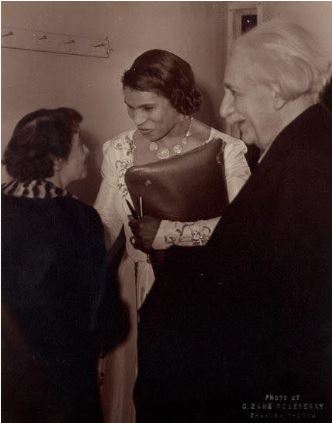
    Anyone remember the time Marian Anderson spent the night with Albert Einstein?

    If that sounds sordid, it absolutely is, but unfortunately in all the wrong ways.

    Anderson, the contralto whose voice no less than Arturo Toscanini gushed was of a kind that comes once in a hundred years, was notoriously barred from performing at Constitution Hall in Washington, D.C., by the Daughters of the American Revolution because of the color of her skin. In the ultimate example of turning lemons into lemonade, Anderson sang instead from the steps of the Lincoln Memorial – to 750,000 people on the mall and a national radio audience estimated in the millions. That was on April 9, 1939, which, as it turned out, was Easter Sunday.

    Two years earlier, after a performance at Princeton’s McCarter Theatre – a performance that drew a packed house and elicited glowing reviews – Anderson had been denied accommodations at the Nassau Inn.

    Fortunately, Einstein happened to be in the audience. Learning of Anderson’s dilemma, he extended the invitation for her to stay with him in his home at 112 Mercer Street.

    Anderson recollected, “I remember thanking him from the bottom of my heart and he seemed just sort of to brush it aside…. Dr. Einstein greeted one warmly and said, ‘We are very happy that you can come and welcome into our home.’”

    For the next 18 years – through 1955, the same year she made her belated debut at New York’s Metropolitan Opera and the last year of Einstein’s life – Anderson made it a point to stay with Einstein whenever she was in Princeton.

    In 1946, Einstein received an honorary degree from Lincoln University. In his acceptance speech, he stated, “There is a separation of colored people from white people in the United States. That separation is not a disease of colored people. It is a disease of white people. I do not intend to be quiet about it.”

    Einstein himself was no stranger to racism. It was antisemitism that drove him to renounce his German citizenship, at a time it was still within his power to do so. The Nazis barred Jews from holding official positions, including professorships, they repeatedly raided his home, they sold his belongings, they burned his books and – though it seems superfluous under the circumstances – one German magazine put a $5000 bounty on his head. “Jewish intellectualism is dead,” proclaimed Goebbels.

    Hitler’s loss was our gain. Though there were Jewish quotas in place at universities even here in the United States, including at Princeton University (unofficially, but understood), Einstein accepted a position at the newly-formed Institute for Advanced Study – which in its early days, kept offices on Princeton’s campus while its own facilities were under construction. Einstein would become an American citizen in 1940.

    Einstein embraced America’s system of meritocracy. He extolled the “right of individuals to say and think what they pleased,” without social barriers, a right he found conducive to creativity and innovation. At the same time, he condemned America’s racism, which he found to be the country’s “worst disease… handed down from one generation to the next.”

    Einstein joined the Princeton chapter of the NAACP. When he put himself forward as a character witness for civil rights activist W.E.B. Du Bois at a trial in 1951, the judge dropped the case.

    In 1959, Anderson herself received an honorary degree from Princeton University. Although by then Einstein had passed, again she stayed at his home.

    There are a lot of reasons to share this story, but I do so today in conjunction with Pi Day (3.14), always a big deal in Princeton. Find yourself a seat at an integrated lunch counter and order yourself a celebratory slice in honor of this extraordinary friendship.

Tag Cloud

Aaron Copland (92) Beethoven (95) Composer (114) Film Music (122) Film Score (143) Film Scores (255) Halloween (94) John Williams (187) KWAX (229) Leonard Bernstein (100) Marlboro Music Festival (125) Movie Music (137) Opera (199) Philadelphia Orchestra (89) Picture Perfect (174) Princeton Symphony Orchestra (106) Radio (87) Ralph Vaughan Williams (85) Ross Amico (244) Roy's Tie-Dye Sci-Fi Corner (290) The Classical Network (101) The Lost Chord (268) Vaughan Williams (103) WPRB (396) WWFM (881)

DON’T MISS A BEAT

Receive a weekly digest every Sunday at noon by signing up here


RECENT POSTS