Tag: Ralph Vaughan Williams

  • Casals and His Composer Friends

    Casals and His Composer Friends

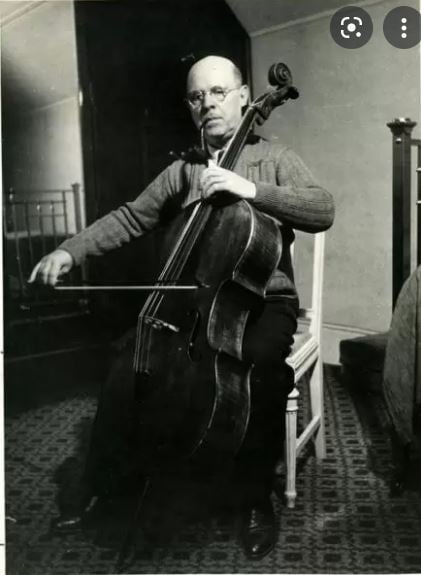
    He put his career on hold to stand up to Franco. He rediscovered the Bach cello suites. He played for Queen Victoria and John F. Kennedy. He founded the Prades Festival. He established the Puerto Rico Symphony and Conservatory. He gave master classes, conducted and recorded at Marlboro. He was even a talented composer.

    Pablo Casals was a giant of an artist and of a man. Is it any wonder so many of his colleagues were moved to write music for him?

    This Sunday night on “The Lost Chord,” we’ll hear works dedicated to Casals by three of his composer friends and colleagues.

    Ralph Vaughan Williams wrote his seldom-heard “Fantasia on Sussex Folk Tunes” around the time he was at work on his Piano Concerto and “Job: A Masque for Dancing.” Casals performed the piece in 1930. It was not heard again until 1983, the year of its world-premiere recording (featuring Julian Lloyd Webber). The composer later undertook a full-scale concerto for Casals. It was never completed, but the sketches for its slow movement were realized for a 2010 performance at the BBC Proms, under the title “Dark Pastoral.”

    Donald Francis Tovey, who would achieve fame as a musicologist, composed quite a lot of music himself, most of it now forgotten. In 1935, he wrote a concerto for Casals. At nearly an hour in length, the work may be the longest cello concerto ever written.

    In 1912, Tovey was a houseguest of Casals and cellist Guilhermina Suggia, at their summer home at Playa San Salvador on the Mediterranean coast. There, he played tennis, swam, and performed chamber music with the likes of Enrique Granados and Mieczyslaw Horszowski. He also made great strides on his opera, “The Bride of Dionysus.” As a show of thanks, he composed for his hosts a Sonata for Two Cellos in G major, which became part of the evenings’ entertainments. The work’s second movement is a set of variations on a Catalan folk song. We’ll hear it performed by Marcy Rosen and Frances Rowell, from a Bridge Records, Inc. release.

    Finally, Arnold Schoenberg, himself an amateur cellist, had done editorial work on three pieces by the 18th century composer Georg Matthias Monn, for inclusion in the publication “Monuments of Music in Austria.” When Casals invited Schoenberg to conduct his orchestra in Barcelona, the composer set about arranging a “new” concerto, based upon a harpsichord work by Monn, written in 1746. We’ll hear Schoenberg’s transformation of the piece performed by Yo-Yo Ma.

    Pau takes a bow! I hope you’ll join me for “Casals’ Pals” – music written for Pablo Casals by notable composer friends and colleagues – this Sunday night at 10:00 EDT, on WWFM – The Classical Network and wwfm.org.

  • Ruth Gipps Centenary Symposium International Women’s Day

    Ruth Gipps Centenary Symposium International Women’s Day

    Somehow, I missed the centenary of the birth of Ruth Gipps (1921-1999), pupil of Ralph Vaughan Williams, whose music I programmed with pleasure while at WWFM. Oh, how I look forward to the day I’ll be allowed back into a studio to put together new shows pertaining to landmark anniversaries. So many of these have slipped by over the Year of Covid.

    Had I a live air shift on February 20, no doubt I would have realized it was Gipps’ 100th birthday. Be that as it may, there is another way to honor her. On Monday – International Women’s Day – scholars and musicians will convene for an online symposium centering on Gipps’ life and works. The hour-long stream will begin at 12:45 pm EST. Registration is required. A donation is suggested. You’ll find more information here:

    https://www.eventbrite.co.uk/e/ruth-gipps-a-centennial-symposium-tickets-141989499415?utm-medium=discovery&utm-campaign=social&utm-content=attendeeshare&aff=esfb&utm-source=fb&utm-term=listing&fbclid=IwAR0H5SFWHlxmNSJKOZK5Xah0Wd7PPr75AHFyZv5kk2r2f3gsenUi4CBzo14

    At 26, Gipps became the youngest English woman ever to receive a doctorate in music. Her mastery of both the oboe and piano suggested a promising future as soloist in virtuoso concert works. However, a shoulder injury, suffered in her early 30s, caused her to shift her focus primarily to composition. Along the way, she also founded two orchestras and directed a choral ensemble.

    Her tone poem, “Knight in Armour,” was performed at the Last Night of the Proms in 1942. Despite early success, she encountered resistance in a field dominated by men. No doubt this contributed to her steely resolve. She was tenacious. Some also found her off-putting.

    In all, she left five symphonies, a respectable number of concertos and concertante works, chamber and instrumental music, and choral pieces. Hopefully, we’ll get to hear more of them soon.

    Register for the symposium. Then take 24 minutes to enjoy Gipps’ multifaceted Symphony No. 2 (1945):

  • Armchair Travel Winter Films & Music

    Armchair Travel Winter Films & Music

    Baby, it’s cold outside! The best time for armchair travel.

    This week on “Picture Perfect,” cozy in, but get a world view, as we drift beyond our shores for an hour of wintry scenes from world cinema, with entries from England, Finland, the Soviet Union, and Japan.

    Akira Kurosawa’s “Dersu Uzala” (1975) is one of the best of his later films, although it seems to have faded into the shadows of “Kagemusha” and “Ran.” The plot centers on an early 20th century friendship between a Russian explorer and an East Asian trapper and hunter, who acts as his guide. This would be the last of Kurosawa’s works to be recognized with an Academy Award for Best Foreign Language Film. The music is by Isaac Schwartz.

    Snow again is in abundance in Finland’s “The White Reindeer” (1952). Set in Lapland, it tells the tale of a lonely herder’s wife, who visits a local shaman and is transformed into a shapeshifting, vampiric hind. The film was honored at the Cannes Film Festival with a special award for Best Fairy Tale Film, and at the Golden Globes as Best Foreign Film. Einar Englund wrote the music.

    Sergei Prokofiev’s concert suite from “Lieutenant Kijé” (1934) is very well known, but for some reason the film is not. In fact, it has been widely circulated in program notes that the film was never actually completed, which is false. It has not been available for purchase in the U.S. for as long as I can remember, but you can watch it here:

    Why The Criterion Collection has never gotten around to this one, I don’t know, but I’m sure there must be an explanation. The famous sleigh-ride, the “Troika,” begins just before the 45-minute mark. Note that the baritone on the soundtrack is none other than the composer himself, who thought the original singer employed for the purpose too refined.

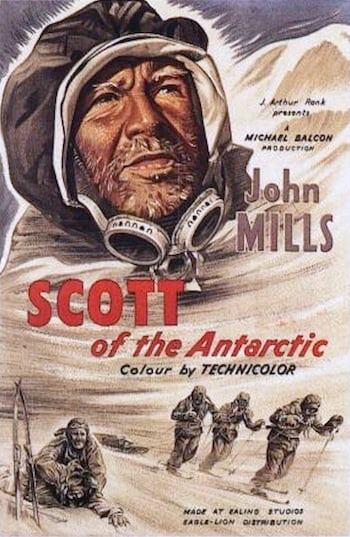
    Finally, we head to the South Pole with Robert Falcon Scott, for “Scott of the Antarctic” (1948). England’s Ealing Studios is probably best recognized for its classic comedies of the 1950s, many of them starring Alec Guinness. There’s not much funny about this harrowing true story, with John Mills as Scott and the most celebrated film score by Ralph Vaughan Williams. Vaughan Williams’ music perfectly reflects the sublime, austere beauty of an impenetrable wilderness. Material from the score was later reworked and incorporated into his Symphony No. 7, the “Sinfonia Antartica” (using the Italian spelling.)

    Don’t forget your gloves and a hat! It’s a small world of cold this week, on “Picture Perfect,” music for the movies, this Saturday evening at 6:00 EST, on WWFM – The Classical Network and wwfm.org.

  • Christmas Music from the English Renaissance

    Christmas Music from the English Renaissance

    With Christmas only days away, there’s still much to be done. Even so, this Sunday night on “The Lost Chord,” we pause to remember the story of the first Christmas, with music by a couple of English composers inspired by the Nativity.

    Alongside Sir Charles Villiers Stanford and Sir Edward Elgar, Sir Hubert Parry was one of the key figures of the so-called “English Musical Renaissance.” He influenced a whole generation of much better-known composers, including Ralph Vaughan Williams and Gustav Holst. We’ll hear his “Ode on the Nativity,” given its first performance on the same concert, at the Hereford Three Choirs Festival in 1912, as Vaughan Williams’ “Fantasia on Christmas Carols.”

    Vaughan Williams, the great-nephew of Charles Darwin, and an atheist in his youth, later softened into a kind of “cheerful agnosticism.” He dearly loved the King James Bible, and he especially enjoyed Christmas. Of course, he wrote much music on the subject. In fact, his very last composition was “The First Nowell.” He worked diligently at the piece, inspired by medieval pageants, during his final month, but died suddenly before its completion.

    However, even at 85 years-old, RVW retained a remarkable concentration. He managed to pound out the whole thing in short score in only a few weeks. Furthermore, he had fully orchestrated the first two-thirds. The finishing touches were applied by his assistant, Roy Douglas – he of “Les Sylphides” fame.

    If you like the “Fantasia on Christmas Carols,” I think you’ll really enjoy this. It’s pastoral music for a pastoral scene. Join me for “A Play in a Manger,” this Sunday night at 10:00 EST, on WWFM – The Classical Network and wwfm.org.

  • Douglas Lilburn New Zealand’s Celebrated Composer

    Douglas Lilburn New Zealand’s Celebrated Composer

    Being such a huge Sibelius fan, I remember being positively charmed on my discovery of the music of Douglas Lilburn. Lilburn is probably New Zealand’s most celebrated composer.

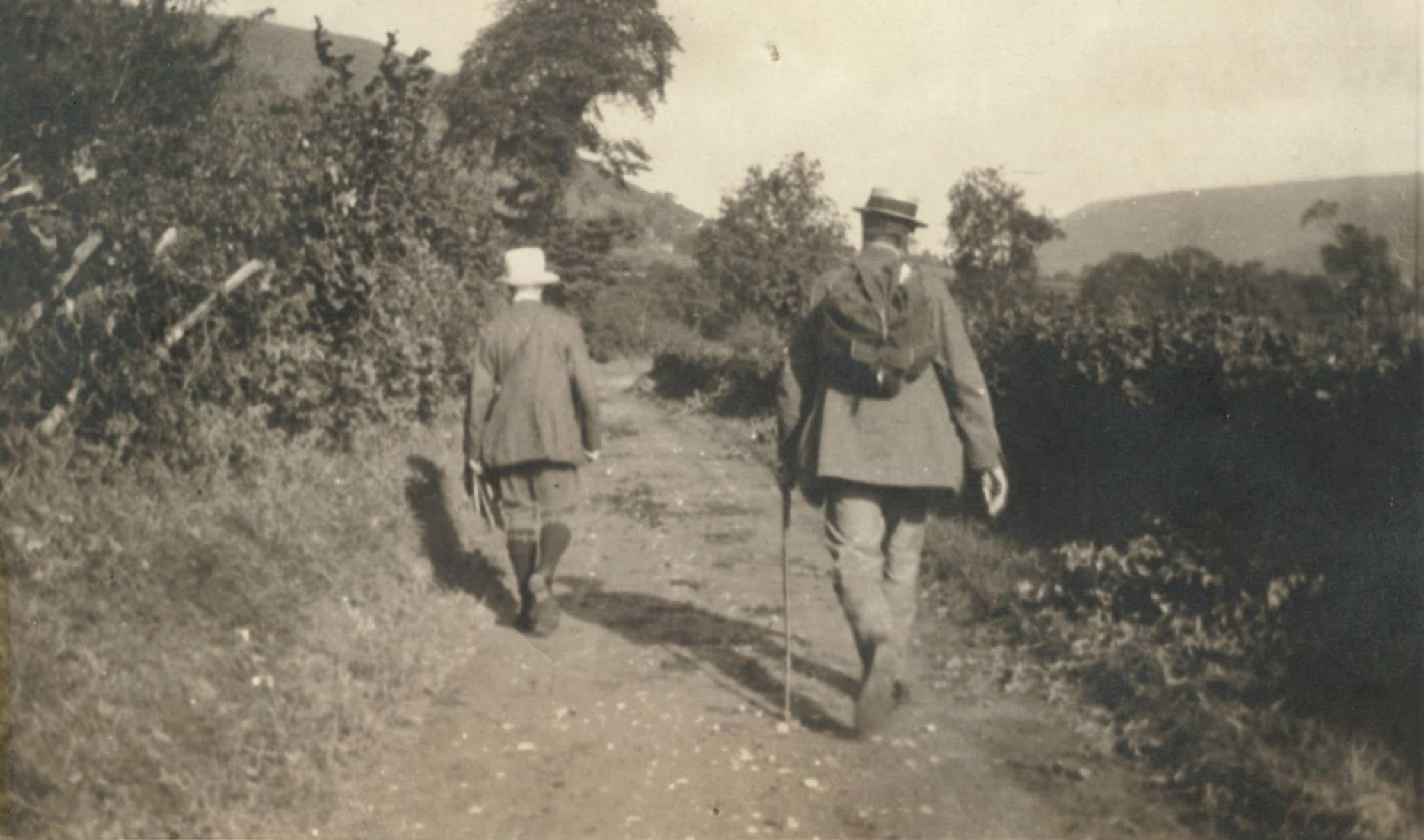
    Lilburn studied journalism and music at Canterbury University College (then part of the University of New Zealand), before embarking for London’s Royal College of Music. There he was tutored by Ralph Vaughan Williams. The two remained good friends, with Lilburn sending his former teacher gifts of New Zealand honey.

    Lilburn made his mark at home not only as a composer, but also as a conductor and a noted teacher. For decades, beginning in 1947, he was associated with Victoria University in Wellington.

    Astonishingly, for one whose own music was so rooted in tradition, Lilburn founded the first electronic music studio in Australasia. This followed visits to electronic facilities at Darmstadt and the University of Toronto.

    Actually, his comparatively thorny Third Symphony signaled something of a turning point. Soon after its completion, in 1961, he shifted his attention exclusively to electronics, a field in which he spent the remainder of his career. Many of his works in the medium evoke the New Zealand landscape and the natural sounds he loved so well.

    Lilburn died in 2001. He was 85 years old. He has been described as the “elder statesman” and “grandfather” of New Zealand music.

    Happy birthday to this Sibelius of the Southern Cross!


    Liliburn’s “A Song of Islands” (1946):

    The composer in the electronic music studio he founded:

    PHOTO: Ant’s-eye Antipodean

Tag Cloud

Aaron Copland (93) Beethoven (95) Composer (114) Film Music (125) Film Score (143) Film Scores (255) Halloween (94) John Williams (189) KWAX (229) Leonard Bernstein (101) Marlboro Music Festival (125) Movie Music (140) Opera (202) Philadelphia Orchestra (89) Picture Perfect (174) Princeton Symphony Orchestra (106) Radio (87) Ralph Vaughan Williams (85) Ross Amico (244) Roy's Tie-Dye Sci-Fi Corner (290) The Classical Network (101) The Lost Chord (268) Vaughan Williams (103) WPRB (396) WWFM (881)

DON’T MISS A BEAT

Receive a weekly digest every Sunday at noon by signing up here


RECENT POSTS