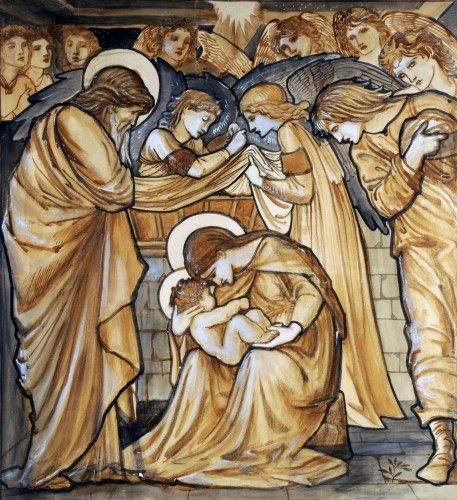
With Christmas only days away, there’s still much to be done. Even so, this Sunday night on “The Lost Chord,” we pause to remember the story of the first Christmas, with music by a couple of English composers inspired by the Nativity.
Alongside Sir Charles Villiers Stanford and Sir Edward Elgar, Sir Hubert Parry was one of the key figures of the so-called “English Musical Renaissance.” He influenced a whole generation of much better-known composers, including Ralph Vaughan Williams and Gustav Holst. We’ll hear his “Ode on the Nativity,” given its first performance on the same concert, at the Hereford Three Choirs Festival in 1912, as Vaughan Williams’ “Fantasia on Christmas Carols.”
Vaughan Williams, the great-nephew of Charles Darwin, and an atheist in his youth, later softened into a kind of “cheerful agnosticism.” He dearly loved the King James Bible, and he especially enjoyed Christmas. Of course, he wrote much music on the subject. In fact, his very last composition was “The First Nowell.” He worked diligently at the piece, inspired by medieval pageants, during his final month, but died suddenly before its completion.
However, even at 85 years-old, RVW retained a remarkable concentration. He managed to pound out the whole thing in short score in only a few weeks. Furthermore, he had fully orchestrated the first two-thirds. The finishing touches were applied by his assistant, Roy Douglas – he of “Les Sylphides” fame.
If you like the “Fantasia on Christmas Carols,” I think you’ll really enjoy this. It’s pastoral music for a pastoral scene. Join me for “A Play in a Manger,” this Sunday night at 10:00 EST, on WWFM – The Classical Network and wwfm.org.
Being such a huge Sibelius fan, I remember being positively charmed on my discovery of the music of Douglas Lilburn. Lilburn is probably New Zealand’s most celebrated composer.
Lilburn studied journalism and music at Canterbury University College (then part of the University of New Zealand), before embarking for London’s Royal College of Music. There he was tutored by Ralph Vaughan Williams. The two remained good friends, with Lilburn sending his former teacher gifts of New Zealand honey.
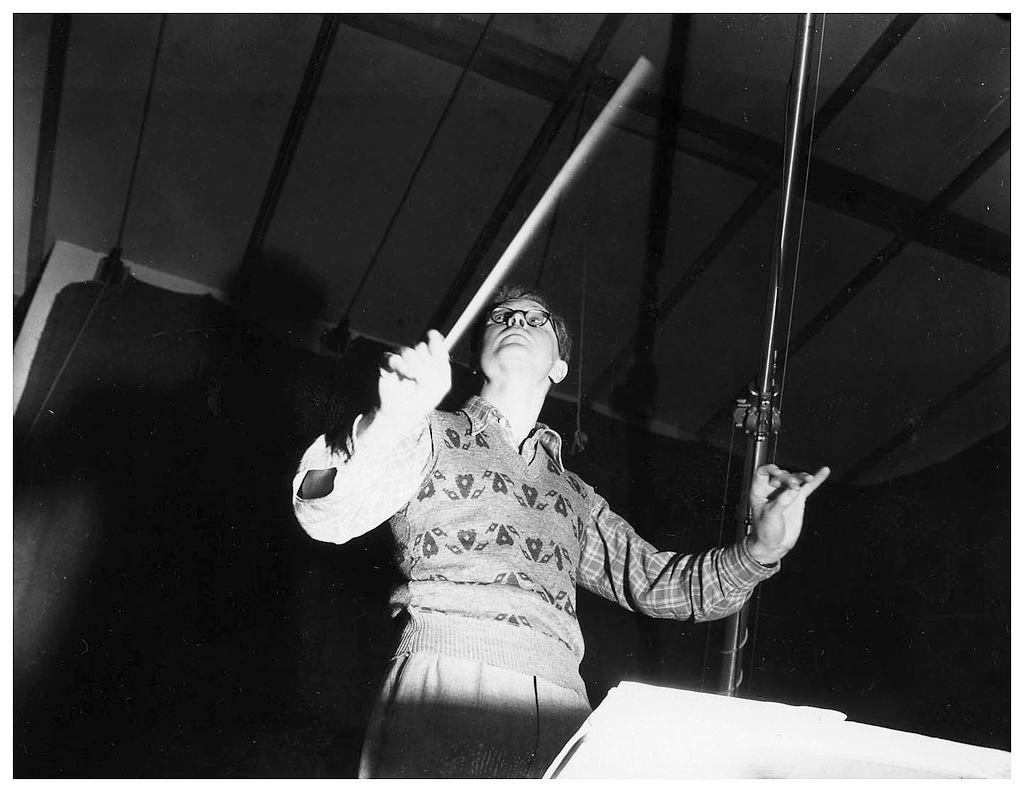
Lilburn made his mark at home not only as a composer, but also as a conductor and a noted teacher. For decades, beginning in 1947, he was associated with Victoria University in Wellington.
Astonishingly, for one whose own music was so rooted in tradition, Lilburn founded the first electronic music studio in Australasia. This followed visits to electronic facilities at Darmstadt and the University of Toronto.
Actually, his comparatively thorny Third Symphony signaled something of a turning point. Soon after its completion, in 1961, he shifted his attention exclusively to electronics, a field in which he spent the remainder of his career. Many of his works in the medium evoke the New Zealand landscape and the natural sounds he loved so well.
Lilburn died in 2001. He was 85 years old. He has been described as the “elder statesman” and “grandfather” of New Zealand music.
Happy birthday to this Sibelius of the Southern Cross!
Liliburn’s “A Song of Islands” (1946):
The composer in the electronic music studio he founded:
A rainy day in Princeton – perfect weather in which to celebrate Ralph Vaughan Williams. Vaughan Williams was born on this date in 1872. Don’t let that easygoing demeanor — the untrimmed eyebrows, the rumpled hat, the unkempt tie – fool you. Aside from being one of England’s greatest composers, “Uncle Ralph” possessed the drive and determination to render several other, far less glamorous services to music, each of which were of incalculable value.
First, he performed the actual legwork of roaming the English countryside and documenting the remnants of authentic folk song, the origins of which reached back deep into the nation’s past. He preserved these at a time when centuries-old traditions were in imminent peril of being swept away by encroaching modernization.
Equally, he worked with tireless enthusiasm in reviving and celebrating English church music. In selecting and arranging numbers for “The English Hymnal,” he produced one of the finest and most influential compilations of its kind. He had a passion for music of the Tudor Era. This is reflected in one of his greatest hits, the “Fantasia on a Theme by Thomas Tallis.” His Mass in G minor is a modern milestone in the revival of English polyphony. His magnum opus, which occupied him for decades, is a spiritual allegory after Bunyan, the opera “The Pilgrim’s Progress.” While not a conventionally religious man, Vaughan Williams wrote music that exudes a generosity of spirit and is often characterized by a kind of otherworldly luminosity, so that it seems at times to transcend any earthly concerns.
At the same time, he understood and confronted the horrors of the 20th century, as can be heard in the turbulent Symphony No. 4 or the desolate Symphony No. 6. Even in “A Pastoral Symphony” (the Symphony No. 3) – despite its title a reflection of the composer’s experiences as an ambulance driver during the First World War – all is not as it seems. But the cumulative effect of his music is one of hope, overriding any loss or melancholy, in pieces like the Symphony No. 5, which more than any other expresses an unshakeable faith in time of darkness.
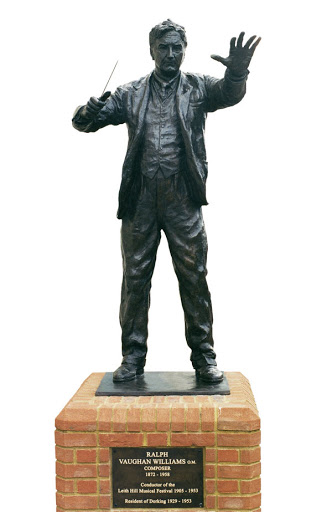
Vaughan Williams also had faith in the value of amateur singing. In addition to his folk song settings and hymn tune arrangements, he composed innumerable Christmas carols. He loved Christmas, and he loved the communal aspect of musicmaking. To his way of thinking, music was not only for the professionals; it was a birthright. Anyone who draws breath should be entitled to partake in its joys. From 1905 to 1953, he returned every year to lead the amateur choirs of the Leith Hill Music Festival in performance of Bach’s “St. Matthew Passion.” He also wrote works, such as his “Concerto Grosso,” that include parts for amateur players, and “Household Music,” designed to be played on whatever instruments happen to be at hand.
Broadly speaking, Vaughan Williams was not enamored of German music – he was intentionally mischievous in his numerous digs against Beethoven, though clearly he recognized Beethoven’s genius – but in Bach he found a kindred spirit. It could be said that Vaughan Williams’ own greatest sin was in not being German himself, since it hindered his broader acceptance in a world that had grown accustomed to regarding Germany as center of the musical universe. Vaughan Williams did more than any other English composer to shatter that hegemony.
So his intent was not merely to promote a conservative agenda, of preserving the status quo. He was also quietly progressive. Every one of his symphonies, while hewing to tonality, is different from every other, always pressing into new territories and exploring fresh sonorities – the stark soundscapes of the “Sinfonia Antartica” (sic), the exotic percussion and sectional division of his Symphony No. 8, the strange saxophones and emotional ambiguity of his Symphony No. 9. When the Symphony No. 5 was given its premiere in 1943, Vaughan Williams was already 70 years-old. Many already began to regard each new work as valedictory. But the old man clearly had plenty of juice left. On top of everything else, he had only just begun to embrace new challenges in writing music for the movies.
As has been the fate of most composers, time and habit have worked against a broader appreciation of Vaughan Williams’ overall output, distilling his life’s work to just a few “hits.” Mostly we hear the “Tallis Fantasia,” the “Fantasia on Greensleeves,” and “The Lark Ascending.” Vaughan Williams’ music is still underrated in many circles, pigeon-holed as the modal ramblings of a cow-pat provincialist. His work on behalf of folk song has forever colored him in some people’s eyes. Certainly, his prominence in the field ensured legions of imitators, and the sins of the sons have been visited upon the father.
But Vaughan Williams was so much more than the musical soul of England, as if that were not enough. He acquired continental polish from his studies with Ravel, and he possessed a largeness of vision and character that place him on a par with any of the great composers. He was a 20th century master. That his music has traveled so poorly is everyone’s loss.
Incidental music to “The Wasps”
“Fantasia on a Theme by Thomas Tallis”
Mass in G minor
Symphony No. 4, conducted by the composer
Phantasy Quintet
Selections from the opera “The Poisoned Kiss,” virtually unknown, but full of good tunes
Adrian Boult conducts a selection from “Job: A Masque for Dancing”
Symphony No. 8, conducted by Charles Munch
Serenade to Music
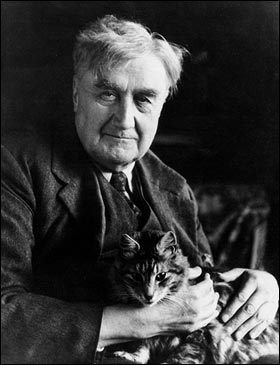
My oft-posted but favorite photo of Vaughan Williams and Foxy
It’s interesting that Gustav Holst and Ralph Vaughan Williams were born three weeks apart, albeit separated by two years. Uncle Ralph’s birthday is looming on October 12, but today we celebrate Holst.
“Gustav” may be a strange name for one of England’s greatest composers. Even stranger, he was actually christened Gustavus. Also, there was a “von” in his name – Gustavus Theodore von Holst. Holst’s father was of Swedish, Latvian, and German descent. His great-grandfather had also been a composer, who taught harp at the Imperial Russian Court in St. Petersburg. Continuing in the family trade, his grandfather set up shop in England. In doing so, he added the “von,” thinking it lent a little gravitas and might help to drum up business. Sensibly, Gustav dropped the prefix with the outbreak of war with Germany in 1914.
Like Vaughan Williams, Holst was born in Gloucestershire. Both were students at the Royal College of Music, who studied with Sir Charles Villiers Stanford. Significantly, they were also linked by a common destiny, spearheading a movement to establish a distinctly “English” national sound in music. They accomplished this by getting their hands dirty, tying on their boots and striking out for the fields and fens, to notate by cylinder and by hand songs of the countryside, already endangered by encroaching industrialization. In some of their best original music, both composers assimilate English folk inflections into their respective styles.
Holst himself was an exacting teacher, who took his duties very seriously. However, in common with the best of his profession, he never imposed his will on his students, but rather shepherded them in finding their own solutions. Holst served as director of music at St. Paul’s Girls’ School, Hammersmith, and at Morley College.
Of course his masterpiece would be “The Planets,” composed between 1914 and 1916. Hard to believe, in a world of composers schooled on the piano, that Holst’s principal instrument was the trombone! I recall listening to this music for the first time in my teens and thinking “Jupiter,” in particular, positively exuded “England.” Its roistering, galumphing, perhaps even Falstaffian antics give way to a stately, processional theme, later adapted into the patriotic hymn “I Vow to Thee, My Country.” But with the passage of time, and longer familiarity, “The Planets’” English identity, as detectable in every note, has become increasingly evident.
Even so, Holst was never of a provincial mindset. On the contrary, he was a much more adventurous – and frequently modernist – composer than he is frequently given credit for having been. His literary inspirations were far-flung, from Thomas Hardy to Walt Whitman to Sanskrit. His music is often less emotive than Vaughan Williams’. I’ve always detected more of an objective detachment in his works. Remarked Vaughan Williams, “He was not afraid of being obvious when the occasion demanded, nor did he hesitate to be remote when remoteness expressed his purpose.”
The two were one another’s most constructive critics. When Holst died, young, at the age of 59, Vaughan Williams felt his friend’s passing keenly. Aside from the personal loss, from a professional and artist standpoint, suddenly he was bereft of his most valued confidante and advisor.
Holst’s legacy can be detected best in those composers who reacted against Vaughan Williams and the pastoral school. His economy and restraint appealed to the generation of Walton, Britten, and Tippett. Also – and I never see this remarked upon – I detect his spirit often in the film and concert music of Bernard Herrmann. (Herrmann was a great anglophile, who championed Holst.) There is a certain aloofness, perhaps even a chill, in the work of both artists, but also great sensitivity.
Happy birthday, Gustav Holst (1874-1934)! You may be regarded by most as a one-hit wonder, but you connected squarely, and the resulting line drive carried further than is generally accepted.
“Jupiter” (1914):
“Beni Mora” (1910):
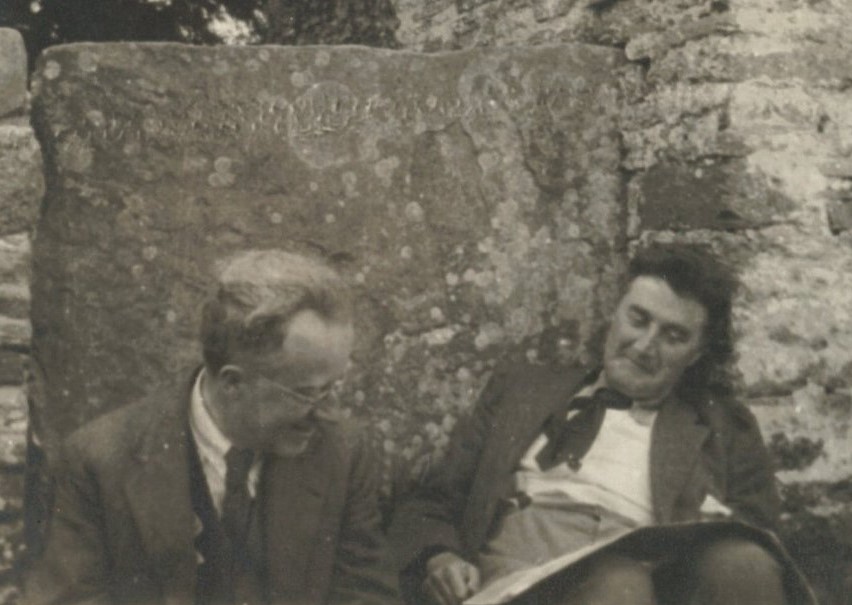
PHOTO: Holst (left) with Vaughan Williams, who never could tie a tie
This afternoon on The Classical Network, we’ll go for Baroque.
First, on today’s Noontime Concert, The Dryden Ensemble will present “A Baroque Tapestry,” with works by Johann Rosenmüller, Heinrich Ignaz Franz von Biber, Tomaso Albinoni, Georg Muffat, and of course Johann Sebastian Bach. The program was performed at Princeton Theological Seminary’s Miller Chapel.
This weekend, Dryden will present three performances of Bach’s “St. John Passion,” at All Saints’ Church in Princeton (Friday & Saturday at 7:30 p.m.) and Trinity Episcopal Church in Solebury, PA (Sunday at 3). To find out more, look online at http://www.drydenensemble.org.
We’re also, of course, in the midst of our annual “Bach 500,” at The Classical Network.
In celebration of the anniversary of Bach’s birthday (March 21st, 1685), we’re looking for 500 listeners to step up and make a donation IN ANY AMOUNT. You set the level. When we reach 500 donations, we’ll tally in the funds from our Bach Pot – contributions solicited in advance from some especially ardent supporters – and, best of all, we’ll be able to cancel fundraising on Bach’s birthday and enjoy just his music.
You can do your part to make that happen by calling us during business hours at 1-888-232-1212, or by donating online anytime at wwfm.org. While you’re over there, at the website, you can monitor our progress by consulting our Bach 500 membership thermometer.
To keep us mindful, following today’s concert broadcast, I’ll continue along the lines of last Tuesday, by offering hourly reminders, harnessed to a short work of Bach; then another work in some way related – for example, the “Choral and Choral-Prelude ‘Ach bleib bei uns, Herr Jesu Christ,’” from Bach’s Cantata, BWV 6, reimagined by Ralph Vaughan Williams – followed by something related to the related material, which ideally will have nothing at all to do with Bach – such as an original work by Vaughan Williams or one of his colleagues – thereby keeping it varied, while still getting the message out there.
If it’s not Baroque, we’ll still fix it, from 12 to 4 p.m. EDT. Thank you for your support of WWFM – The Classical Network and wwfm.org.
PHOTO: William Fawke’s statue commemorating Ralph Vaughan Williams, who annually conducted the combined choirs of the Leith Hill Music Festival in Bach’s “St. Matthew Passion”