Tag: Ralph Vaughan Williams

  • Scrooge Opera & Christmas Carols on Classical Network

    Scrooge Opera & Christmas Carols on Classical Network

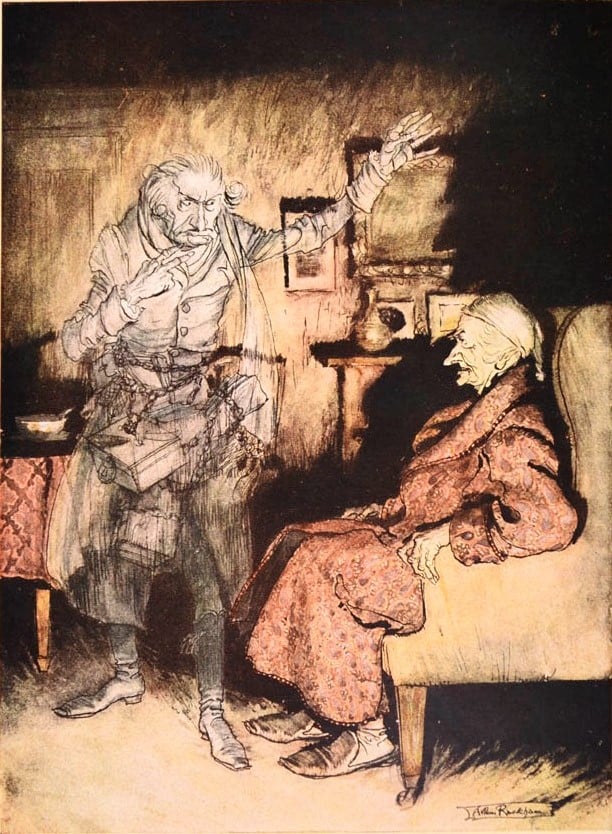
    If I could work my will, every idiot who goes about with ‘Merry Christmas’ on his lips should be boiled with his own pudding and buried with a stake of holly through his heart!

    Be that as it may, I hope you’ll join me this afternoon on The Classical Network for a conversation with documentarian H. Paul Moon of Zen Violence Films, who dropped by the WWFM studios last week to talk about the release of his latest project, a filmed production of John Deak’s chamber opera, “The Passion of Scrooge.”

    The work is a real tour de force for baritone William Sharp, who appears with Washington DC’s 21st Century Consort.

    Moon’s film is now available on BluRay and DVD. Learn more about it, when you tune in for our chat – with selections from the opera – beginning at 5 p.m., or by visiting scroogeopera.com

    The balance of the hour will be devoted to a complete performance of “On Christmas Night,” a rarely-heard masque, also inspired by Charles Dickens’ “A Christmas Carol,” by Ralph Vaughan Williams.

    Prior to that, we’ll remember American composer and pianist Edward MacDowell, on his birthday, with his “Fireside Tales,” and Rita Streich, whom we heard yesterday in Josef Rheinberger’s “The Star of Bethlehem,” on hers. This afternoon, she will present a medley of German language Christmas songs.

    At 6:00, it’s another “Music from Marlboro,” with works for Christmas by Wagner and Brahms. There will also be time for a cheerful wind octet by Carl Reinecke.

    Fires will roar and winds will blow. I hope you’ll join me for a bit of beef, a blot of mustard, a crumb of cheese, a fragment of underdone potato, this Wednesday from 4 to 7 p.m. EST, on WWFM – The Classical Network and wwfm.org.

  • Saint Cecilia Feast Day Music on WWFM

    Saint Cecilia Feast Day Music on WWFM

    Hail! Bright Cecilia, hail!

    November 22 is the feast day of Saint Cecilia – the patron saint of music.

    Join me this afternoon at 4:00 on The Classical Network, as we celebrate with musical tributes by William Boyce, Benjamin Britten, Anthony Collins, Charles Gounod, George Frideric Handel, Henry Purcell, Joaquin Rodrigo, and Alessandro Scarlatti. We’ll also hear the “Serenade to Music” by Ralph Vaughan Williams and “The Young Person’s Guide to the Orchestra,” narrated by Sean Connery.

    At 6:00, look ahead to Thanksgiving on “Picture Perfect,” with selections from “Friendly Persuasion” (Dimitri Tiomkin), “Our Town” (Aaron Copland), “Plymouth Adventure” (Miklós Rózsa), and the building-the-barn sequence from “Witness” (Maurice Jarre).

    There’s always plenty to be thankful for, musically speaking, from 4 to 7 p.m. EST, on WWFM – The Classical Network and wwfm.org.

  • Vaughan Williams A Birthday & Symphony No 5

    Vaughan Williams A Birthday & Symphony No 5

    Happy birthday, Ralph Vaughan Williams, one of my favorite composers!

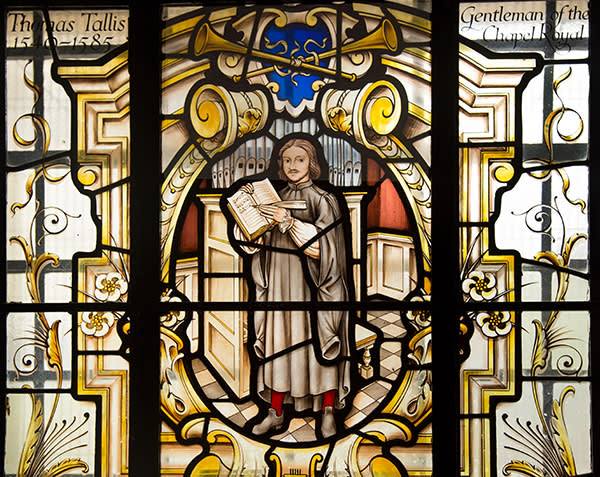
    Thank you so much for the “Serenade to Music,” “The Lark Ascending,” the “Fantasia on a Theme by Thomas Tallis,” “Five Variants of Dives and Lazarus,” “The Wasps,” the “Norfolk Rhapsody No. 1,” the “English Folk Song Suite,” the “Fantasia on Christmas Carols,” “Five Mystical Songs,” the “Charterhouse Suite,” the “Concerto Grosso,” the “Old King Cole” ballet, “Household Music,” “Hugh the Drover,” “Sir John in Love,” and too many others to enumerate.

    Of your nine symphonies, I certainly have my preferences. Each of them holds its own particular delight – even the ones that are served up harsh or leave us hanging, with big questions about their, and our, ultimate destinations. Collectively, they form a surprisingly disparate body of work, belying your reputation as a pastoralist.

    That said, if I want to find solace or to be uplifted, I always gravitate to the Fifth.

    For me, the facts surrounding the Fifth’s creation make it all the more moving. It’s frequently been remarked upon that the symphony shares a certain kinship with your opera, “The Pilgrim’s Progress,” which you worked at for decades and still remained incomplete.

    At first, when you heard the symphony played by friends in its two-piano reduction, you had doubts as to its value. That’s a little ironic for a work that is so imbued with the power of faith. And by faith, I don’t mean religion. It’s well-known to most that in your maturity you embraced what you described as a “cheerful agnosticism” (downgraded from earlier assertions of atheism). When it was finally performed by an orchestra, you realized your reservations were unfounded.

    You dedicated the work to Jean Sibelius, “without permission.” However, when Sibelius heard the piece, he too was delighted. He wrote to Adrian Boult, “This symphony is a marvelous work… the dedication made me feel proud and grateful… I wonder if Dr. Williams has any idea of the pleasure he has given me?”

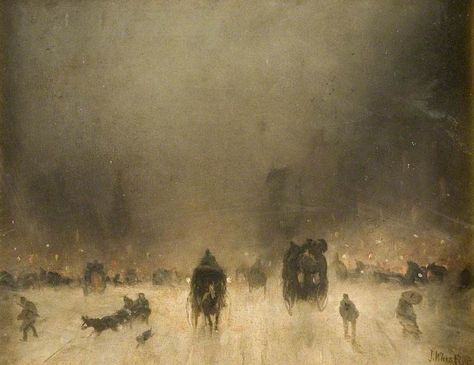
    The symphony was introduced in June of 1943, at the height of the blitz. German bombs rained down on London after dark, so the concert had to be held in the afternoon. We can only imagine what that must have been like – the nightly danger, the disruption of conveniences, the loss of life, the injuries, the rationing, the rubble, the noise, the fear – and then the power of this music, music of fortitude and optimism, and what affect it must have had on its first audiences. Here was assurance that everything was going to be all right. This too would pass. Beyond the bombs, beyond Hitler, England would endure, as would other things. Larger things. Immutable things.

    Who knew that you, the cheerful agnostic, would turn out to be a prophet?

    Here you are conducting, at the age of 80, your Symphony No. 5.

  • RVW Birthday Dett Celebration & De Palma Scores

    RVW Birthday Dett Celebration & De Palma Scores

    Tomorrow is the birthday of Ralph Vaughan Williams. Tune in this afternoon to The Classical Network to hear selections from a new CD issued on Dutton Vocalion Records that features what is billed as the world premiere recording of RVW’s incidental music to a radio presentation of Shakespeare’s “Richard II.”

    Also, we’ll celebrate the anniversary of the birth of R. Nathaniel Dett. Dett was born in what is now Niagara Falls, Ontario. His grandfather was an escaped slave who found freedom on the Underground Railroad. Dett became an important figure in the American music of his time. Yet he is remembered today, if at all, for a lone piano suite, “In the Bottoms,” or perhaps only for its two-minute concluding dance, “Juba,” which was championed by Percy Grainger, among others.

    Clipper Erickson, piano, was the first to record all of Dett’s keyboard works. His performances have been collected on an album titled “My Cup Runneth Over,” on Navona Records, a division of PARMA Recordings.

    If you find this music attractive, you can hear more by joining Clipper, soprano Rochelle Ellis, and the Westminster Jubilee Sings, at Westminster Choir College’s Bristol Chapel, tonight at 7:30, for an R. Nathaniel Dett birthday blow-out. Get there early, at 6:45, to attend a pre-concert talk.

    Back to radio: Coming up at 6:00 this evening, it’s music from the suspense, horror, and crime thrillers of director Brian De Palma, on “Picture Perfect” – music for the movies. We’ll hear selections by Bernard Herrmann, John Williams, Pino Donaggio, and Ennio Morricone.

    The week ends strong, from 4 to 7 p.m. EDT, on WWFM – The Classical Network and wwfm.org.

  • Music for Casals Friends & Colleagues

    Music for Casals Friends & Colleagues

    It’s hardly surprising that anyone would be moved to write music for Pablo Casals. Regarded by many as the greatest cellist of his time, perhaps ever, he was certainly a giant-of-an-artist and of a man. Born in Catalonia, he stood up to the Franco regime, entering into self-imposed exile and refusing to perform in countries that recognized Franco’s authority. He rediscovered the Bach cello suites in a secondhand bookshop and made them famous. Over the span of his career, he played for both Queen Victoria and John F. Kennedy.

    As a conductor and administrator, he founded the Prades Festival and Casals Festival. He established the Puerto Rico Symphony and Conservatory. He gave master classes, conducted and recorded at Marlboro. He was even a talented composer.

    This Sunday night on “The Lost Chord,” we’ll hear works dedicated to Casals by three of his friends and colleagues.

    Ralph Vaughan Williams wrote his seldom-heard “Fantasia on Sussex Folk Tunes” around the time he was at work on his Piano Concerto and “Job: A Masque for Dancing.” Casals performed the piece in 1930. It was not heard again until 1983, the year of its world-premiere recording (featuring Julian Lloyd Webber). The composer later undertook a full-scale concerto for Casals. It was never completed, but the sketches for its slow movement were realized for a 2010 performance at the BBC Proms, under the title “Dark Pastoral.”

    Donald Francis Tovey, who would achieve fame as a musicologist and writer on music, wrote quite a lot of music himself, most of it now forgotten. In 1935, he composed a concerto for Casals. At nearly an hour in length, the work may be the longest cello concerto ever written.

    In 1912, Tovey was a houseguest of Casals and cellist Guilhermina Suggia, at their summer home at Playa San Salvador on the Mediterranean coast. There, he played tennis, swam and performed chamber music with the likes of Enrique Granados and Mieczyslaw Horszowski. He also made great strides on his opera, “The Bride of Dionysus.” As a show of thanks, he composed for his hosts a Sonata for Two Cellos in G major, which became part of the evenings’ entertainments. The work’s second movement is a set of variations on a Catalan folk song. We’ll hear it performed by Marcy Rosen and Frances Rowell, from a Bridge Records, Inc. release.

    Finally, Arnold Schoenberg, himself an amateur cellist, had done editorial work on three pieces by the 18th century composer Georg Matthias Monn for inclusion in the publication “Monuments of Music in Austria.” When Casals invited Schoenberg to conduct his orchestra in Barcelona, the composer set about arranging a “new” concerto, based upon a harpsichord work by Monn, written in 1746. We’ll hear Schoenberg’s transformation of the piece performed by Yo-Yo Ma.

    I hope you’ll join me for “Casals’ Pals” – music written for Casals by notable composers, friends and colleagues – this Sunday night at 10:00 EDT, on WWFM – The Classical Network and wwfm.org.

Tag Cloud

Aaron Copland (93) Beethoven (95) Composer (114) Film Music (125) Film Score (143) Film Scores (255) Halloween (94) John Williams (189) KWAX (229) Leonard Bernstein (101) Marlboro Music Festival (125) Movie Music (140) Opera (202) Philadelphia Orchestra (89) Picture Perfect (174) Princeton Symphony Orchestra (106) Radio (87) Ralph Vaughan Williams (85) Ross Amico (244) Roy's Tie-Dye Sci-Fi Corner (290) The Classical Network (101) The Lost Chord (268) Vaughan Williams (103) WPRB (396) WWFM (881)

DON’T MISS A BEAT

Receive a weekly digest every Sunday at noon by signing up here


RECENT POSTS