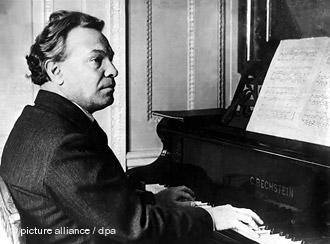
In 1944, American composer David Diamond, at 29-years-old, received a commission from Dimitri Mitropoulos, principal conductor of the Minneapolis Symphony Orchestra. Mitropoulos had only one stipulation. “These are distressing times,” he said. “Most of the music I play is distressing. Make me happy.” Diamond responded, in the exuberance of youth, with his “Rounds for String Orchestra.”
The piece is alive with imitative counterpoint, the title a reference to musical canons or “rounds” – you know, like the “Row, Row, Row Your Boat” or “Frère Jacques” – with the different “voices” entering in rapid succession along the same melodic lines. The melodies are Diamond’s own, but sound every bit as “American” as Copland’s assimilation of an Appalachian fiddle dance or a Shaker tune or a Mississippi riverboat song.
Regarding the piece, Diamond wrote, “The different string choirs enter in strict canonic fashion as an introduction to the main subject, which is played by the violas and soon restated by the cellos and basses. The Adagio is an expressive lyric movement, acting as a resting point between the two fast movements. The last movement again makes use of characteristic canonic devices, though it may be more specifically analyzed as a kind of fugal countersubject for the principal thematic ideas, so helping to ‘round’ out the entire work and unify the entire formal structure.”
There is an inevitability about the piece that makes it almost an ebullient, extroverted flipside of Barber’s “Adagio for Strings.” Both works exude inspiration and are perfectly argued, without a wasted note. “Rounds” is Diamond’s most famous work, but it still deserves to be heard more frequently. It can hold its head high on any classical music concert that aspires to represent what’s best in American music.
It should be considered with the same respect and affection as Barber’s “Adagio,” Copland’s “Appalachian Spring,” Gershwin’s “Rhapsody in Blue,” and Sousa’s “The Stars and Stripes Forever.” It’s that good. Optimism, vitality, and joy are too often dismissed at the expense of the weightier considerations of human existence.
Today would have been Diamond’s 110th birthday. He went on to write quite a lot of quality music – and not all of it “happy” – including 11 symphonies (criminally, some of these have yet to be recorded), but nothing I’ve heard – and I have heard more than most – equals the sustained inspiration of Diamond’s “Rounds.”
I pray that the impending U.S. Semiquincentennial brings a much-deserved reassessment of the greatest generation of American symphonists, now sadly neglected, of which Diamond is one; but so far, what I’ve seen of the 2025-26 concert season brochures from Philadelphia, New York, and Princeton has not been promising (one Ives symphony aside). If I had the power and a podium, I would see to it that the cream of Walter Piston, Roy Harris, William Schumann, Howard Hanson, Peter Mennin, Vincent Persichetti, Randall Thompson, Harold Shapero, and yes, David Diamond, would flow.
The world should be reminded of the creative promise of this country – its vibrancy, energy, and invention – when it still seemed to be very much on the way up.
Thank you, David Diamond, and happy birthday wherever you are.
I just discovered this remarkable performance of “Rounds” by a youth orchestra, so don’t tell me it’s too “difficult” to program. Too bad somebody in the audience drops an anvil at around 5:45.