This week on “Picture Perfect,” we look past the white picket fences and manicured lawns of suburban and small town America to arrive at some disturbing truths.
Films like “Peyton Place” and “Kings Row” present seemingly idyllic settings full of long shadows and closets heaped with skeletons; while those like “Far from Heaven” and “Edward Scissorhands” explore the themes of isolation and the consequences of bucking conformity.
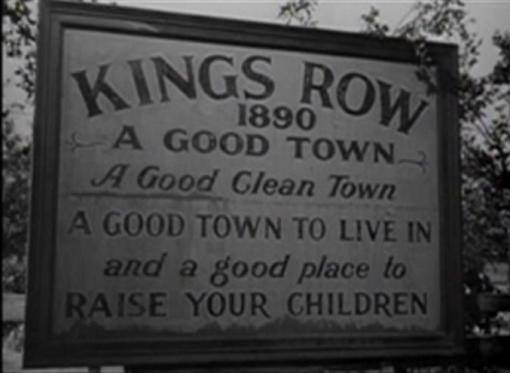
For all its Hays Code concessions, “Kings Row” (1942) can be seen as a spiritual forerunner of the films of David Lynch. Yet its makers manage to finesse Henry Bellamann’s novel so that, for all the terrible occurrences, the film is also full of hope and optimism.
Erich Wolfgang Korngold, at this point in his career associated with historical adventure films (as Errol Flynn’s regular composer), wrote a brash fanfare wholly in this vein, on an initial assumption made from the film’s title.
“Peyton Place” (1957) is a natural successor, another sleepy town full of secrets and roiling with gossip. Again, Grace Metalious’ bestselling novel was cleaned up somewhat in its transfer to the screen. Still, the film and a subsequent TV series were spicy enough to stir controversy. Franz Waxman wrote the music, and the theme retains a toehold in the public consciousness.
“Far from Heaven”(2002) brings the sensibility of a Douglas Sirk melodrama of the 1950s into the 21st century, with its exploration of social issues regarding race, class, gender roles and sexual orientation. Elmer Bernstein, who had been scoring films since the Sirk era, was a perfect choice for composer. He was nominated for an Academy Award for the 14th time, at the age of 80. “Far from Heaven” would be Bernstein’s final score.
Director Tim Burton’s take on suburban conformity is much broader, with everyone following the same routine, their cookie-cutter houses painted in faded pastels. Fashion and décor are simultaneously tacky and anonymous. Into this setting wanders “Edward Scissorhands” (1990), a gentle Frankenstein’s monster, whose special gifts soon ingratiate him with the suspicious neighbors. But Edward’s acceptance is not to last, as in the film’s third act a mob mentality takes hold. Danny Elfman’s music suits Burton’s alternately moving and satirical fable.
I hope you’ll join me for an hour of suburban and small town blues this week, on “Picture Perfect,” music for the movies – this Friday evening at 6 ET, with a repeat Saturday morning at 6; or that you’ll enjoy the show later as a webcast at http://www.wwfm.org.
(And lest you think I am slamming small towns, next week’s theme will be “Gritty Cities.”)
PHOTO: Well, yeah, if you don’t mind madness, murder, suicide and unnecessary amputation