During his time with the Swedish Broadcasting Corporation (1937-1944), Lars-Erik Larsson provided music for everything from cantatas to radio plays to brief vignettes to accompany the recitation of poetry.
Material from these projects would frequently find its way into the composer’s concert works. Most notably, three of the six movements of “Hours the Day,” from 1938, were organized into what went on to become the composer’s most famous piece, the “Pastoral Suite.”
This week on “The Lost Chord,” we’ll hear the world premiere recording, from 1994, of the complete, original, six-movement work, alongside another one of Larsson’s poetic suites for radio, “God in Disguise,” from 1940.
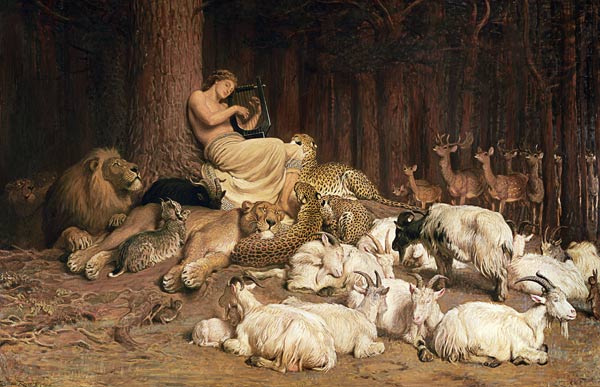
Larsson had been asked as early as 1930 if he would be interested in setting to music Hjalmar Gullberg’s cycle of poems. Gullberg, then the head of Swedish Radio’s drama division, took as his starting point Euripides’ “Alcestis,” in which the god Apollo, temporarily exiled from Olympus, acts as servant and shepherd to King Admetus of Thessaly.
It would be a full decade before the project was realized, in part due to the scale of the undertaking. By then, neighboring Denmark and Norway were under Nazi occupation. Gullberg wrote additional text to mold the work into a protest against violence in the world. In spite – or perhaps because – of the harsh reality of the times, “God in Disguise” retains an optimistic and indeed a determinedly pastoral outlook.
This too will be heard in a world premiere recording, from 1956, featuring speaker Lars Ekborg, soprano Elisabeth Söderström, and the orchestra and chorus conducted by Stig Westerberg.
Brush up on your Swedish, as we celebrate all that is worthy and simple. I hope you’ll join me for “Best at Verse” – Lars-Erik Larsson’s poetic suites for radio – on “The Lost Chord,” now in syndication on KWAX Classical Oregon!
——-
Clip and save the start times for all three of my recorded shows:
PICTURE PERFECT, the movie music show – Friday at 8:00 PM EDT/5:00 PM PDT
SWEETNESS AND LIGHT, the light music program – Saturday at 11:00 AM EDT/8:00 AM PDT
THE LOST CHORD, unusual and neglected rep – Saturday at 7:00 PM EDT/4:00 PM PDT
Stream them, wherever you are, at the link!
https://kwax.uoregon.edu
Tag: Sweden
-

Gävle Goat The Burning Christmas Tradition
Even at Christmas, it seems, some people just want to get your goat.
How else to explain the continued desire to see one city’s oversized symbol of Christmas cheer go up in flames?
The Gävle Goat, basically a 40-foot version of those miniature tree ornaments you sometimes see, made of straw and bound by red ribbon, is erected annually in Castle Square, Gävle, Sweden. The Goat is constructed over a period of two days, just in time for Advent.
Then begins an unsanctioned game of cat-and-mouse, with the authorities attempting to guard the Goat, while everyone else attempts to light it off. If the Goat is burned to the ground before December 13 (today, St. Lucia’s Day), it is rebuilt.
This is all highly illegal, by the way. Neither the police nor the local businesses that rely on the Goat to draw tourists are terribly happy when there’s an immolation.
Nevertheless, over the years, the Goat has been damaged by fireworks, rammed by a Volvo, stomped to pieces, fired upon with flaming arrows (launched by vandals dressed as Santa and gingerbread men), and torched by a hapless American, who was egged-on by Swedes who convinced him that doing so was an accepted holiday tradition. (It’s not; he was fined $14,700 and spent a month in jail.) In 2010, there was even a failed attempt to abduct the Goat by helicopter.
In 2016, the Big Goat was set ablaze within hours of its construction. The catastrophe was timed to coincide with a security guard’s bathroom break. Then for four years, the Big Goat stood unmolested, the longest it has survived. A rival Natural Science Club Goat (only a kid by comparison), also located in Castle Square, did get singed a couple of times, but was not destroyed.
Last year, the streak ended, with both goats going up in flames. A 40-year-old man was implicated in the burning of the larger goat. He was sentenced to six months in prison and fined 109,000 Swedish kronor (10,691.93 U.S. dollars). That’s a lot of goat feed.
The Gävle Goat has been a Christmas staple since 1966, but its origins reach back into the shadowy past of Northern Europe, when wacky pagan traditions enlivened midwinter celebrations. The Yule Goat may have derived from the worship of Thor. The God of Thunder’s chariot was drawn by two goats. The Christmas version of the goat was led about by Saint Nicholas, possibly as a symbol of the subjugation of evil.
Whatever the goat’s function, it’s been around for hundreds of years. A time there was when rowdy young men in costumes would travel door to door to enact plays and demand gifts. One of these assumed the role of the ornery Yule Goat. For this reason, Scandinavians sometimes refer to the practice of wassailing as “going Yule Goat.”
In the 19th century, the Goat’s role was transformed into a giver of gifts. Though the Goat has since been replaced by a humanoid Father Christmas, in Finland he is still referred to by the name Joulupukki (literally Yule Goat).
The second, smaller goat appeared in Gävle in 1986. Well, it’s not always smaller. There were a couple of dust-ups early on as it attempted to usurp the Guinness title for “Largest Yule Goat.” But usually it’s smaller, at around 7-feet. The larger Goat is sponsored by the Southern Merchants. The little goat was added by the Natural Science Club of the School of Vasa. For the most part, the goats peacefully coexist.
In Sweden, Norway, and parts of Finland, St. Lucia’s Day is celebrated as a festival of lights, falling as it does so close to the winter solstice. Girls dress in white, wear a red sash around their waists (to signify Lucy’s martyrdom), carry a palm, and, most strikingly, wear a crown or wreath of candles on their heads.
St. Lucy makes an appearance today on the Goat’s Twitter feed. “I’ll make sure to watch from a safe distance,” writes the Goat. “I’m not really a fan of all the lit candles.”
You’ll find more information and a complete history of the Gävle Goat’s destruction here:
http://en.wikipedia.org/wiki/G%C3%A4vle_goat
Excellent time-lapse burning of the Goat:
Follow the Goat’s Twitter feed:
View the live webcam (note the security booth, just to the right of the Goat):
https://www.visitgavle.se/en/gavlebocken
And to keep it musical, a Christmas song by Swedish composer Hugo Alfvén:
-

Gävle Goat Arson! Little Goat Torched
All during the Christmas season, I follow the Gävle Goat’s Twitter feed, half dreading, half hoping for disaster.
Now, for the first time since 2016, tragedy has struck. In the wee hours of the morning yesterday, the Natural Science Goat – the Big Goat’s “little brother” – was burned.
The Gävle Goat, basically a 40-foot version of those miniature tree ornaments you sometimes see, made of straw and bound by red ribbon, is erected annually in Castle Square, Gävle, Sweden. The Goat is constructed over a period of two days, just in time for Advent.
Then begins an unsanctioned game of cat-and-mouse, with the authorities attempting to guard the Goat, while everyone else attempts to light it off. If the Goat is burned to the ground before December 13 (today, St. Lucia’s Day), it is rebuilt. Whether that courtesy will be extended to the Little Goat is unclear.
This is all highly illegal, by the way. Neither the police nor the local businesses that rely on the Goat to draw tourists are terribly happy when there’s been an immolation.
Nevertheless, over the years, the Goat has been damaged by fireworks, rammed by a Volvo, stomped to pieces, fired upon with flaming arrows (launched by vandals dressed as Santa and gingerbread men), and torched by a hapless American, who was egged-on by Swedes who convinced him that doing so was an accepted holiday tradition. (It’s not; he was fined $14,700 and spent a month in jail.) In 2010, there was even a failed attempt to abduct the Goat by helicopter.
2016 was the last year the Big Goat went up in flames, set ablaze within hours of its construction. The catastrophe was timed to coincide with a security guard’s bathroom break. At five years, this is the longest the larger Goat has survived.
The Gävle Goat has been a Christmas staple since 1966, but its origins reach back into the shadowy past of Northern Europe, when wacky pagan traditions enlivened midwinter celebrations. The Yule Goat may have derived from the worship of Thor. The God of Thunder’s chariot was drawn by two goats. The Christmas version of the goat was led about by Saint Nicholas, possibly as a symbol of the subjugation of evil.
Whatever the goat’s function, it’s been around for hundreds of years. A time there was when rowdy young men in costumes would travel door to door to enact plays and demand gifts. One of these assumed the role of the ornery Yule Goat. For this reason, Scandinavians sometimes refer to the practice of wassailing as “going Yule Goat.”
In the 19th century, the Goat’s role was transformed into a giver of gifts. Though the Goat has since been replaced by a humanoid Father Christmas, in Finland he is still referred to by the name Joulupukki (literally Yule Goat).
A second, smaller goat appeared in Gävle in 1986. Well, it’s not always smaller. There were a couple of dust-ups early on as it attempted to usurp the Guinness title for “Largest Yule Goat.” But usually it’s smaller, at around 7-feet. The larger Goat is sponsored by the Southern Merchants. The little goat was added by the Natural Science Club of the School of Vasa. For the most part, the goats coexist peacefully in Castle Square.
2019 was the last time the “kid” was singed, but not destroyed.
Personally, I always wanted to see the Big Goat get it. Now that his little brother’s been torched, I’m not so sure. Maybe I’m selling out.
Sending a prayer to St. Lucy to watch over Gävle.
You’ll find more information and a complete history of the Gävle Goat’s destruction here:
http://en.wikipedia.org/wiki/G%C3%A4vle_goat
Excellent time-lapse burning of the Goat:
Follow the Goat’s Twitter feed:
View the live webcam:
https://www.visitgavle.se/en/gavlebocken
And to keep it musical, here’s a Christmas song by Swedish composer Hugo Alfvén:
-
Gävle Goat The Burning Christmas Tradition
I’ve been following the Gävle Goat’s Twitter feed, half dreading, half hoping for disaster, since Thanksgiving. I kid you not.
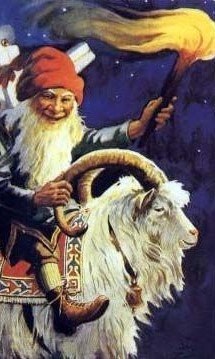
One of Northern Europe’s wackier Christmas traditions – no doubt with pagan roots – the Yule Goat may have derived from the worship of Thor. After all, the God of Thunder’s chariot was drawn by two goats. The Christmas version of the goat is led about by Saint Nicholas, possibly as a symbol of the subjugation of evil.
Whatever the goat’s function, it goes way back. For hundreds of years, rowdy young men in costumes would go door to door to enact plays and demand gifts. One of these, naturally, was the ornery Yule Goat. Scandinavians sometimes refer to the practice of wassailing as “going Yule Goat.”
In the 19th century, the Goat’s role was transformed into a giver of gifts. Though the Goat has since been replaced by a humanoid Father Christmas, in Finland he is still referred to by the name Joulupukki (need I say, Yule Goat?).
Nowadays, the Goat is mostly seen in its incarnation as a miniature tree ornament, made of straw and bound by red ribbon. A notable exception is the Gävle Goat – erected annually in Castle Square, Gävle, Sweden – which is basically that ornament, only on the grandest of scales (i.e. 40-feet tall). The Gävle Goat is constructed over a period of two days, just in time for Advent.
Then begins an unsanctioned game of cat-and-mouse, with the authorities attempting to guard the Goat, while everyone else attempts to light it off. Yes, you read that correctly. If the Goat is burned to the ground before December 13 (St. Lucia’s Day), it is rebuilt.
Over the years, the Goat has been rammed by a Volvo, damaged by fireworks, stomped to pieces, fired upon with flaming arrows (launched by vandals dressed as Santa and gingerbread men), and torched by a hapless American who was talked into using his lighter by Swedes who convinced him it was a perfectly legal holiday tradition. (It’s not.) In 2010, there was even a failed plot to abduct the goat by helicopter.
2016 was the last year the goat went up in flames, set ablaze within hours of construction. The catastrophe was timed to coincide with a security guard’s bathroom break. The most recent attempt was in 2018, but the Goat sustained only minor damage to its front left leg.
But there is also a smaller, companion goat, in the same park, which stands only about 7-feet tall. In 2019, just after I stopped checking, apparently the “kid” got singed. Nevertheless, this is the first time the larger Goat survived for more than two years in a row.
You’ll find more information and a complete history of the Gävle Goat’s destruction here:
http://en.wikipedia.org/wiki/G%C3%A4vle_goat
Excellent time-lapse burning of the Goat:
Follow the Goat’s twitter feed:
https://twitter.com/Gavlebocken…
View the live webcam:
https://www.visitgavle.se/en/gavlebocken
And to keep it musical, here’s a Christmas song by Swedish composer Hugo Alfvén:
Anyone care to start a pool?
-

Easter Witches A Spooky European Tradition
It’s almost Easter. Time for… witches?
Ah, Europe. You can always be counted on to make the most unlikely holidays spooky.
In Sweden and parts of Finland, people love their painted eggs as much as anyone. But they also dress their kids up as witches and send them door to door in search of treats. You have to admit, it’s a lot more interesting than our anodyne peeps and hyacinths that always seem to be trying just a little too hard with their annoying pastel hues. I’m just coming out of winter, dammit! I need me some witches.
In the collective mind of Northern Europe, the dark time between Christ’s betrayal on Maundy Thursday and the radiant hope of His resurrection on Easter is the optimal strike zone for witchery. Just as ants start to find their way into American homes in spring, witches begin to swarm on Nordic rooftops and create mischief for Scandinavian villagers. As preventative measures, devout Christians hide their gardening tools – especially brooms and rakes – and paint crosses on their chests.
I think it’s fairly well-known by now that a number of Easter traditions have their origins in a shadowy pre-Christian past. The Church shrewdly co-opted these for its own festivals and teachings. So the fertility symbols of eggs and hare, central to the pagan celebration of spring and the goddess Eostre, are now enshrined in chocolate and sold to us by Cadbury.
Witches, condemned by the Church since the Middle Ages, are a little harder to market in a young country like the U.S., with its proud Puritan heritage, but to the Northern European the ideas of women riding around on brooms or traveling in the company of black cats are a matter of course. In fact, the prototype can be found in Freyja, the Norse fertility goddess. Wagnerians know her well as Freia, the spouse of Wotan, or Odin.
I won’t go into the details of what kind of debauchery these witches would get up to if they kidnapped you and took you back to their boss. Suffice it to say, the reverent lit fires of evergreens to smoke them out of their chimneys and fed large bonfires against them on Holy Saturday.
Fear and hysteria led to plenty of very real and gruesome deaths of those suspected of witchery. But after a few centuries that all began to die down and everyone decided that witches weren’t so bad after all. In fact, they were rather quaint. Perhaps as a reaction against the Industrial Age, society grew nostalgic for the rural folk superstitions of yore, and the Easter Witch was embraced by mummers as a now-welcome guest at feasts and parades. All at once, it was considered lucky to have a witch on your roof on Maundy Thursday. The witch was even given a companion in the flower-loving Easter Troll.
Hey, I like to think of myself as pretty live and let live. Of more concern to me is that the Easter Witch is also said to be very fond of coffee. Benevolent or not, any witch who tries to get between me and my coffee is going be met by a brand of flaming evergreen.
Wishing you all a Glad Påsk!
Four images of the Easter Witch. Note the prevalence of coffee!
Tag Cloud
Aaron Copland (94) Beethoven (95) Composer (114) Film Music (149) Film Score (143) Film Scores (255) Halloween (97) John Williams (197) KWAX (232) Leonard Bernstein (105) Marlboro Music Festival (125) Movie Music (164) Mozart (91) Opera (215) Philadelphia Orchestra (90) Picture Perfect (174) Princeton Symphony Orchestra (110) Radio (90) Ross Amico (244) Roy's Tie-Dye Sci-Fi Corner (290) The Classical Network (101) The Lost Chord (269) Vaughan Williams (107) WPRB (397) WWFM (881)