Tag: Tchaikovsky

  • Beethoven’s 9th: A Symphony of Brotherhood and Influence

    Beethoven’s 9th: A Symphony of Brotherhood and Influence

    In the past, May 7 was a day for frenemies, as I’ve always been fond of emphasizing the uneasy friendship of Brahms and Tchaikovsky on their birthday anniversaries – artists repelled by one another’s creations, who were pleasantly surprised by how well they got along once they met in person (though they still disliked one another’s music). The alcohol they consumed certainly could not have hurt.

    However, today, we put all that frenemy business aside, as all men are brothers, when the birthdays of Brahms and Tchaikovsky coincide with the 200th anniversary of the premiere of Beethoven’s Symphony No. 9. The Ninth, of course, is the visionary symphony that climaxes with an ecstatic setting of Schiller’s “Ode to Joy.” Everyone knows the melody, even if they think they don’t. The text proclaims, depending on the translation, “All mankind will become as brothers!”

    The tune is demonstrated here by Schroeder, insistently joyous even in the face of Lucy’s hostility:

    Beethoven’s revolutionary masterwork, striking for both its scale (oversized orchestra with a quartet of vocal soloists and chorus) and length (running to well over an hour), cast a forbidding shadow. Much ink has been spilled about the struggles of composers throughout the 19th century to come to terms with the Ninth. In fact, I remember reading a book by conductor Felix Weingartner, a renowned Beethoven interpreter (he was the first to record all nine symphonies), titled “On the Performance of Beethoven’s Symphonies and Other Essays,” in which he addresses the successes and failures of all the major symphonic composers that followed.

    The story of the legendary first performance of the work, on May 7, 1824, is well-known, but bears repeating. The auditorium of Vienna’s Theater am Kärntnertor (Carinthian Gate Theater) was packed – Schubert was in attendance, and so was Czerny – and the orchestra was staffed by many of the great musicians of the day. No complete roster of performers survives, but as was the case with the all-star team that played in the premiere of Beethoven’s 7th, many of Vienna’s most elite musicians participated.

    It was Beethoven’s first public appearance in 12 years. By that time, of course, the composer was almost completely deaf. But that didn’t keep him from air-conducting as the ideal interpretation unfurled in his head. The official conductor was the theater’s kapellmeister, Michael Umlauf, and he instructed the musicians to watch him, not the composer, as he had witnessed an earlier disaster with Beethoven in the pit for a dress rehearsal for “Fidelio.”

    According to one of the violinists, Beethoven “stood in front of a conductor’s stand and threw himself back and forth like a madman. At one moment he stretched to his full height, at the next he crouched down to the floor, he flailed about with his hands and feet as though he wanted to play all the instruments and sing all the chorus parts.”

    When the piece concluded, the hall resounded with applause, but Beethoven was still conducting. The contralto soloist, Karoline Unger, approached the composer and gently turned him around to acknowledge the cheers. Members of the audience, who recognized they could not be heard, waved their handkerchiefs, hats, and hands, so that even in his isolation, the composer knew he had scored a hit.

    Mankind never does seem to get its act together, but even as the world teeters on the brink of disaster, the Ninth continues to resonate. Concert halls fill wherever it is programmed. When the compact disc was developed, technicians standardized the length at 74 minutes, so that the format could accommodate a complete recording of the work. (In the days of LP, I recall some rather awkward breaks in the middle of the third movement.) Used as the prototype was Wilhelm Furtwängler’s 1951 recording.

    In the history of music, the Ninth stands like the monolith in Stanley Kubrick’s “2001: A Space Odyssey.” (Interesting that Kubrick would use the work to such ironic effect a few years later in “A Clockwork Orange.”) There was music before the Ninth and there was music after the Ninth. From a certain point of view, everything seemed to culminate in its creation, and afterward, all was decadence. It is the Continental Divide of classical music.

    For the Romantics, the Ninth changed everything. Every composer for a hundred years had to grapple with its influence. For the rest of the century, experiments with orchestra and chorus became larger and larger, setting all manner of aspirational texts. Mahler pushed 74 minutes to 90 with his Third Symphony. His Eighth is so large, it was dubbed “The Symphony of a Thousand.” In the 20th century, there was nowhere to go but down. Even as composers embraced the leaner textures of neoclassicism they continued to labor in the shadow of Beethoven, whether assimilating his lessons or rejecting them.

    The inclusion of the chorus is the most obvious innovation, but Beethoven wouldn’t be Beethoven if there weren’t plenty else to reward a closer look, and musicians and scholars have been dissecting the work and studying its secrets for the past two centuries.

    Brahms, who lived from 1833 to 1897, and Tchaikovsky, who lived from 1840 to 1893, were no different from their contemporaries in feeling the heat of the 9th. It is well-known that Brahms experienced enormous pressure in his own mastery of symphonic form, postponing his first symphony for many years, as he continued to hone his skills on works such as the orchestral Serenades and the Piano Concerto No. 1, the latter conceived on a suspiciously symphonic scale. It took him over twenty years to own up to an actual symphony.

    At its debut, conductor Hans von Bülow dubbed it “Beethoven’s Tenth,” no doubt because of its excellence, but also because of the perceptible influence of the earlier composer. It was Bülow who also formulated “the three B’s,” grouping Bach, Beethoven, and Brahms in a spontaneously-erected pantheon that music-lovers still invoke. Brahms was surely relieved that the work was so rapturously received, but (being Brahms) he was also annoyed when it was pointed out that the chorale theme that forms the basis of the last movement bears an uncanny resemblance to Beethoven’s “Ode to Joy.” To this, Brahms gruffly responded, “Any ass can see that!”

    I’ve cued the theme up for you at the link, but nothing’s stopping you from going back to listen to the entire symphony:

    After the First, things came easier for Brahms. The ice broken, he composed his Symphony No. 2, with confidence, in a single summer.

    In Tchaikovsky’s case, his own predilection gravitated more toward Mozart. This is evident, of course, in his Orchestral Suite No.4, subtitled “Mozartiana,” but also in the “Variations on a Rococo Theme” for cello and orchestra. He confided to his diary, “I do bow before the greatness of some of his works, but I do not love Beethoven.” That’s not to say he did not respect, or even revere him. His remarks are more nuanced than I make them out to be. You’ll find his complete thoughts here, including the diary entry from which I excerpt, at the bottom of the page:

    https://en.tchaikovsky-research.net/pages/Ludwig_van_Beethoven#:~:text=I%20bow%20before%20the%20greatness,the%20same%20time%20also%20fear.

    Fascinating, then, that Tchaikovsky would exhibit such youthful bravado in setting Schiller’s text himself for his graduation examinations at the St. Petersburg Conservatory! This is a stunning display of self-assurance for a composer who frequently struggled with insecurity. He later dismissed the work as immature, but it is certainly worth hearing:

    In Beethoven, as in all things, it seems, Brahms and Tchaikovsky were divided. Fortunately, they were united in the brotherhood of drink.

    Happy birthday to the Felix and Oscar of classical music, and raise a glass to the most important symphony ever written, with a thought for the brotherhood of man, now to be desired as much as ever.


    This brisk performance from 1958 is one of my favorites. Not for every day, perhaps, but thrilling.

    Weingartner conducts in 1935

    Furtwängler sets the standard length of the CD in 1951

    Bernstein celebrates the fall of the Berlin Wall with a multinational ensemble in 1989, substituting “Freiheit” (Freedom) for Schiller’s “Freude” (Joy)

  • Tchaikovsky sells cigarettes?

    Tchaikovsky sells cigarettes?

    Even the great composers can be monetized. On Tchaikovsky’s birthday, Paul Hogan (of “Crocodile Dundee” fame) employs the Fifth Symphony to sell some cigarettes. Why he plays this arrangement, as opposed to one of the actual piano concertos, is anyone’s guess.

    PHOTO: Nothing makes Tchaikovsky happy like a good smoke

  • Spring Arrives Tchaikovsky vs Rimsky-Korsakov

    Spring Arrives Tchaikovsky vs Rimsky-Korsakov

    So long, winter. We hardly knew ye! Spring arrives this afternoon at 5:24 EDT.

    Last night on “The Lost Chord,” I presented highlights from Nikolai Rimsky-Korsakov’s opera “The Snow Maiden.” The work is an allegorical fairy tale of humans, quasi-mythological creatures, and the eternal forces of nature, with the story of a star-crossed love bringing about the end of a 15-year winter.

    Rimsky’s opera, composed in 1880-81, was based on a play by Alexander Ostrovsky, which was first presented in 1873 with incidental music by Peter Ilych Tchaikovsky.

    Tchaikovsky (1840-1893) and Rimsky-Korsakov (1844-1908) shared something of a complicated rivalry. In public, they were genial and even supportive of one another, while in private both grappled with suspicion and envy. By the mid-1880s, Tchaikovsky achieved such eminence that Rimsky found himself creatively paralyzed. For his part, Tchaikovsky swore his publisher to secrecy about his use of a recently-invented instrument, the celesta, to characterize the Sugar Plum Fairy in “The Nutcracker,” so nervous was he that Rimsky would steal his thunder.

    Tchaikovsky’s untimely death finally lifted some of the pressure. Rimsky exorcised his demons by setting Nikolai Gogol’s short story “Christmas Eve,” a work Tchaikovsky had already adapted as an opera twice: in 1874, as “Vakula the Smith,” and in 1885, as “Cherevichki” (“The Slippers”). Rimsky’s own operatic version of the tale appeared in 1895.

    Rimsky was only 50 when he began work on “Christmas Eve,” but it proved to be the start of something of an Indian summer for the composer. 11 of his 15 operas followed. By the time of his death at the age of 64, he could be said to have been every bit as revered as Tchaikovsky.

    Thanks to the orchestral suite Rimsky distilled from “The Snow Maiden,” at least some of his music is better-known, especially “Dance of the Tumblers,” which is a favorite for drive-time radio. The best-known bit from Tchaikovsky’s version, which honestly has never really caught on to the extent that Rimsky’s has, is also his “Dance of the Tumblers.”

    Winter isn’t over until a ray of sunshine strikes the Snow Maiden. All hail Yarilo, Slavic god of vegetation, fertility, and springtime!


    Tchaikovsky, “Dance of the Tumblers”

    Rimsky-Korsakov, “Dance of the Tumblers”

    Tchaikovsky, Complete incidental music to “The Snow Maiden”

    Rimsky-Korsakov, Suite from the opera “The Snow Maiden”

  • Plimpton, Bernstein, and Tchaikovsky

    Plimpton, Bernstein, and Tchaikovsky

    After posting about Tchaikovsky’s “Little Russian” Symphony this morning, on the 150th anniversary of the work’s first performance, I recollected an anecdote once shared by the writer George Plimpton.

    Plimpton, of course, was most famous for his forays into “participatory journalism” – getting his hands dirty, with the occasional gash or broken bone, in pursuit of a better understanding of the subject he happened to be writing about, whether it be what it would be like to box with Archie Moore, train to be a goalie with the Boston Bruins, or to play quarterback with the Detroit Lions.

    The guy had guts, without the posturing of a Hemingway or a Mailer, and he wasn’t afraid to look foolish. Or if he was, he made pride subservient to the experience. It was an endearing quality in a man who spoke with a patrician accent, cofounded The Paris Review, and could trace his lineage to the Mayflower.

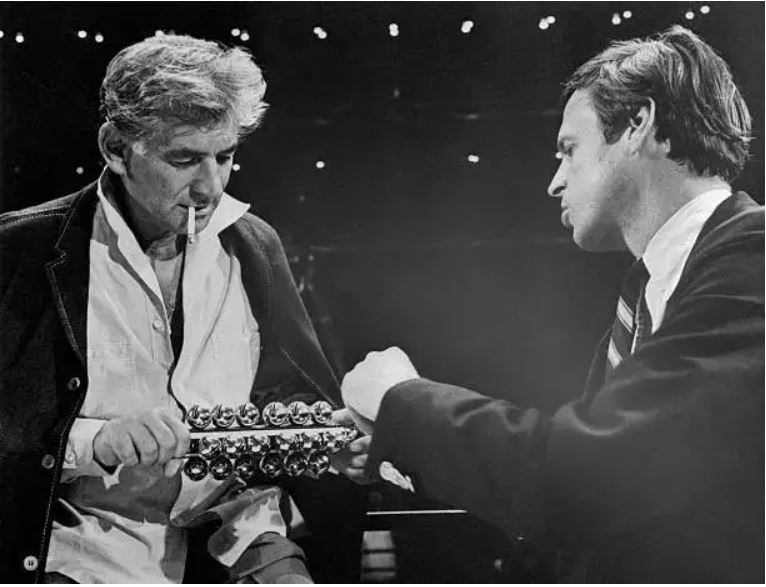
    When Plimpton took an interest in what it would be like to be an orchestra musician, he was allowed to tag along with the New York Philharmonic as a percussionist on its Canadian tour. In this capacity, he played the sleigh bells in the opening movement of Mahler’s Symphony No. 4 – very badly, it turned out, which infuriated the conductor, Leonard Bernstein.

    But Plimpton redeemed himself when he was assigned the gong in Tchaikovsky’s “Little Russian” Symphony. He was so keyed-up in the work’s final movement, as his big moment approached, that when he received his cue from the podium, he struck with such force that he claimed he could see the shock wave travel across the rows of stunned musicians to Bernstein himself, whose eyes widened in surprise. The conductor had to wait for the sound to decay before he could launch into the symphony’s final bars. Bernstein was so pleased with the result that he invited Plimpton to be on the recording of the piece that he and the orchestra subsequently made.

    But I’m only paraphrasing from the words of a very capable writer. Here’s the story from Plimpton’s own lips. Enjoy!

    https://www.c-span.org/video/?c4539798/user-clip-george-plimpton-joins-york-philharmonic


    PHOTO: Plimpton (right) with Bernstein and the Mahler 4 sleigh bells

  • Tchaikovsky’s “Little Russian” Symphony: A Personal Favorite

    Tchaikovsky’s “Little Russian” Symphony: A Personal Favorite

    Favorite Tchaikovsky symphony? In my teens it was the “Pathétique,” easily. I was emotionally aligned with it, as I was with most Romantic music. I never much cared for the 5th, with its annoying recurring motto, except perhaps for the overheated slow movement. The 4th at the moment seems to be enjoying a bit of a vogue – as if it were ever out of style – as seemingly everyone has been programming it for the past season or two. Those are the three most popular.

    But for several decades now my personal favorite must be the 2nd, the one that’s traditionally been identified as the “Little Russian.” The nickname stems from the fact that the work employs Ukrainian folksong. Certainly, the composer had a great deal of affection for Ukraine, though I’m guessing the combined implications in the subtitle of diminution and ownership might annoy present-day Ukrainians. Since the Russian invasion, I’ve seen it referred to several times as “Tchaikovsky’s Symphony No. 2, ‘Ukrainian.’” Will the new name stick? Only time will tell.

    It wasn’t Tchaikovsky who subtitled the work anyway, but rather a friend, the critic Nikolay Kashkin. There was a big nationalist push in Russian music at the time, so Tchaikovsky’s folksong approach was embraced by his peers of the Mighty Handful, or the Russian Five (consisting of Balakirev and his disciples, Rimsky-Korsakov, Mussorgsky, Borodin, and Cui).

    The symphony scored a resounding success when the finale was first played at the home of Rimsky-Korsakov on this date 150 years ago. Tchaikovsky wrote to his brother, Modest, that “the whole company almost tore me to pieces with rapture.”

    The public loved it too. Conductors were eager to program it and critics were enthusiastic. It seems that only Cui, who later trashed Rachmaninoff’s 1st Symphony, disliked it.

    Ultimately, Tchaikovsky would follow a different course and come to be viewed with suspicion by The Five, who looked upon his music as less Russo-centric and more cosmopolitan. But of course, Tchaikovsky would always be Russian to his core.

    That said, the composer genuinely loved Ukraine. He wrote most of the symphony during a summer holiday with his sister’s family in Kamianka. He joked that he should dedicate the work to their elderly butler, who first sang him the folksong “The Crane” that would form the basis for the symphony’s finale.

    Tchaikovsky nearly lost the manuscript on his return to Moscow, when he passed himself off as royalty in order to convince an uncooperative postmaster to hitch up his coach. It was only when he reached his next stop that he realized he had left his luggage behind. Full of nerves that the postmaster would have opened it and discovered his true identity, he sent back an intermediary to retrieve it, but the postmaster would not hand it over. He said he would only release it to the “prince” himself. So Tchaikovsky had to go back.

    Much to his relief, the postmaster seemed to behave normally, so that the composer began to think he had not been caught in his lie. But as he was about to leave, he asked the postmaster’s name, and he replied, “Tchaikovsky!” It was only later that he learned that Tchaikovsky really was the postmaster’s name.

    Despite its immediate success, somehow the composer was not entirely satisfied with the symphony and revised it extensively in 1879-80. Mostly, he rewrote the first movement and tightened up the last. His pupil, Sergei Taneyev, was not alone in the opinion that these changes weakened the work, rather than strengthened it. Even so, it is the revised version we usually hear today.

    In whatever form, the work makes me happy, having heard memorable performances of it with Mstislav Rostropovich on the podium and at an outdoor concert from a makeshift stage in Philadelphia’s Rittenhouse Square. You might say, I have always had great affection for this “Little” symphony.


    A brisk performance of the revised version (1879-80)

    The rarely-heard original version (1872)

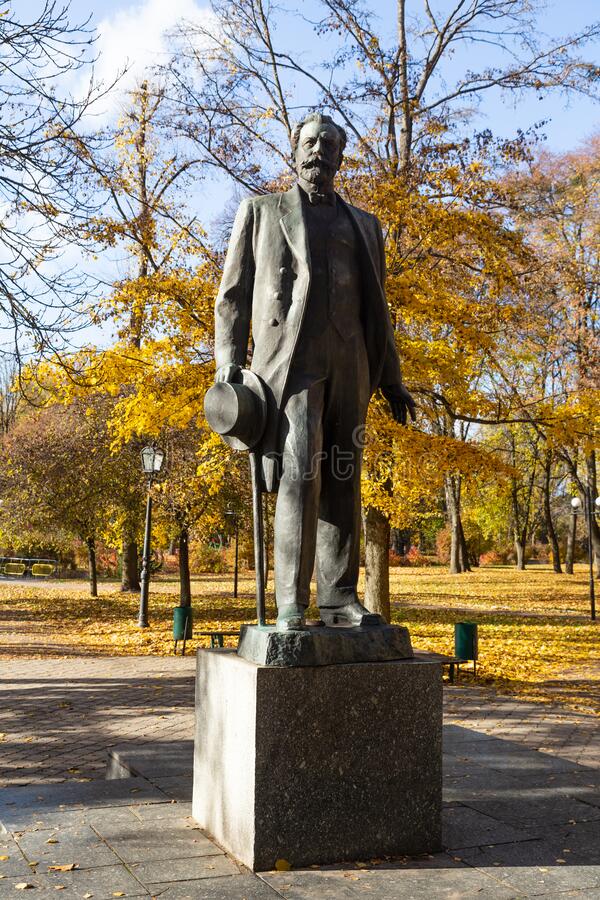
    Tchaikovsky’s house, yet another casualty of the war in Ukraine

    https://www.classicfm.com/composers/tchaikovsky/trostyanets-destroyed-russian-army-ukraine/


    PHOTO: Tchaikovsky statue in Trostyanets, Sumy Oblast, Ukraine

Tag Cloud

Aaron Copland (92) Beethoven (95) Composer (114) Film Music (119) Film Score (143) Film Scores (255) Halloween (94) John Williams (185) KWAX (229) Leonard Bernstein (99) Marlboro Music Festival (125) Movie Music (134) Opera (198) Philadelphia Orchestra (86) Picture Perfect (174) Princeton Symphony Orchestra (106) Radio (87) Ralph Vaughan Williams (85) Ross Amico (244) Roy's Tie-Dye Sci-Fi Corner (290) The Classical Network (101) The Lost Chord (268) Vaughan Williams (102) WPRB (396) WWFM (881)

DON’T MISS A BEAT

Receive a weekly digest every Sunday at noon by signing up here


RECENT POSTS