Tag: Tchaikovsky

  • Brahms & Tchaikovsky A Hirsute Bromance

    Brahms & Tchaikovsky A Hirsute Bromance

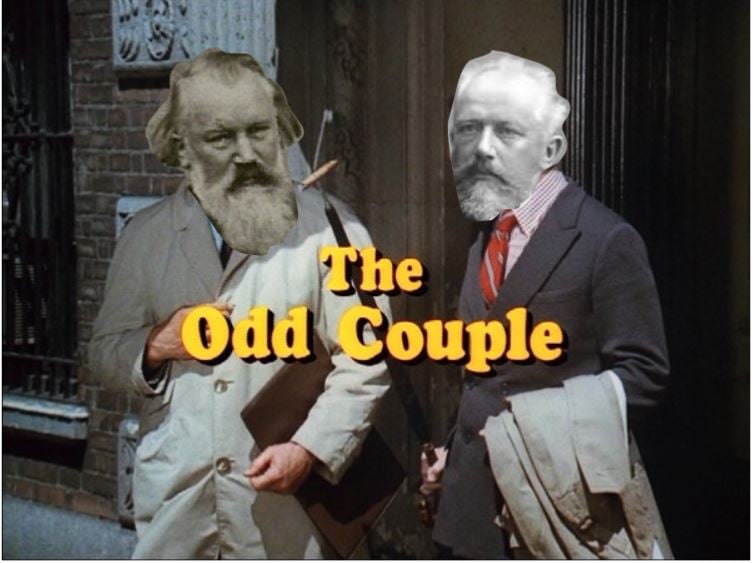
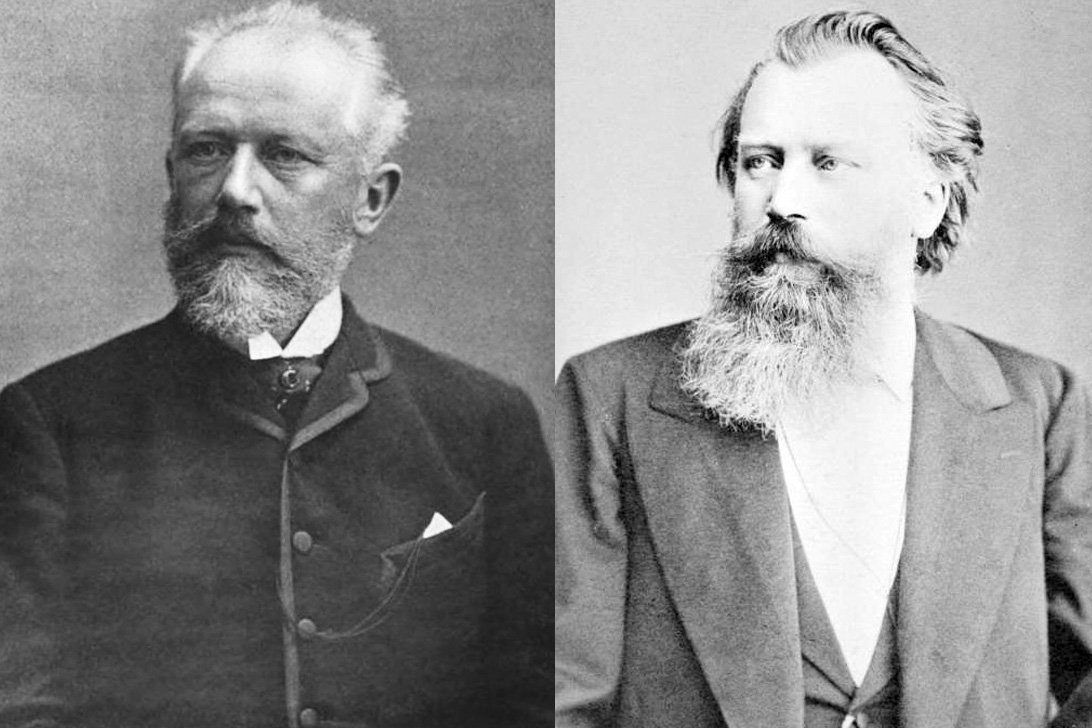
    They were like the Felix and Oscar of Romantic music – the high-strung, fastidious Tchaikovsky (1840-1893), and the acerbic, unkempt Brahms (1833-1897). May 7th marks the anniversary of the births of these twin titans of hirsute Romanticism.

    I always find it oddly endearing that Brahms and Tchaikovsky were able to look past their personal aversions to one another’s music to actually grow to appreciate their individual qualities as people. There’s a lesson to be learned from that, I think.

    Initially, Tchaikovsky might have been right at home posting in a YouTube comments section, confiding to his diary, “I have played over the music of that scoundrel Brahms. What a giftless bastard!”

    For his part, Brahms indelicately drifted off to sleep during a rehearsal of Tchaikovsky’s Fifth Symphony – unfortunately, in the presence of the composer.

    According to the pianist Zygmunt Stojowski, “Tchaikovsky’s comment to me was that he would have been deeply hurt had he not, himself, frankly hated the Brahms symphonies.”

    The two composers met unexpectedly in Leipzig in 1888. They must have been as surprised as anyone to find themselves actually delighting in one another’s company.

    “I’ve been on the booze with Brahms,” Tchaikovsky wrote. “He is tremendously nice – not at all proud as I’d expected but remarkably straightforward and entirely without arrogance. He has a very cheerful disposition, and I must say that the hours I spent in his company have left me with nothing but pleasant memories.”

    The following year, the two met again in Hamburg. That’s when Brahms slept through the Fifth Symphony. Tchaikovsky bore it lightly and was convivial throughout the meal they shared afterward. Although Brahms was harsh in his assessment of the last movement of the symphony and Tchaikovsky confessed an overall aversion to Brahms’ style, the evening was full of good cheer and ended with Tchaikovsky inviting Brahms to visit him in Russia.

    How large a role alcohol may have played in the two men’s warmth for one another we can only guess. It was not just anyone who could be Brahms’ drinking buddy.

    Regardless of their mutual affection, the two never could reconcile themselves to one another’s music. When asked what he thought of a piano trio Brahms had been rehearsing (the Trio in C minor), Tchaikovsky was polite but frank: “Don’t be angry with me, my dear friend, but I did not like it.”

    Happy birthday, boys.


    Brahms, Piano Trio No. 3 in C minor, Op. 101 (disliked by Tchaikovsky)

    Tchaikovsky, Symphony No. 5 in E minor (disliked by Brahms)

  • Sir Thomas Beecham Birthday Tribute

    Sir Thomas Beecham Birthday Tribute

    From the Beecham humidor on his birthday…

    Beecham conducts the nascent London Philharmonic in Tchaikovsky’s “Polish” Symphony

    Beecham interview and rehearsal

    Beecham conducts his arrangements of Handel

    Mozart

    https://www.youtube.com/watch?v=vA83lt-Kg0M

    More about Beecham here:

    https://www.theguardian.com/friday_review/story/0,3605,468909,00.html

    In Delius:

    Berlioz:

    Schubert:

    Liszt:

    Balakirev:

    Vintage Handel:

    Sibelius:

    “The British may not like music, but they absolutely love the noise it makes.”

    Happy birthday, Sir Thomas Beecham (1879-1961)

  • Lysenko’s Taras Bulba Rediscovered

    Lysenko’s Taras Bulba Rediscovered

    It’s funny how one CD, harvested in a batch of probably dozens on one of my trips to Princeton Record Exchange, can suddenly wind up taking on such significance. In 2019, I paid a dollar for it. I never even got around to listening to it. Now, since the invasion of Ukraine, it’s seldom been out of my CD player.

    Mikola Lysenko was a seminal figure of the Ukrainian national school, and “Taras Bulba” is his magnum opus. Based on Nikolai Gogol’s historical novella of patriotism and personal tragedy among the Cossacks, Lysenko’s opera drew praise from no less than Peter Ilych Tchaikovsky.

    Tchaikovsky, himself of Cossack descent (on his father’s side), spent his summers in Ukraine and lived there for several years. Once, Lysenko played through the entire opera for him at the piano, after which Tchaikovsky rose and embraced him. So taken with it was he that he hoped to arrange a performance of it in Moscow. But Lysenko’s insistence that the work be sung in Ukrainian was an obstacle that proved to be insurmountable.

    The year after Lysenko’s death, in 1912, at the age of 69, a piano reduction was published. Unfortunately, much of the opera’s original orchestration was lost and had to be reconstructed by Lysenko’s pupil, Boris Lyatoshynsky. Lysenko himself had studied orchestration with Nikolai Rimsky-Korsakov.

    The first complete performance took place in Kharkiv in 1924. A revision was then undertaken to address concerns that the completion had deviated too far from the composer’s original intentions. The present-day performing edition was given its premiere in Kyiv in 1955. So fervently has the work been embraced by the Ukrainian people that a production of “Taras Bulba” now concludes every season at the Kyiv Opera.

    To discover the disc in my collection is but one of the joys of maintaining a large physical library. Who can tell what other treasures are hidden in plain sight, or the next glint that will catch my eye?

    Happy birthday, Mikola Lysenko. Would that I could offer my respect under better circumstances.

    Click “play all” for a sampling here:

  • Liszt & Friends A Collaborative Genius

    Liszt & Friends A Collaborative Genius

    Sometimes even Romantic geniuses can use a hand.

    This Sunday night on “The Lost Chord,” we’ll hear several works on which Franz Liszt was aided and abetted by his peers.

    While it’s true that, early on, Liszt possessed a degree of insecurity over his abilities as an orchestrator, enlisting the aid of pupils like Joachim Raff and Franz Doppler during his years as Kapellmeister Extraordinaire in Weimar– after all, the bulk of his experience had been as a keyboard composer – he soon mastered the art himself and set about revising every bar, stamping his early orchestral works very much with his own distinctive voice.

    The story behind Liszt’s “Concerto in the Hungarian Style,” however, is quite a different matter.

    German pianist Sophie Menter studied with Liszt in Weimar, beginning in 1869. Her gift was such that Liszt dubbed her “the greatest pianist of her day.” He admired her “singing hand” and called her his “only legitimate daughter as a pianist.” George Bernard Shaw compared her favorably to Paderewski. She was by Liszt’s side in Bayreuth when he died in 1886.

    Menter taught at the St. Petersburg Conservatory between 1883 and 1887. There, she became friendly with Tchaikovsky and convinced him to orchestrate a piano concerto she claimed to have written to showcase her talents as a performer. Tchaikovsky did so and also dedicated the orchestral score of his own “Concert Fantasy” to her.

    What he didn’t realize, and what is now widely believed – thanks to fellow Liszt pupil and Menter confidante Vera Timanoff – is that the piece was actually written, at least in part, by Liszt himself. Had Tchaikovsky known, he may very well have torn up the manuscript. He had come to loathe Liszt, and was particularly disgusted by Liszt’s transcription of the Polonaise from “Eugene Onegin.” But the truth – if truth it be – didn’t emerge, for nearly a hundred years, and Tchaikovsky conducted the first performance of the work in Odessa in 1893.

    Roll over Beethoven, tell Tchaikovsky the news!

    Alongside this colorful concerto by Menter’s mentor, we’ll also hear “The Black Gondola,” orchestrated by John Adams, about a century after Liszt’s death; “Hexameron,” a titanic set of piano variations with contributions from six virtuoso superstars of the 1830s, including Liszt, Carl Czerny, Sigismond Thalberg, and Frederic Chopin; and a selection from the ballet “Apparitions,” engineered in 1936 by Constant Lambert and Gordon Jacob.

    Liszt gets by with a little help from his friends, on “An Assist for Liszt,” this Sunday night at 10:00 EDT, on WWFM – The Classical Network and wwfm.org.

  • Brahms vs Tchaikovsky Birthday Bash on WWFM

    Brahms vs Tchaikovsky Birthday Bash on WWFM

    It’s time for our annual steel-cage death match between Johannes Brahms and Peter Ilych Tchaikovsky. For the shared birthday anniversary of classical music’s greatest frenemies, WWFM The Classical Network will celebrate with a mixed menu of their music, today from 10 a.m. to 7 p.m. EDT.

    Whether your personal taste runs to Brahms, the great classicist among Romantics, or Tchaikovsky, always heart-on-the-sleeve, we hope you will support the tremendous variety of music offered year-round on The Classical Network by contributing right now at 1-888-232-1212, or online at wwfm.org.

    As an added bonus, George Marriner Maull will cap this special day with a program of music and discussion, featuring members of The Discovery Orchestra, coming to you live from Mercer County Community College’s Black Box Theater, adjacent to the WWFM studios. This very special edition of “Inside Music” will commence tonight at 8 pm. (Please note: “Inside Music” is ordinarily heard on the second and fourth Saturdays of every month at 7:30 p.m.)

    Learn more about tonight’s broadcast here:
    https://www.wwfm.org/post/inside-music-goes-live-brahmstchaikovsky-birthday-celebration

    While Brahms and Tchaikovsky were both born on this date – Brahms in 1833, and Tchaikovsky in 1840 – their stars didn’t quite align when it came to what they wanted to express in their art.

    Tchaikovsky notoriously confided to his diary, “I have played over the music of that scoundrel Brahms. What a giftless bastard!”

    For his part, Brahms demonstrated his slight regard of Tchaikovsky’s Fifth Symphony by falling asleep, during a rehearsal, in the composer’s presence.

    The two were finally brought together socially on New Year’s Day, 1888. And surprise! They actually delighted in one another’s company.

    “I’ve been on the booze with Brahms,” Tchaikovsky wrote. “He is tremendously nice – not at all proud as I’d expected but remarkably straightforward and entirely without arrogance. He has a very cheerful disposition, and I must say that the hours I spent in his company have left me with nothing but pleasant memories.”

    The following year, the two met again in Hamburg. That’s when Brahms slept through the Fifth Symphony. Tchaikovsky bore it lightly and was convivial throughout the meal they shared afterward. Although Brahms was harsh in his assessment of the last movement of the symphony and Tchaikovsky confessed an overall aversion to Brahms’ style, the evening was full of good cheer and ended with Tchaikovsky inviting Brahms to visit him in Russia.

    How large a role alcohol may have played in the two men’s warmth for one another we can only guess. It was not just anyone who could be Brahms’ drinking buddy.

    Regardless of their mutual affection, the two never could reconcile themselves to one another’s music. After a lovely evening with Brahms, during which both men drank and smoked prodigiously, while Adolph Brodsky – the violinist who had introduced Tchaikovsky’s Violin Concerto – rehearsed a Brahms piano trio, Mrs. Brodsky asked Tchaikovsky what he had thought of the piece.

    “Don’t be angry with me, my dear friend,” he said, “but I did not like it.”

    Happily, we can enjoy both men’s contributions, thanks to your continued support of classical music, in all its variety, on WWFM – The Classical Network!

    https://wwwfm.secureallegiance.com/wwfm/WebModule/Donate.aspx?P=DEFAULT&PAGETYPE=PLG&CHECK=vOU2bz5JCWmgCDbf53nm9ezWDeZ%2BeA1M&fbclid=IwAR2Z5QwBDt_X7iHkl7UeDuP59E-Xc14Vk8cRM7Ic8NKgMBIhLeMRE8DVBKQ

Tag Cloud

Aaron Copland (92) Beethoven (95) Composer (114) Film Music (119) Film Score (143) Film Scores (255) Halloween (94) John Williams (185) KWAX (229) Leonard Bernstein (99) Marlboro Music Festival (125) Movie Music (134) Opera (198) Philadelphia Orchestra (86) Picture Perfect (174) Princeton Symphony Orchestra (106) Radio (87) Ralph Vaughan Williams (85) Ross Amico (244) Roy's Tie-Dye Sci-Fi Corner (290) The Classical Network (101) The Lost Chord (268) Vaughan Williams (102) WPRB (396) WWFM (881)

DON’T MISS A BEAT

Receive a weekly digest every Sunday at noon by signing up here


RECENT POSTS