
Tag: The Lost Chord

  • WWFM’s Lost Programs & Radio Memories

    WWFM’s Lost Programs & Radio Memories

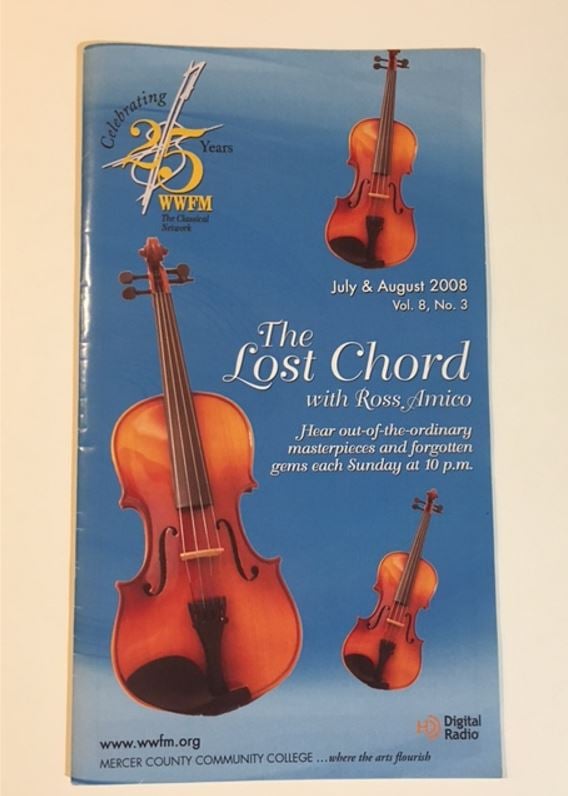
    Remembering the old bi-monthly WWFM – The Classical Network program guides, which passed into obsolescence as the station gradually shifted its focus to online content.

    “The Lost Chord” made the cover in July/August 2008. The show, devoted to unusual and neglected repertoire, is now in its 18th year. This week’s program, focusing on music composed at Howard Hanson’s summer home on Bold Island, Maine, has now been posted a webcast. You can enjoy it here.

    https://www.wwfm.org/post/lost-chord-august-22-august-hanson

    It’s sobering to note that three of the hosts pictured are no longer with us. The photo of WXXI’s Richard Gladwell, longtime host of the syndicated sacred choral music show, “With Heart and Voice,” was snapped on a visit to Trenton-Princeton. Gladwell died in 2009 at the age of 88.

    Radio legend Ralph Collier hosted numerous talk shows, travelogues, and review segments over the course of his career, with guests ranging from Maria Callas to Fred Astaire to President Dwight D. Eisenhower. During his time at WWFM, I acted as Ralph’s “mule,” transporting audio from Ralph’s home in Philadelphia to the station. His was a voice I’d known since childhood, so I always got a charge out of hearing him at the other end of the phone. I still have one of his messages. Ralph died in 2013 at the age of 91.

    And of course, Bliss Michelson was probably my most significant mentor. He was perhaps the most complete “radio man” I ever worked with. I greatly admired his avuncular, unflappable on-air presence. He could handle any challenge you dropped on him, even in front of the microphone, with absolutely no notice. Bliss died of complications from COVID-19 in March at the age of 71. He is fondly remembered.

  • Shelley’s Summer Serenade on The Lost Chord

    Shelley’s Summer Serenade on The Lost Chord

    Music, when soft voices die,
    Vibrates in the memory…

    This Sunday night on “The Lost Chord,” ‘tis an hour of seasonal works inspired by Percy Bysshe Shelley and friends.

    Hearken to Geoffrey Bush’s “A Summer Serenade,” from 1948, settings of poems by Shelley, James I of Scotland, Samuel Daniel, William Blake, Thomas Heywood, and the ever-prolific Anonymous.

    Then listen, listen, Mary mine, to Arnold Bax’s “Enchanted Summer,” from 1918, the text drawn from Act II, Scene 2, of Shelley’s “Prometheus Unbound.” Composed in the midst of a run of Bax’s better-known nature poems (on the one hand, “Into the Twilight” and “In the Fairy Hills,” and on the other, “Nympholept” and “The Garden of Fand”), the work opens with the play of light and shadow on a forest floor, traverses mysterious caves and crags, and conjures woodland spirits; dallies with “voluptuous nightingales;” and eavesdrops on the exchange of two fauns, who contemplate the wondrous things they have witnessed.

    In conclusion, bring hot blushes to thy cheek, with one of Romantic poetry’s most protracted pick-up lines and Roger Quilter’s “Love’s Philosophy,” from 1905.

    ’Tis mine hope that thou wilt join me for “Summer Shelley, Some Are Not.” The dulcet music swells, this Sunday night at 10:00 EDT on WWFM – The Classical Network and wwfm.org!

  • Vacation Music on the Radio This Sunday

    Vacation Music on the Radio This Sunday

    Armchair travelers, rejoice! This Sunday night on “The Lost Chord,” it’s an hour of musical impressions of composers on vacation.

    Tune in for “Postcard Greetings” by Jenö Takács, “Four Breton Sketches” by Anthony Hedges, and “En Vacances” (“On Vacation”) by Deodat de Severac.

    No baggage! No fuss!

    Relax and enjoy the music, on “Leisure Treasures,” this Sunday night at 10:00 EDT, on WWFM – The Classical Network and wwfm.org.
  • Gershwin’s Genius: July 4th on The Lost Chord

    Gershwin’s Genius: July 4th on The Lost Chord

    Happy Independence Day! This Sunday night on “The Lost Chord,” cap your Fourth of July celebrations with an hour of vintage recordings of the music of George Gershwin.

    Gershwin occupied a unique place in American music, rising from Tin Pan Alley scrapper to Broadway royalty. From there, he conquered the concert hall and even the opera house, with his blend of popular song, jazz, blues, spirituals and European classical forms.

    Like Franz Schubert a hundred years before, Gershwin managed to churn out an astonishing amount of music over a comparatively brief span. His songs, in particular, have been of enduring interest. His gift of lyricism and invention defied early critics as he bestrode the worlds of popular and classical music like an American colossus.

    Sadly, at the peak of his success, he died of a brain tumor at the age of 38.

    We’ll sample Gershwin’s artistry in recordings of the era, including several songs performed by Al Jolson, Fred Astaire and Ella Logan. (So many excellent recordings to choose from!)

    We’ll also hear the world premiere recording of “An American in Paris” – performed by the Victor Symphony Orchestra (really members of the Philadelphia Orchestra), with the composer himself on the celesta – and the Concerto in F, performed as part of a memorial concert at the Hollywood Bowl, with the composer’s friend, Oscar Levant, as soloist.

    Three of these recordings date from 1937, the year of the composer’s death. All are from his era. I hope you’ll join me for “Vintage Gershwin,” this Sunday night at 10:00 EDT, on WWFM – The Classical Network and wwfm.org.


    PHOTO: (left to right) Astaire with George and Ira Gershwin

  • George Walker Pulitzer Winner Remembrance

    George Walker Pulitzer Winner Remembrance

    George Walker would have been 99 years-old today.

    Walker was the first African-American recipient of the Pulitzer Prize for Music – as recently as 1996 – for “Lilacs for Voice and Orchestra.” He was the first black pianist to present a solo recital at New York’s Town Hall (in 1945). He was the first black performer to appear as soloist with the Philadelphia Orchestra (performing Rachmaninoff’s Piano Concerto No. 3). He was the first black musician to graduate from the Curtis Institute of Music (where he studied with Rudolf Serkin and Rosario Scalero).

    Walker died on August 23, 2018, at the age of 96. This Sunday night on “The Lost Chord,” we’ll celebrate this trailblazing artist with a program of four of his original works, including his Piano Sonata No. 2 (with the composer himself at the keyboard), the award-winning “Lilacs” (after poetry of Walt Whitman), “Address for Orchestra” (his first major orchestral work), and “Lyric for Strings” (his most famous music, in its original version for string quartet).

    Born in Washington, D.C., Walker was a longtime resident of Montclair, NJ. His father emigrated from Kingston, Jamaica, to study at Temple University School of Medicine; Walker’s mother supervised his first piano lessons. He was admitted to the Oberlin School of Music at the age of 14. He was then admitted to the Curtis Institute in Philadelphia, and later attended the Eastman School. For two years, he studied in Paris with famed pedagogue Nadia Boulanger.

    Walker’s own academic career included posts with Dillard University in New Orleans, the Dalcroze School of Music, the New School for Social Research, Smith College, the University of Colorado Boulder, Rutgers University (where he served as chairman of the music department), the Peabody Institute of John Hopkins University, and the University of Delaware.

    He was the father of two sons, violinist and composer Gregory T.S. Walker and playwright Ian Walker. His sister was the pianist Frances Walker-Slocum.

    By his own assessment, Walker was a composer more interested in building “elegant structures” than in “creating beauty.” Depending on one’s sensibility, it could be argued that he achieved both.

    I hope you’ll join me in “Perambulating with Walker,” this Sunday night at 10:00 EDT, on WWFM – The Classical Network and wwfm.org.


    A fascinating interview with Walker by Frank J. Oteri, which, among other things, lends an added dimension to Walker’s most frequently performed music (the “Lyric”) and offers insights into his life and musical philosophy. Also, some great photos!

    https://nmbx.newmusicusa.org/george-walker-concise-and-precise/


    Do you enjoy exploring unusual and neglected repertoire like that offered on “The Lost Chord?” Whatever it is you appreciate about WWFM The Classical Network, we hope you will help support it with your contribution today. Make a donation through Wednesday, June 30 (the end of our fiscal year), and help balance our budget, at wwfm.org.

    We couldn’t do it without enthusiastic and committed listeners like you. Thank you for all that you do to keep classical music on the radio!

    https://wwwfm.secureallegiance.com/wwfm/WebModule/Donate.aspx?P=DEFAULT&PAGETYPE=PLG&CHECK=vOU2bz5JCWmgCDbf53nm9ezWDeZ%2beA1M

Tag Cloud

Aaron Copland (92) Beethoven (95) Composer (114) Film Music (123) Film Score (143) Film Scores (255) Halloween (94) John Williams (187) KWAX (229) Leonard Bernstein (101) Marlboro Music Festival (125) Movie Music (138) Opera (202) Philadelphia Orchestra (89) Picture Perfect (174) Princeton Symphony Orchestra (106) Radio (87) Ralph Vaughan Williams (85) Ross Amico (244) Roy's Tie-Dye Sci-Fi Corner (290) The Classical Network (101) The Lost Chord (268) Vaughan Williams (103) WPRB (396) WWFM (881)

DON’T MISS A BEAT

Receive a weekly digest every Sunday at noon by signing up here


RECENT POSTS