Tag: The Lost Chord

  • Shofar Sounds for Rosh Hashanah on The Lost Chord

    Shofar Sounds for Rosh Hashanah on The Lost Chord

    Shana tova!

    This Sunday night on “The Lost Chord,” to coincide with the start of Rosh Hashanah, the Jewish New Year, we celebrate the High Holidays with several works highlighting the shofar, a ram’s horn blown as a symbolic call to worship during the holiday season.

    We’ll hear “Call of the Shofar,” for trombone quartet, by Matthew H. Fields (including a pre-performance demonstration by the composer); “Shofar Service,” for baritone, trumpets, shofar, and chorus, by Herman Berlinski (from the Milken Archive of Jewish Music Series, on the Naxos label); and “Tekeeyah,” for shofar, trombone, and orchestra, by Meira Warshauer Composer (on a Navona Records/PARMA Recordings release).

    Get ready to party like it’s 5779. Horn in on the High Holidays with music for the shofar – “Have a Blast,” this Sunday night at 10:00 EDT, on WWFM – The Classical Network and wwfm.org.

  • Vaughan Williams Remembered on WWFM

    Vaughan Williams Remembered on WWFM

    With all the hoo-ha surrounding the 100th anniversary of the death of Claude Debussy, it’s easy to forget that Ralph Vaughan Williams (who studied for a time with Ravel) died 60 years ago today. Yeah, I know 60 doesn’t quite have the marketing punch of 50 or 100, but Vaughan Williams is one of my all-time favorite composers, so I am going to go with it.

    This Sunday night on “The Lost Chord,” we’ll remember one of England’s finest composers by way of three rare recordings he made of his own music.

    Unlike Sir Edward Elgar, who was given the opportunity to record most of his major output, Vaughan Williams was generally overlooked as a conductor by the major labels – which is a shame, because the few recordings he did make are superb.

    Among the acoustical documents, none match the hilarity of RVW’s 1925 performance of “The Wasps” overture. Vaughan Williams’ recording is by far the fastest – and jauntiest – “Wasps” on record, although I’m unsure whether it is due to the composer’s own preference, or because of the limitations of the technology. It’s hard not to smile at such manic high spirits.

    By contrast, his 1937 recording of the Symphony No. 4 is a masterpiece of temperament and ferocity – all the more jarring in that the turbulence evoked in the work is not at all what most people associate with this composer. The urgency of the music is captured, eerily, at a time when the ink was still fresh on the page and the world was on the brink of chaos. It certainly belies the snide dismissal of much of the composer’s output as languid “cow-pat” music.

    In all, Vaughan Willliams’ meager commercial discography as a conductor wouldn’t even fill two hours. It is most fortunate, then, that a few concert recordings have emerged over the years. We’ll conclude with of one of RVW’s loveliest pieces, the “Serenade to Music,” the work which actually brought tears to the eyes of Sergei Rachmaninoff at its first performance in 1938. The text is from Act V, scene I, of Shakespeare’s “The Merchant of Venice.”

    “How sweet the moonlight sleeps upon this bank!
    Here will we sit and let the sounds of music
    Creep in our ears: soft stillness and the night,
    Become the touches of sweet harmony.”

    This performance was captured at Royal Festival Hall on November 22, 1951. Vaughan Williams was 79 years old. What’s especially remarkable is that the recording features 11 of the 16 soloists who sang in the work’s 1938 premiere. We’ll hear it from a compact disc issued on Albion Records, the official label of the Ralph Vaughan Williams Society.

    Vaughan Williams’ ashes are interred in Westminster Abbey alongside some of the nation’s greatest artists – yet, in some measure, the composer is still underestimated, especially by those outside the British Isles. I hope you’ll join me as we remember RVW on the 60th anniversary of his death. That’s “Vaughan, But Not Forgotten,” this Sunday night at 10:00 EDT, on WWFM – The Classical Network and wwfm.org.

  • César Franck & His Belgian Legacy

    César Franck & His Belgian Legacy

    César Franck was a strangely charismatic outsider. A Belgian abroad, he was required to take French citizenship in order to teach at the Paris Conservatory. A renowned organist, his unexpected genius for composition blossomed late.

    His enduring fame rests on a handful of fairly late works. He managed to reinvigorate the French symphonic and chamber music traditions through his use of “cyclic form,” with themes throughout generated from a single motif. He also embraced the symphonic poem. In these regards he certainly bore the influence of Franz Liszt. In turn, he himself became highly influential among a generation of French and Belgian composers.

    This Sunday night on “The Lost Chord,” we’ll examine music by two Belgians who fell under his sway.

    Armand Marsick, born in 1877, trained as a violinist at the Liège Conservatory, before studying abroad in Nancy with Franck enthusiast Guy Ropartz. Then he moved to Paris, where he studied with another Franckian, Vincent d’Indy. His career led him to Athens, and then Bilbao, where he founded a conservatory and an orchestra. He returned to Liège at the age of 50, settling in to teach and direct the concert society there. He died in 1959. The bulk of Marsick’s compositional output, which consisted of some forty works, was written between the ages of 23 and 37. We’ll enjoy a symphonic poem from 1908, titled “La Source.”

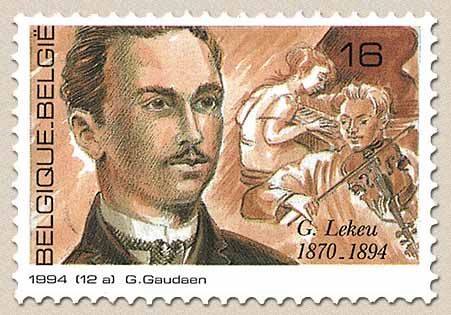
    Guillaume Lekeu was born in Verviers in 1870. He studied with Franck in Paris, then, like Marsick, with d’Indy following Franck’s death. Lekeu, unfortunately, is also remarkable for his very short life. He became ill with typhoid fever after consuming contaminated sherbet at a restaurant, and died in 1894, one day after his 24th birthday. Despite his sadly foreshortened existence, he managed to make important contacts and to write music of considerable promise. At the time of his death, he had already been composing for nine years, from the age of 15. In 1891 he was recipient of a second prize in the celebrated Prix de Rome competition.

    In all, Lekeu composed about 50 works. We’ll hear his Violin Sonata from 1892, written for the great Belgian virtuoso Eugene Ysaye, and his Adagio from 1891, originally composed for quartet and string orchestra. The score to the latter bears an epigraph from a poem by Georges Vanor, “The pale flowers of memory.”

    I hope you’ll join me for music by these Belgian followers of César Franck – “Franckly Belgian” –– this Sunday night at 10:00 EDT, on WWFM – The Classical Network and wwfm.org.
  • Albéric Magnard Fiery French Composer

    Albéric Magnard Fiery French Composer

    To say that French composer Albéric Magnard had a fiery personality stands the risk of skirting bad taste.

    Magnard was born in Paris on this date in 1865. His father, François Magnard, was a notable author and the editor of Le Figaro. His family being rather well off, the younger Magnard exhibited an early determination to make his own way. (As a boy, he had been taunted by cries of “Le fils du Figaro” – the son of Figaro.)

    Following military service, he acquired his law degree. However he was destined never to practice. Instead he made a fateful trip to Bayreuth, where he fell under the spell of Richard Wagner and determined to become a composer.

    He was accepted into the Paris Conservatory, where he studied with Théodore Dubois, Jules Massenet, and Vincent d’Indy. He became particularly close to d’Indy, though he abhorred the latter’s anti-Semitism. (Magnard was outspokenly pro-Dreyfus.)

    Despite his son’s insistence on self-reliance, François helped the young man in whatever way he could, which for the most part meant publishing favorable notices of his son’s music in his influential journal. Magnard “fils” somewhat resented this – but he was also kind of grateful – so that he and his father shared a complicated relationship.

    Like Paul Dukas, who was born the same year, Magnard was highly self-critical, so that his output consists of only 22 works with opus numbers. The publication of most of these he paid for himself. The observation has been made that his symphonies in some respects prefigure those of Gustav Mahler, though others have referred to him as “the French Bruckner.” It’s probably more realistic to say Magnard caught his love of cyclic form from César Franck.

    Incidentally, I’ll be presenting music by some followers of Franck tomorrow night at 10:00 EDT on “The Lost Chord, on WWFM – The Classical Network. Tune in for music by Armand Marsick and Guillaume Lekeu. Curiously, I didn’t think to include Magnard.

    Unfortunately, the most striking feature of Magnard’s life was the manner of his death. In 1914, the composer, aged 59 and a civilian, refused to surrender his property to invading German forces. After sending his wife and two daughters out the back door, he opened fire on some trespassing soldiers and instantly killed one of them. In retaliation, the Germans set fire to his house, and Magnard is assumed to have perished in the conflagration. That said, his body was never discovered.

    Might it be possible that he spent a secret retirement in the company of Ambrose Bierce – who, curiously enough, also disappeared in 1914?

    https://en.wikipedia.org/wiki/Ambrose_Bierce

    Classic Ross Amico, you dog, that is brilliant.


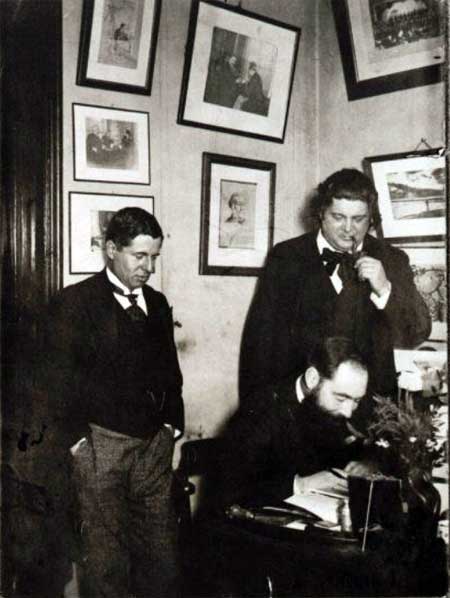
    PHOTO: Magnard (left) with famed Belgian violinist Eugène Ysaÿe (standing) and composer Guy Ropartz. Through a remarkable feat of memory, Ropartz, who had recently conducted Magnard’s opera, “Guercoeur,” was able to reconstruct the score, after it was partially destroyed in the fire that consumed Magnard’s home.

  • Stokowski’s Wagner Philadelphia Orchestra

    Stokowski’s Wagner Philadelphia Orchestra

    With the exception, perhaps, of his own transcriptions of the music of Johann Sebastian Bach, Leopold Stokowski recorded more Wagner with the Philadelphia Orchestra than any other single composer.

    This Sunday night on “The Lost Chord,” we’ll revisit some of Stoky’s early recordings, originally issued on 78s, including the controversial “Liebesnacht,” the original version of his symphonic synthesis after “Tristan und Isolde” – an arrangement that infuriated listeners, with its inconclusive ending – and the “Liebestod,” which he undertook by popular demand, in order to provide a more satisfactory conclusion.

    We’ll also hear baritone Lawrence Tibbett, in a role he never sang on stage, in a superb recording of “Wotan’s Farewell and Magic Fire Music.”

    That’s “Magic Fire” – Leopold Stokowski’s early Wagner recordings with the Philadelphia Orchestra” – this Sunday night at 10:00 EDT, on WWFM – The Classical Network and wwfm.org.
Tag Cloud

Aaron Copland (92) Beethoven (95) Composer (114) Film Music (123) Film Score (143) Film Scores (255) Halloween (94) John Williams (187) KWAX (229) Leonard Bernstein (101) Marlboro Music Festival (125) Movie Music (138) Opera (202) Philadelphia Orchestra (89) Picture Perfect (174) Princeton Symphony Orchestra (106) Radio (87) Ralph Vaughan Williams (85) Ross Amico (244) Roy's Tie-Dye Sci-Fi Corner (290) The Classical Network (101) The Lost Chord (268) Vaughan Williams (103) WPRB (396) WWFM (881)

DON’T MISS A BEAT

Receive a weekly digest every Sunday at noon by signing up here


RECENT POSTS