Tag: The Lost Chord

  • Vintage Wagner on The Lost Chord

    Vintage Wagner on The Lost Chord

    Time to get out the crazy helmets. Tomorrow, May 22, is the birthday of Richard Wagner (1813-1883). This Sunday night on “The Lost Chord,” we’ll honor his legacy with a handful of historic recordings.

    American baritone Lawrence Tibbett never actually sang the role of Wotan on-stage, in the context of a “Ring” cycle. However, he did record “Wotan’s Farewell and Magic Fire Music,” magnificently, in 1934, with the Philadelphia Orchestra and Leopold Stokowski.

    Karl Muck was a victim of anti-German sentiment during his time as music director of the Boston Symphony Orchestra, which, unfortunately, happened to coincide with the First World War. Be that as it may, he was held in the highest regard by fellow musicians and thought by many to be one of Wagner’s finest interpreters. We’ll hear a fascinating 1927 recording of the Transformation music and the beginning of the Grail Scene from Act III of “Parsifal,” made at the Festspielhaus in Bayreuth. The recording employs the original bells designed by Wagner, which would be melted down by the Nazis for ammunition during the Second World War. So this will be a rare opportunity to experience the “Parsifal” Wagner actually knew. Muck was principal conductor of the Bayreuth Festival since 1903. He conducted “Parsifal” at Bayreuth 14 times between 1901 and 1930.

    Finally, we’ll return to “Die Walkure” to wrap things up on a buoyant note with Siegmund and Sieglinde’s love music from Act I, which concludes with the lovers fleeing together into the welcoming spring. Nine months later, Sieglinde gives birth to Siegfried, the saga’s hero-without-fear. Lotte Lehmann strikes sparks with legendary Danish heldentenor Lauritz Melchoir in a 1935 recording with Bruno Walter and the Vienna Philharmonic.

    The power of these performances has been undiminished by the passage of time. Join me for “Vintage Wagner,” this Sunday night at 10 EDT, on WWFM – The Classical Network and wwfm.org.


    PHOTOS: Lotte Lehmann as Sieglinde and Lauritz Melchior as Siegmund

  • Swedish Spring Music on The Lost Chord

    Swedish Spring Music on The Lost Chord

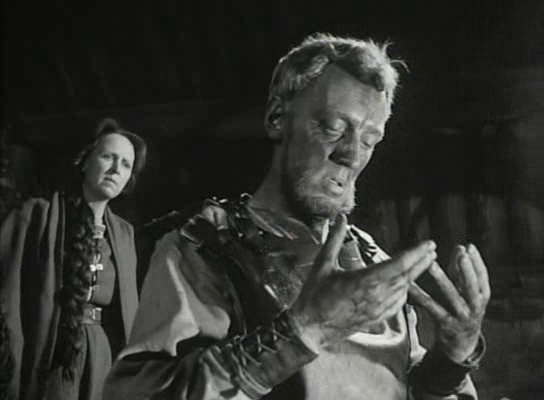
    This Sunday night on “The Lost Chord,” we focus on “The Virgin Spring.” No, not the Bergman film, in which Max von Sydow exacts terrible vengeance on those who… well, nevermind. See the movie.

    Anyway, the show’s not about that. The spring in the film is a body of water, a symbol of rebirth and renewal, but we’re using “spring” in the purely seasonal sense, as we enjoy an hour of vernal expressions by Swedish composers.

    We’ll hear the “Pastoral Suite,” by Gunnar de Frumerie, and two works by Wilhelm Peterson-Berger: first, one of the books from his collection “Flowers of Frösö;” then the “Earina Suite.” “Earina,” derived from the Greek “earinos,” meaning “spring-like,” according to the composer, conjures a world of “cult deeds and magic rites… belonging to some undefined natural religion.” Appropriate music, then, for Walpurgis Night.

    The long winter dissolves in the lengthening days of “The Virgin Spring,” this Sunday night at 10 EDT, on WWFM – The Classical Network and at wwfm.org.

  • Odysseus’s Journey Home A Spring Adventure

    Odysseus’s Journey Home A Spring Adventure

    Ah! Enchanted April…

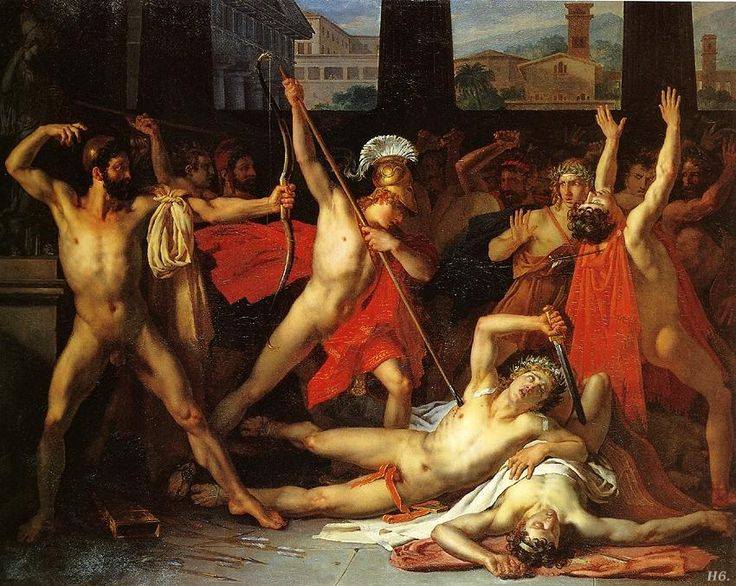
    What is it about spring that puts me in the mind of angry gods, shipwreck, cannibalism, gratuitous nudity, riotous drunkenness, blinded Cyclopes, and the wholesale slaughter of one’s rivals? Actually, I just felt like doing a rerun.

    From “The Lost Chord” archive, it’s an hour of high adventure and satisfied bloodlust, as we listen to musical evocations of Odysseus’ homeward journey.

    Odysseus, of course, is one of the heroes of the Trojan War, waylaid time and again upon his return by Poseidon and the frailties of his own men. It takes him ten years to find his way back to Ithaca. When he gets there, he finds his wife beset by boorish suitors all vying for her hand and his throne.

    What happens next pushes all the same buttons that are still pushed whenever Sylvester Stallone or Arnold Schwarzenegger apply the camouflage and begin strapping on their bandoliers and sheathing their big knives. In the process, there’s also some meaningful father-son bonding. Leave it to Homer, who always knew how to lend class to the classics.

    Just in time for baseball season, I hope you’ll join me for “Home Sweet Homer” (the greatest stretch this side of the seventh inning), this Sunday night at 10:00 EDT, on WWFM – The Classical Network and at wwfm.org.

  • French Women Composers Rediscovered

    French Women Composers Rediscovered

    On this last Sunday of Women’s History Month, we travel to France on “The Lost Chord” for an hour of neglected music by female composers.

    We’ll hear from Augusta Holmès (1847- 1903), French composer of Irish ancestry. Holmès received encouragement from Liszt and Wagner, as well as multiple marriage proposals from Saint-Saëns (which she declined). She became a pupil of César Franck. It’s said that Franck’s Piano Quintet enshrines the teacher’s ardent longing for his student. Saint-Saëns, who participated in the work’s premiere, was not amused.

    Holmès will be represented by her symphonic poem “Andromède,” from 1883. Andromeda, as you may recall from Greek mythology, is at the receiving end of divine envy because of her extraordinary beauty. She is chained to a rock as a sacrifice to a sea serpent, but rescued from her fate by Perseus, who arrives just in the nick of time, astride the winged horse Pegasus and bearing the severed head of the Gorgon Medusa, with which he turns the serpent to stone.

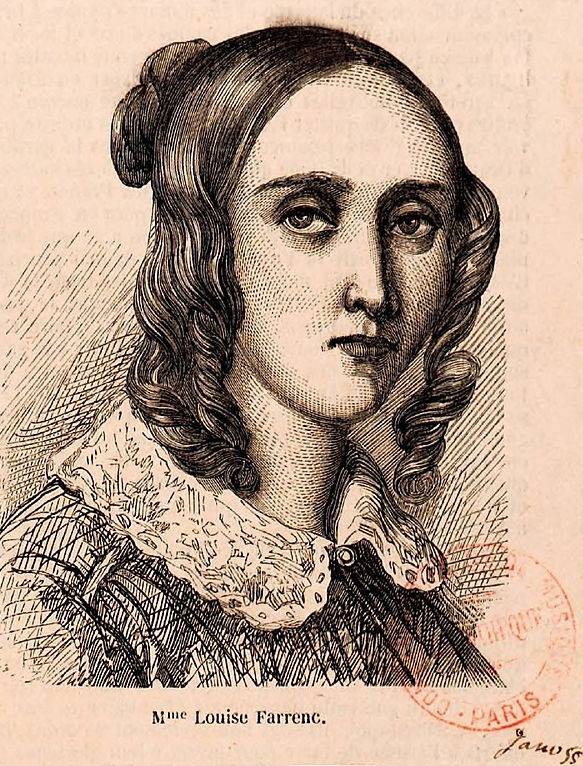
    Louise Farrenc (1804-1875) was remarkable for, among other things, being the only woman on the teaching faculty of the Paris Conservatory during the whole of the 19th century. Beginning in 1842, she served as professor of piano there for 30 years. Of course, she was only allowed to teach women. By the end of the first decade, her stature was such that she was able to demand – and receive – equal pay.

    A pupil of Moscheles (who taught Mendelssohn) and Hummel (who studied with Mozart), she also took composition lessons privately with Anton Reicha, who also taught at the conservatory. She paused in her career as a performer to start a successful publishing house, Éditions Farrenc, which flourished for nearly 40 years. Farrenc composed three symphonies. We’ll hear the third of those tonight.

    Finally, we’ll have music by Marie Gandval (1830-1907). Grandval studied with Flotow, then Chopin, and later Saint-Saëns. Saint-Saëns dedicated his Christmas Oratorio to her. She was the most frequently performed composer on concerts of the Société Nationale de Musique, which Saint-Saëns founded to promote orchestral music, underserved in opera-mad France, where orchestras were tied to the theatres. Grandval herself was a composer of opera and choral music, but we’ll have just enough time for “Deux pièces” for oboe, cello and piano.

    I hope you’ll join me for “Cherchez la Femme,” neglected music by French female composers, this Sunday night at 10:00 EDT, on WWFM – The Classical Network and at wwfm.org.

  • Stephen Dodgson Composer Remembered

    Stephen Dodgson Composer Remembered

    The English composer Stephen Dodgson was born on St. Patrick’s Day, March 17, 1924. At the time I spoke with him in 2012, he was the closest living relative to share the surname Dodgson with his famous forebear, Charles Dodgson, better known as Lewis Carroll.

    At 88, he was in good physical health, it seemed, but unfortunately he was developing serious problems with his memory. His wife informed me after our interview, which took place via telephone, that he had good days and bad days, and that he had been perfectly lucid the day before. In any case, he was a perfectly articulate and charming man, who even invited me to dinner at his house outside of London. However, at the end of 15 or 20 minutes, I still had nothing that I could use on my radio show, “The Lost Chord.”

    Dodgson wasn’t making a lot of sense that afternoon, but when it came to his music, it was like a cloud lifted. He may not have been able to stay on topic long enough to give me any useful audio, but he had no trouble at all naming some of his favorite pieces.

    After the program aired, in October of 2012, I was told by his wife that the two were able to listen to the webcast and that it brought Stephen a lot of pleasure to hear it. I was sorry to learn that he died six months later, nearly a month after his 89th birthday. This Sunday night on “The Lost Chord,” I will be rebroadcasting that program, a few days in advance of what would have been Dodgson’s 93rd birthday.

    The composer was perhaps best known for his guitar music, beginning with a commission from Julian Bream in 1952. The show will open and close with selections from “Watersmeet,” from 2002, written for John Williams (the guitarist was to have been the Dodgsons’ dinner guest on the night that we spoke), for solo guitar and guitar ensemble.

    Flutist Robert Stallman, who lived in Philadelphia for many years, will perform Dodgson’s Flute Quintet, composed in 2003. We’ll also hear the cantata “The Last of the Leaves,” from 1975, on texts of Austin Dobson, Ernest Rhys, G.K. Chesterton and Harold Monro, with bass Michael George and clarinetist John Bradbury. This was an absolute favorite of the composer and his wife.

    Dodgson wrote no symphonies, but he wrote eight large-scale orchestral movements, which he called “Essays.” He selected the fifth of those for inclusion in our program. The Essay No. 5 was composed in 1985.

    Stephen Dodgson was a gentleman in all regards. He was also an educator (beginning at the Royal College of Music in 1947) and a radio host (with the BBC). I am sorry I wasn’t able to take him up on his invitation for dinner, but it was a pleasure at least to make contact with him by telephone, since I genuinely admire his music. I hope you’ll join me tonight at 10:00 EDT* for “Dodgson’s Choice,” on WWFM – The Classical Network and at wwfm.org.

    *Did you remember to turn your clocks ahead?


    ON A RELATED NOTE: The Stephen Dodgson Charitable Trust has been quite active recently in promoting his music. You can learn more at their Facebook page, Stephen Dodgson – composer, or at stephendodgson.com.

Tag Cloud

Aaron Copland (92) Beethoven (95) Composer (114) Film Music (123) Film Score (143) Film Scores (255) Halloween (94) John Williams (187) KWAX (229) Leonard Bernstein (101) Marlboro Music Festival (125) Movie Music (138) Opera (202) Philadelphia Orchestra (89) Picture Perfect (174) Princeton Symphony Orchestra (106) Radio (87) Ralph Vaughan Williams (85) Ross Amico (244) Roy's Tie-Dye Sci-Fi Corner (290) The Classical Network (101) The Lost Chord (268) Vaughan Williams (103) WPRB (396) WWFM (881)

DON’T MISS A BEAT

Receive a weekly digest every Sunday at noon by signing up here


RECENT POSTS