Tag: The Lost Chord

  • Domenico Scarlatti Tributes on The Lost Chord

    Domenico Scarlatti Tributes on The Lost Chord

    Not for any reason beyond the fact that I was able to cobble together what I think is an interesting program, this Sunday night on “The Lost Chord,” the focus will be on Domenico Scarlatti.

    The Baroque keyboard master, born in Naples in 1685 – the same year as Bach and Handel – composed some 555 keyboard sonatas, revered by artists from Frédéric Chopin to Marc-André Hamelin.

    We’ll have tributes and arrangements by four different composers, including Charles Avison, Norman Dello Joio, Dmitri Shostakovich and Alfredo Casella.

    Casella’s “Scarlattiana” (1926), a seven movement suite for piano and orchestra, draws its inspiration from dozens of Scarlatti sonatas. It was not intended for the dance, but since it unabashedly recalls Stravinsky’s “Pulcinella,” it’s hardly surprising that it was only a matter of time before some clown decided to choreograph it.

    I hope you’ll join me for “Italian Dressing” – musical tributes to Domenico Scarlatti – tomorrow night at 10 ET, with a repeat Wednesday evening at 6; or that you’ll enjoy to it later as a webcast at http://www.wwfm.org.

    PHOTO: Wladimir Skouratoff (levitating) and Jacqueline Moreau in a 1954 production of “Scarlattiana”

  • Memorial Day Military Symphonies on The Lost Chord

    Memorial Day Military Symphonies on The Lost Chord

    This Sunday night on “The Lost Chord,” in anticipation of Memorial Day, we’ll have two symphonies composed for the armed forces.

    Morton Gould wrote his Symphony No. 4 for the United States Military Academy at West Point. It was his first large scale piece for symphonic band. The score calls for a “marching machine,” but the recording we’ll hear, issued on the Mercury label, employs the feet of 120 musicians of the Eastman School Symphony Band. Frederick Fennell directs the Eastman Wind Ensemble.

    Samuel Barber composed his Symphony No. 2 in 1943, while he was serving in the U.S. Army Air Force. 20 years later, he revised and published the slow movement as a separate opus, titled “Night Flight,” and then jettisoned – and actually tried to destroy – the rest. The work was reconstituted after the composer’s death, and is now back in circulation. We’ll hear a recording with Marin Alsop and the Royal Scottish National Orchestra.

    I hope you’ll join me for “Orchestrated Maneuvers” – American military symphonies for Memorial Day – tonight at 10 ET, with a repeat Wednesday evening at 6; or that you’ll listen to it later as a webcast, at http://www.wwfm.org.

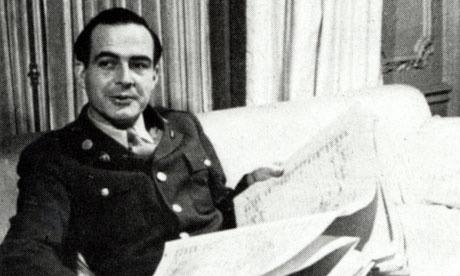
    PHOTO: Corporal Samuel Barber with the score of his Second Symphony

  • Schulz’s Favorite Composer Revealed

    Schulz’s Favorite Composer Revealed

    Who was Charles M. Schulz’s favorite composer? Hint: It wasn’t Beethoven.

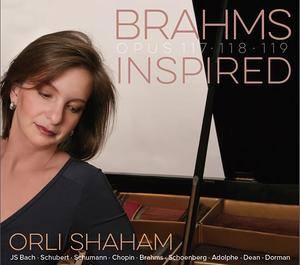
    You can find out the correct answer tonight on “The Lost Chord,” as my guest this evening will be pianist Orli Shaham, who heard it directly from Schulz’s mouth.

    In advance of Brahms’ birthday (on May 7), Shaham will discuss her new album, “Brahms Inspired,” scheduled for release on the Canary Classics label on June 9. The two-CD set features music by some of the composers who influenced Brahms (Bach, Schubert, Chopin, Schumann) and some that Brahms, in turn, inspired (Schoenberg). We’ll be listening to three brand new works, two of them commissioned by Shaham, by Bruce Adolphe, Avner Dorman and Brett Dean, interspersed with late keyboard music by the master himself.

    Shaham will appear in recital at Reform Congregation Keneseth Israel in Elkins Park, Pa., right on the outskirts of Philadelphia, on May 16 at 7:45 p.m. For tickets and information, look online at http://www.kenesethisrael.org/

    For more about Orli, visit her website, http://www.orlishaham.com.

    Who was Schulz’s favorite composer? Well, actually, I suppose you can surmise the answer from the theme of the show, but do tune in anyway, if you can. At least you’ll learn why Schroeder is fixated on Beethoven instead.

    That’s “Aimez-vous Brahms?” on “The Lost Chord,” tonight at 10 ET, with a repeat Wednesday evening at 6; or listen to it later as a webcast at http://www.wwfm.org.

  • Alexandre Dumas in Music on The Lost Chord

    Alexandre Dumas in Music on The Lost Chord

    He is best known as the author of “The Three Musketeers” and “The Count of Monte Cristo.” However, Alexandre Dumas churned out historically-inspired prose on all manner of subjects, and he did so by the yard.

    This Sunday night on “The Lost Chord,” we present an hour of music inspired by his works, including rarely-heard incidental music, written for a revival of the play, “Caligula,” by Gabriel Fauré; ballet music from an opera, “Ascanio,” taken from a novel featuring Benvenuto Cellini, by Camille Saint-Saëns; and a poetic monologue, “Joan of Arc at the Stake,” by Franz Liszt. We’ll also hear the suite for symphonic band, “The Three Musketeers,” by George Wiliam Hespe.

    I hope you’ll join me for “The Lost Sword,” tonight at 10 ET, with a repeat Wednesday evening at 6; or that you’ll listen to it later as a webcast at http://www.wwfm.org.

  • Robert Stallman on The Lost Chord

    Robert Stallman on The Lost Chord

    This Sunday night on “The Lost Chord,” I’ll be joined by flutist Robert Stallman, who will talk about his new album, “Cosi fan Flauti,” recently issued on the Bogner’s Café label.

    On top of a lifetime of experience as a performer, Stallman (a former pupil of Jean-Pierre Rampal) has an unusually intimate knowledge of the scores of Mozart, having transcribed some 50 of his works for other combinations involving the flute. A superb album of “new” quintets for flute and strings, derived from some of the piano sonatas, was met with great acclaim upon its release in 2006, in large part for Stallman’s idiomatic grasp of the composer’s method. He went on to perform the same service for Franz Schubert, having arranged some 40 of his works, several of which were issued on another album in 2009.

    The centerpiece of his most recent issue is a new “Sinfonia Concertante” for two flutes and orchestra, based on a two-piano sonata, which Stallman transcribed and then had his friend, the English composer Stephen Dodgson (a descendent of Charles Dodgson, a.k.a. Lewis Carroll), orchestrate. We’ll be listening to this reimagining of Mozart’s original, as well as Dodgson’s own Concerto for Flute and Strings, which was dedicated to Stallman and recorded for the Biddulph Recordings label, back in 1994.

    Also on the new album is Mozart’s Concerto for Flute and Harp (with Stallman’s own cadenzas) and two selections from the “Haffner Serenade” performed on the flute.

    I hope you’ll join me for “Cosi fan Flauti,” this Sunday night at 10 ET, with a repeat Wednesday evening at 6; or that you’ll listen to it later as a webcast at http://www.wwfm.org.

Tag Cloud

Aaron Copland (92) Beethoven (95) Composer (114) Film Music (123) Film Score (143) Film Scores (255) Halloween (94) John Williams (187) KWAX (229) Leonard Bernstein (101) Marlboro Music Festival (125) Movie Music (138) Opera (202) Philadelphia Orchestra (89) Picture Perfect (174) Princeton Symphony Orchestra (106) Radio (87) Ralph Vaughan Williams (85) Ross Amico (244) Roy's Tie-Dye Sci-Fi Corner (290) The Classical Network (101) The Lost Chord (268) Vaughan Williams (103) WPRB (396) WWFM (881)

DON’T MISS A BEAT

Receive a weekly digest every Sunday at noon by signing up here


RECENT POSTS