Tag: The Lost Chord

  • Film Composers Beyond the Screen

    Film Composers Beyond the Screen

    If after about three hours you find yourself getting played out on the Academy Awards– once Ennio Morricone finally wins his first competitive Oscar, that is (fingers crossed) – you might consider tuning in to “The Lost Chord.” We’ll both complement and enjoy counterprogramming to the ceremony by listening to concert works by composers better known for their work in film.

    Franz Waxman was a two-time Academy Award winner, honored with back-to-back Oscars, in 1950 and 1951, for his work on “Sunset Boulevard” and “A Place in the Sun.” Some of his other classic scores include those for “The Bride of Frankenstein,” “Rebecca,” “Rear Window,” “Peyton Place” and “The Nun’s Story.”

    In 1955, he was traveling from California to Zurich to conduct a new piece commissioned by Rolf Liebermann. When Waxman reached New York he was met with a request from Lieberman’s office for program notes for the impending premiere. Waxman was forced to admit he hadn’t yet begun work on the piece, which he had planned to write during the ocean voyage. Fortunately, he was accustomed from his experience in Hollywood to write very quickly. The result was his “Sinfonietta for String Orchestra and Timpani.”

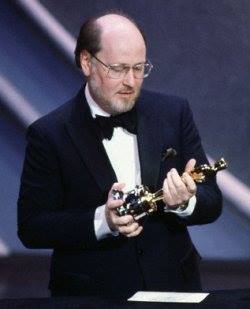
    Five-time Academy Award winner John Williams – whose 50th nominated score, for “Star Wars: The Force Awakens,” is in contention tonight – is of course very well-known for his collaborations with George Lucas and Steven Spielberg. Over the years, he’s also accrued an impressive quantity of concertos. One of the more immediately attractive of these is his Tuba Concerto of 1985, written for the 100th anniversary of the Boston Pops.

    Finally, we’ll turn to three-time Academy Award winner Miklós Rózsa, honored for his work on Alfred Hitchcock’s “Spellbound” in 1945, the Ronald Colman thriller “A Double Life” in 1947, and “Ben-Hur” in 1959. He also composed quite a bit of concert music, including concertos for Jascha Heifetz, Gregor Piatigorsky, Janos Starker, Leonard Pennario and Pinchas Zukerman.

    Rózsa, Hungarian by birth, turned to film after a period of struggle as a young artist in Paris, where he learned from Arthur Honegger that he was able to pay the rent by supplementing his concert music with cinematic efforts. Rózsa’s “Theme, Variations and Finale,” Op. 13, of 1933, preceded the start of his film career by a few years. He revised the piece in 1943, by which time he had already completed his classic fantasy scores for Alexander Korda’s “The Thief of Bagdad” and “Jungle Book,” and was on the verge of becoming a leading composer of film noir.

    “Theme, Variations and Finale” received performances by Charles Munch, Karl Böhm, Georg Solti, and Eugene Ormandy. It was also one of the works that featured on the legendary concert that launched Leonard Bernstein with the New York Philharmonic, on November 14, 1943, when the young assistant conductor substituted at the last minute for an ailing Bruno Walter.

    I hope you’ll join me for an hour of concert music by composers better known for their work in film – “Against Type” on “The Lost Chord” – this Sunday night at 10 ET, with a repeat Wednesday evening at 6; or that you’ll listen to it later as a webcast at wwfm.org.


    PHOTOS: Has anyone here seen Kelly? (Clockwise from left) John Williams wins the Oscar for “Star Wars;” Franz Waxman and Miklós Rózsa receive their awards from the hands of Gene Kelly
  • Nordic Enchanters Music After the Super Bowl

    Nordic Enchanters Music After the Super Bowl

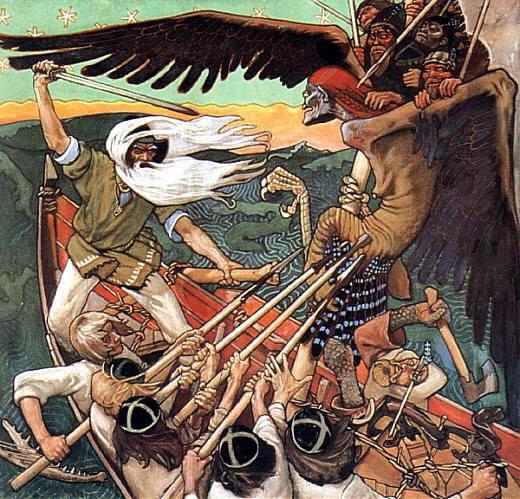
    By my calculations, the Super Bowl should be over by about 10:00. Just in time for this week’s edition of “The Lost Chord.” Who do you think you’re fooling, anyway? You’re never going to get to sleep tonight, with that belly full of buffalo wings and blue cheese dip. So why don’t you pour yourself a nice, cold glass of water and kick back for an hour of music about Nordic enchanters?

    We’ll hear selections from a Finnish film, from 1952, called “The White Reindeer.” Set in Lapland, it tells the tale of a lonely herder’s wife, who visits a local shaman and is transformed into a shapeshifting, vampiric white reindeer. The film was honored at the Cannes Film Festival with a special award for Best Fairy Tale Film, and at the Golden Globes as Best Foreign Film. Einar Englund wrote the score.

    Icelandic composer Jón Leifs saw the play “Galdra-Loftr,” by Jóhann Sigurjónsson, in Reykjavik as a teenager in 1915. He determined at once to set it to music, and carried the idea with him for nearly a decade while he acquired the technique to make it so. Loftur Þorsteinsson, a semi-historical character, was kind of a Faustian figure, a student at the Latin school in Hólar in northern Iceland, whose fascination with black magic ended in tragedy. We’ll hear Leif’s “Loftr Suite.”

    Finally, Gandalf, a beloved figure from J.R.R. Tolkien’s “The Lord of the Rings,” is said to have been inspired in part by the wizard Väinämöinen from “The Kalevala,” the Finnish national epic. Väinämöinen is familiar to music-lovers, perhaps, from his appearances in the works of Jean Sibelius, especially the symphonic fantasy “Pohjola’s Daughter.”

    In 1996, Finnish composer Aulis Sallinen completed his Symphony No. 7, on a commission from the Gothenburg Symphony, which he subtitled “The Dreams of Gandalf.” The origins of the work were in a projected ballet inspired by “The Lord of the Rings.” However, the composer hastens to add that the symphony doesn’t actually depict any of the events in the story, but rather its atmosphere and its poetry.

    The music is bound to be more enchanting than the Super Bowl. I hope you’ll join me for these “Blizzard Wizards,” this Sunday night at 10 ET, with a repeat Wednesday evening at 6; or that you’ll listen to it later as a webcast at wwfm.org.


    PHOTO: Väinämöinen, inspiration for Gandalf, offers his own alternative to buffalo wings

  • Florent Schmitt Rediscovered on The Lost Chord

    Florent Schmitt Rediscovered on The Lost Chord

    This Sunday night on “The Lost Chord,” we bask in the opulent Orientalisms of Florent Schmitt.

    Florent Schmitt, who lived from 1870 to 1958, studied at the Paris Conservatory, where Gabriel Fauré, Jules Massenet, and Théodore Dubois were among his teaches. He befriended Frederick Delius while Delius was in Paris and prepared the vocal scores of a number of his operas.

    Schmitt was also a music critic, who attained a degree of notoriety for shouting out his assessments from the audience. As a composer, he was remarkably successfully, his works among the most frequently performed French music during the early decades of the 20th century.

    His reputation plummeted in the years following the Second World War, and it wasn’t really until the past few decades that his music began to be revived in any significant manner, with a number of fine compact disc recordings of his work currently on the market.

    One of the most recent of these was issued on the Naxos label, with the Buffalo Philharmonic, conducted by JoAnn Falletta. The disc features the symphonic etude, “The Haunted Palace,” after Edgar Allan Poe, and incidental music written for a production of Shakespeare’s “Antony and Cleopatra.” We’ll be listening to the first of the two suites.

    Schmitt was a winner of the Prix de Rome in 1900. The later neglect of his music may have been in part due to his willingness to cooperate with the Vichy regime during the Nazi occupation of France, as well as a marked change in musical fashion from the kind of opulence characteristic of his music, with one foot in the world of Debussy and the other in the world of Wagner and Richard Strauss.

    Even so, Stravinsky was an early admirer, saying of Schmitt’s ballet, “The Tragedy of Salome,” that the work gave him greater joy than any he had heard in a long time. Certain elements of the ballet anticipate analogous experiments in Stravinsky’s “The Rite of Spring.”

    One of Schmitt’s most celebrated works is his setting of “Psalm XLVII.” Despite its Biblical source, the work has little to do with ecclesiastical matters. Rather, the composer was chiefly inspired by ceremonial acclamations of the Ottoman Sultan, which he had witnessed himself in Istanbul in 1903. He appropriates, and interprets, the text as an expression of Oriental triumph, in the opening and closing “O Clap your hands all ye people,” and languor, with a soprano soloist singing, “He hath chosen our inheritance for us, the beauty of Jacob whom He loved.” We’ll hear the BBC National Orchestra and Chorus of Wales conducted by Thierry Fischer.

    I hope you’ll join me for “Schmitt Happens” – recordings from the Florent Schmitt revival – this Sunday night at 10 ET, with a repeat Wednesday evening at 6; or that you’ll listen to it later as a webcast at wwfm.org.


    Exhaustive website devoted to all things Florent Schmitt: http://florentschmitt.com/

  • Remembering John Duffy American Composer

    Remembering John Duffy American Composer

    His was an optimistic and gentle soul. This Sunday night on “The Lost Chord,” we remember John Duffy, who died on December 22, at the age of 89.

    Duffy was founder and president of Meet the Composer, an organization dedicated to the creation, performance and recording of music by American composers. In that capacity, from 1974 to 1995, he initiated countless programs to advance American music.

    We’ll hear Duffy’s Symphony No. 1, commissioned by the Utah Chapter of the Sierra Club, “A Time for Remembrance,” a cantata written to mark the 50th anniversary of the attack on Pearl Harbor, and a selection from his Emmy Award winning music for the PBS television series, “Heritage: Civilization and the Jews.”

    I hope you’ll join me for “Meet the Composer,” as we remember John Duffy on “The Lost Chord,” tonight at 10 ET, with a repeat Wednesday evening at 6; or that you’ll listen to it later as a webcast at wwfm.org.


    John Duffy on his war experiences and his decision to become a composer:

    On naming Meet the Composer:

    On tolerance and growth:

  • Homebodies The Lost Chord American Composers

    Homebodies The Lost Chord American Composers

    With the lingering evidence of Thanksgiving both in our refrigerators and around our waistlines, it’s hardly surprising that our thoughts and memories would be full of home. Perhaps you still are “home,” with family and a full day of travel ahead of you, or you can’t wait to get home (your own).

    Whatever the case may be, this Sunday night on “The Lost Chord,” we’ll have music by American composers inspired by the idea of home.

    We’ll have a work by the “Dean of American composers,” Aaron Copland – his “Letter from Home,” from 1943-44; then a recent piece by John Fitz Rogers, “Magna Mysteria,” from 2010.

    Rogers, who studied with Steven Stucky, Roberto Sierra, Martin Bresnick, and Jacob Druckman, is an associate professor at the University of South Carolina School of Music and the founder of the Southern Exposure New Music Series, which received the 2005-2006 Chamber Music America/ASCAP Award for Adventurous Programming.

    “Magna Mysteria” was commissioned in 2009 to celebrate the restoration of Trinity Episcopal Cathedral (Columbia, South Carolina). From its very title, which translates as “Great Mysteries,” it is clear that this is a work about questions. Its intent is nicely encapsulated in the promotional material accompanying this brand new release from Innova Recordings:

    “Weaving together Latin biblical texts and poetic verse from the sixth-century philosopher Boethius, the composition explores ideas of home and the seeking of home, the elevation of home to a metaphorical or spiritual realm, and the nature of time.”

    What is clear is that the work is gorgeous. If you have a fondness for the choral music of Morten Lauridsen or Stephen Paulus, you will enjoy this, though Rogers is very much his own man. His music is tonal, melodic, and quite lovely. Thank you, Marvin Rosen, for introducing me to this beautiful piece, which I first heard on your radio show, Classical Discoveries.

    We’re home for the holidays this week, on “The Lost Chord.” I hope you’ll join me for “Homebodies,” tonight at 10 ET, with a repeat Wednesday evening at 6; or that you’ll listen to it later as a webcast at wwfm.org.

Tag Cloud

Aaron Copland (92) Beethoven (95) Composer (114) Film Music (123) Film Score (143) Film Scores (255) Halloween (94) John Williams (187) KWAX (229) Leonard Bernstein (101) Marlboro Music Festival (125) Movie Music (138) Opera (202) Philadelphia Orchestra (89) Picture Perfect (174) Princeton Symphony Orchestra (106) Radio (87) Ralph Vaughan Williams (85) Ross Amico (244) Roy's Tie-Dye Sci-Fi Corner (290) The Classical Network (101) The Lost Chord (268) Vaughan Williams (103) WPRB (396) WWFM (881)

DON’T MISS A BEAT

Receive a weekly digest every Sunday at noon by signing up here


RECENT POSTS