Tag: The Lost Chord

  • Pulitzer Prize Winning Music on the Radio

    Pulitzer Prize Winning Music on the Radio

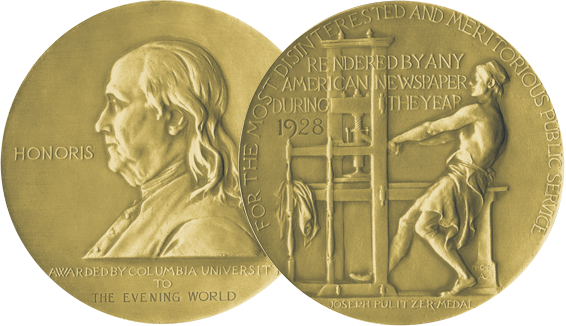
    April is Pulitzer Prize time. This year marks the centennial of the award, which honors excellence in journalism and the arts. Media interest is cresting in advance of the naming of the 2016 honorees, which will take place tomorrow.

    This Sunday night on “The Lost Chord,” we’ll take a look at the Pulitzer Prize for Music. The first Pulitzer Prizes were awarded in 1917, in the fields of journalism, education, letters and drama. The music prize didn’t come along until 1943.

    Of the dozens of pieces honored over the years, surprisingly few have remained in the public consciousness. Only Aaron Copland’s “Appalachian Spring” and perhaps Charles Ives’ Symphony No. 3 “The Camp Meeting” have established themselves firmly in the repertoire – though the operas of Gian Carlo Menotti and Robert Ward are occasionally revived.

    I thought we’d spend yet another hour in what has become an annual salute with some perhaps lesser-known works, though their lack of familiarity is certainly no reflection on the quality of the music or the talent of the composers themselves.

    We’ll hear a piece by Norman Dello Joio, who was awarded a Pulitzer for his “Meditations on Ecclesiastes” in 1957. You know the famous Bible verse, from Book Three of Ecclesiastes, which begins “To everything there is a season.” Its twelve sections consist of an introduction, a statement of a theme, and then ten variations on that theme, calibrated to reflect the verses’ inner meanings. We’ll hear the strings of the Oregon Symphony conducted by James DePriest.

    Then we’ll turn to a deserving work from more recent times. Caroline Shaw, currently a Ph.D. candidate at Princeton University, was 30 years old when she received her award in 2013, making her the youngest Pulitzer winner in her category.

    She was recognized for a virtuosic piece of “a cappella” writing, her “Partita for 8 Voices,” composed between 2009 and 2012. Shaw wrote it for performance by her ensemble, Roomful of Teeth, of which she is a founding member. Roomful of Teeth is well-versed in world styles, and the “Partita” reflects the group’s mastery of a broad array of genres and idioms.

    The Pulitzer committee cited Shaw’s creation as a “highly polished and inventive a cappella work uniquely embracing speech, whispers, sighs, murmurs, wordless melodies and novel vocal effects.” Its four movements are titled after baroque dance forms – Allemande, Sarabande, Courante and Passacaglia. The texts are drawn from instructions for a wall drawing by Sol Lewitt, “Wall Drawing 305,” currently on display at the Massachusetts Museum of Contemporary Art. The performance on this recording, issued on New Amsterdam Records, is incredible.

    I hope you’ll join me for “Pulitzer Prized” – music by recipients of one of music’s most prestigious awards – this Sunday night at 10 ET, with a repeat Wednesday evening at 6; or that you’ll listen to it later as a webcast at wwfm.org.

  • Remembering Sir Peter Maxwell Davies

    Remembering Sir Peter Maxwell Davies

    He burst onto the British musical scene as a fiery iconoclast. Then late in life he ascended to the ultimate Establishment post of Master of the Queen’s music. He was a passionate advocate both of music education for the young and the importance of music in (and from) the community, yet a good many of his major works could be rather forbidding. He wrote pieces that seem to thumb their nose at centuries-old traditions, lacing them with trifling foxtrots. Yet he embraced and elevated that most standardized of forms, the symphony. He ping-ponged back and forth from irreverence to austerity to genuine popular acceptance with folk-inflected works like “An Orkney Wedding with Sunrise” (which he wrote for the Boston Pops). To say that Sir Peter Maxwell Davies was a man of contradictions is an understatement.

    This Sunday night on “The Lost Chord,” we remember Max, who died on March 14 at the age of 81. It was exceedingly difficult to find three works that could encapsulate the most distinctive and disparate aspects of his creative personality, but I believe I’ve finally done so. Part of the challenge is that the symphonies are so blooming long, with all of them (of the ones I know, with the exception the Fifth) running to an hour in length. At last, I struck upon “The Beltane Fire,” which grew out of a ballet commission, but took on a life of its own. The work is meant to suggest the historical conflict between the Reformation clergy and the pagan traditions of the Orkney Islands, located off the northern coast of Scotland. Max enlivens the rather austere sound world of the symphonies with populist interludes in the kind of folk style that worked so well in “An Orkney Wedding.”

    We’ll begin with a cheeky little piece from his “enfant terrible” period inspired by Henry Purcell – a “realisation” (so called) of a “Fantasia and Two Pavans.” The Fantasia employs a shrill piccolo, suggestive of a baroque organ, and the “pavans” are actually foxtrots. Listen for some great aural jokes in the second of them, including a simulation of a Victrola winding down and being wound up again, and then of the “white noise” at the end of a record.

    We’ll conclude with one of Max’s most beloved pieces, a moving work for piano called “Farewell to Stromness.” It was actually written in protest against a proposed uranium mine, which would have been located not far from the town of the title, again located in the Orkney Islands. Though Max was born in Lancashire, he made his home in the Orkneys since 1971.

    A point of local interest: Max, a product of the University of Manchester and the Royal Manchester College of Music (later amalgamated into the Royal Northern College of Music), traveled to Princeton in 1962 to study with Roger Sessions, Milton Babbitt and Earl Kim.

    I hope you’ll join me for “Farewell to Max,” as we remember Sir Peter Maxwell Davies, this Sunday night at 10 EDT, with a repeat Wednesday evening at 6; or that you’ll listen to it later as a webcast at wwfm.org.

  • Celebrating Women Composers Kápralová and Smyth

    Celebrating Women Composers Kápralová and Smyth

    It’s the first day of spring – and Palm Sunday, to boot. With March already slipping away, on this week’s edition of WWFM’s “The Lost Chord,” I’ve opted to focus on contributions of two female composers in honor of Women’s History Month. Both were featured on my earlier, WPRB salute.

    However, I feel in some way that I could have made a stronger case for Vitězslava Kápralová (1915-1940). While I called her one of the great hopes of Czech music, a figure who undoubtedly would be much better known had she not died of tuberculosis at the age of 25, I opted to play her “Partita for Strings and Piano.” While impressive, the work was written very much under the influence of her teacher and lover, Bohuslav Martinu. Martinu’s fingerprints are all over the piece.

    Her String Quartet, on the other hand, was written while she was yet a student at the Prague Conservatory, where her teachers included Vitězslav Novák and Václav Talich. (She studied with Martinu later in Paris.) The work was completed in 1936, when Kápralová was about 21 years-old. In many ways it is a more distinctive and appealing creation. Judge for yourself tonight.

    More about Kápralová here, in this article written to mark her centenary in 2015:

    http://www.telegraph.co.uk/culture/music/classicalmusic/11365848/The-tragedy-of-Europes-great-forgotten-female-composer.html

    Then we’ll have a chance to enjoy a second hearing of Ethel Smyth’s “Serenade in D” – a symphony in all but name – which brought such a positive response when I played it a few weeks ago on WPRB. What I neglected to mention on that occasion was that the piece was Smyth’s first orchestral score, composed in 1890, when she was about 32 years-old.

    I did state that the “Serenade” is better than just about anything composed by her contemporary, Sir Hubert Parry, and much more compelling than the symphonies of Sir Charles Villiers Stanford, and I stand by those assessments. It’s a remarkably assured work, and one that deserves to be far better known.

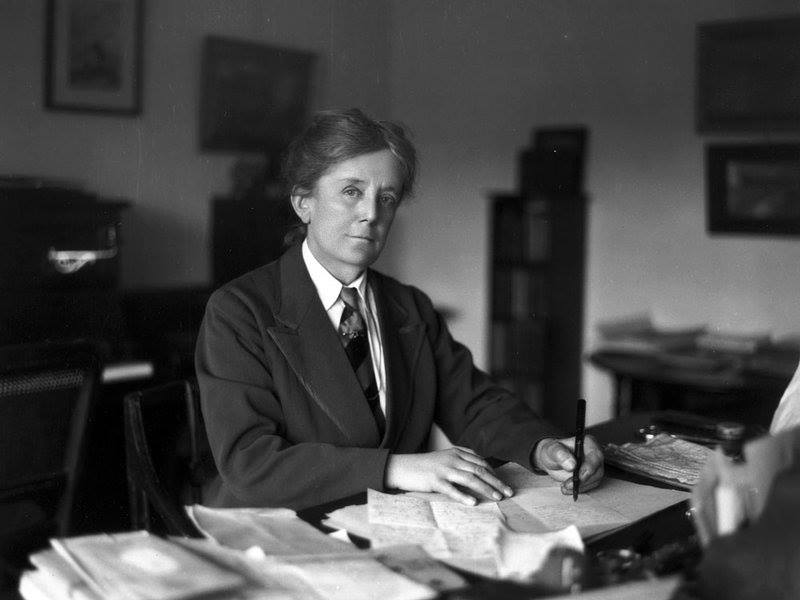
    Smyth (later DAME Ethel Smyth, 1858-1944) was one of the most vocal advocates of the women’s suffrage movement in England. She overcame early opposition to a career in music on the part of her father to receive the praise of George Bernard Shaw, who called her Mass “magnificent.”

    However, her works were often better-appreciated abroad. Her operas, in particular, were embraced in Germany. One of them, “Der Wald,” was the only opera by a woman composer mounted by New York’s Metropolitan opera for over a century!

    Smyth served time in prison for putting out the windows of politicians who opposed a woman’s right to vote. She also wrote for the cause “The March of the Women.” When Sir Thomas Beecham went to visit her in jail, he witnessed her conducting through the bars of her window with a toothbrush as her associates gathered for exercise in the courtyard.

    More about Ethyl Smyth here, in this piece put together in connection with a revival of her opera, “The Wreckers,” by the great Leon Botstein:

    http://www.npr.org/sections/deceptivecadence/2015/07/23/410033088/one-feisty-victorian-womans-opera-revived

    I hope you’ll join me tonight on “The Lost Chord” for music by these two extraordinary women – “A Woman’s Place is in the Concert Hall” – this Sunday night at 10 ET, with a repeat Wednesday evening at 6; or that you’ll listen to it later as a webcast at wwfm.org.


    PHOTOS: Ethel Smyth at her desk (top); Vitězslava Kápralová taking up the baton (she studied conducting in Prague with Václav Talich and in Paris with Charles Munch)
  • Irish Music This Sunday on The Lost Chord

    Irish Music This Sunday on The Lost Chord

    This Sunday night on “The Lost Chord,” it’s a mulligan stew of music by Irish composers and/or on Irish themes, with works by native composers Philip Hammond, John Larchet and A.J. Potter, and Irishmen-for-a-day Arnold Bax, John Foulds, and Percy Grainger, including a roistering set of variations on “The Wild Colonial Boy.”

    It’s probably a lot to expect you to join me for these “Presentiments of St. Patrick,” tonight at 10 EDT – everyone is going to be a bit hagged out from the weekend, between the pre-St. Patrick’s parties, Pi Day, and a short night springing forward into Daylight Saving Time – but do remember that the show will be repeated Wednesday evening at 6 (St. Patrick’s Eve), then archived as a webcast at wwfm.org.

    Sláinte!

  • Early Music Month: Renaissance Sounds on The Lost Chord

    Early Music Month: Renaissance Sounds on The Lost Chord

    This Sunday night on “The Lost Chord,” we continue our celebration of Early Music Month with three works by contemporary American composers who look back to the Renaissance.

    William Kraft (b, 1923), long associated with the Los Angeles Philharmonic, composed “Vintage Renaissance” for the Boston Pops. The work incorporates two 15th century melodies: “Danza,” by Francesco de la Torre, and an anonymous “bransle.”

    George Frederick McKay (1899-1970), the so-called “Dean of Northwest Composers,” founded the composition department at the University of Washington, where he taught for over 40 years. His “Suite on Sixteenth Century Hymn Tunes” is based on works by Louis Bourgeois (c. 1510-1559), compiler of Calvinist hymn tunes and composer of the Protestant doxology known as the “Old 100th.”

    Lukas Foss (1922-2009), the German-born musical prodigy who settled in the United States in 1937, composed his “Renaissance Concerto” in 1986. The work, for flute and orchestra, falls into four movements: “Intrada;” “Baroque Interlude” (on a theme of Rameau); “Recitative” (after Monteverdi); and “Jouissance” (after a 1612 madrigal by a composer of the name David Melville).

    I hope you’ll join me for “It’s Never Too Late to Be Early,” this Sunday night at 10 ET, with a repeat Wednesday evening at 6; or that you’ll listen to it later as a webcast at wwfm.org.

    #EarlyMusicMonth

    Early Music America

Tag Cloud

Aaron Copland (92) Beethoven (95) Composer (114) Film Music (123) Film Score (143) Film Scores (255) Halloween (94) John Williams (187) KWAX (229) Leonard Bernstein (101) Marlboro Music Festival (125) Movie Music (138) Opera (202) Philadelphia Orchestra (89) Picture Perfect (174) Princeton Symphony Orchestra (106) Radio (87) Ralph Vaughan Williams (85) Ross Amico (244) Roy's Tie-Dye Sci-Fi Corner (290) The Classical Network (101) The Lost Chord (268) Vaughan Williams (103) WPRB (396) WWFM (881)

DON’T MISS A BEAT

Receive a weekly digest every Sunday at noon by signing up here


RECENT POSTS