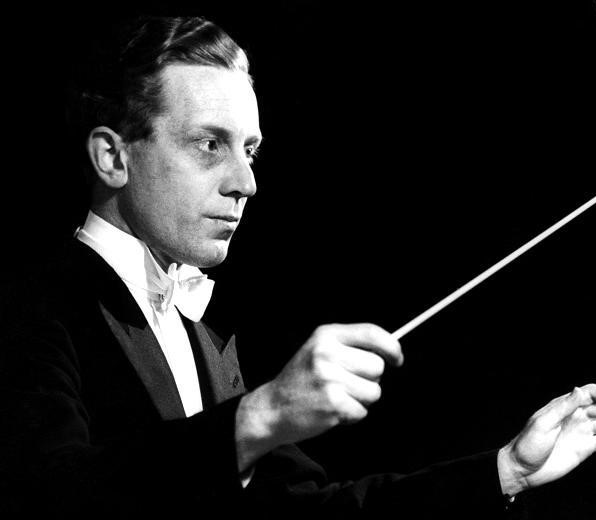
Sir Charles Mackerras excelled as an interpreter of a lot of different kinds of music. He was acclaimed as a Mozartian and recorded a celebrated set of the composer’s complete symphonies. He was also something of a specialist in Czech music, setting down most of Janeček’s operas, in particular.
But he was a lifelong enthusiast of the works of Gilbert & Sullivan, from the time he was a boy, in to old age. This week on “Sweetness and Light,” we’ll enjoy an hour of Mackerras’ delightful Gilbert & Sullivan recordings.
When the copyright expired on Sir Arthur Sullivan’s music in 1950, Mackerras arranged any number of the composer’s works, but most especially the stage successes conceived in collaboration with librettist W.S. Gilbert, into a ballet, “Pineapple Poll.” Employing a method similar to that of Manuel Rosenthal, when reimagining the works of Jacques Offenbach into the ballet “Gaîté Parisienne,” Mackerras cherry-picks from his harvested source material to mix and match and present the music in new and inventive ways. There are a lot of familiar tunes here for seasoned Savoyards, so feel free to hum along.
Mackerras was in his 70s, when he returned to the recording studio to set down more G&S, with a series of their operettas issued on single compact discs (shorn of the overtures and dialogue for time considerations) for the Telarc label in the 1990s. To round out the hour, we’ll sample from his late-career recording of “The Mikado.”
Oh joy unbounded! Oh rapture unexampled! Make way for Charles Mackerras and Gilbert & Sullivan on “Sweetness and Light,” this Saturday morning at 11:00 EDT/8:00 PDT, exclusively on KWAX, the radio station of the University of Oregon!
BONUS! A 1959 broadcast of “Pineapple Poll,” with the Royal Ballet. The work was co-created by the production’s choreographer, John Cranko, and its arranger/conductor (Mackerras, of course).
As a disturbing addendum to yesterday’s post about “The Mikado,” written in honor of Sir Arthur Sullivan’s birthday: the same friend with whom I enjoyed a volley of favorite Gilbert & Sullivan YouTube videos last week wrote overnight to remind me that, in the case of Ko-Ko the Lord High Executioner’s famous “list” song – in which he catalogues those “society offenders who never would be missed” – absent from modern productions is the line, “There’s the n***** serenader and others of his race… I’ve got them on the list!”
I remember, even after the lyric had been altered, as it had been by the time of the D’Oyly Carte Opera Company recording through which I first encountered the work when I was in high school, to “the banjo serenader and others of his race,” that I found it curiously jangling. What race could possibly be meant? Sure, “The Mikado” was written in 1885, when everyone would have been familiar with minstrel shows and the songs of Stephen Foster, with all their banjo strumming, but even a hundred years later, as a teenager, I knew precisely.
Of course, we can deflect it onto the character of Ko-Ko – not everything a character says necessarily reflects the attitudes or beliefs of its author (in this case, W.S. Gilbert) – but considering everything else on the list is calculated to provoke a titter, its out-of-left-field inclusion strikes a sour note indeed.
Perhaps “others of his race” is now to be taken figuratively, as in any kind of person who might play the banjo? I think it requires some seriously gymnastic denial to contort from the original line and arrive at that conclusion.
What I find especially poignant about my friend’s note is that he alludes to his friendship with Henry Varlack, long-time radio personality at the late, lamented WFLN, for 50 years Philadelphia’s full-time classical music station.
My friend recalls, “Oddly enough…when I visited Henry Varlack… after he’d retired from even the tour business… and was approaching the end… he always sang it: ‘You know… it’s the n***** serenader and the others of his race… and the prohibitionist. I’ve got them on the list. I’ve got them on the list.’
“I was always extremely saddened by him singing these verses… but… in retrospect… I realize that he might’ve known that I was the only person in the room who understood the historical context of the lyrics, as none of the other employees had ever listened to Henry as a classical D.J.
“It still disturbs me though… that these lyrics were running through his head in the weeks before died.
“Henry lived through the height of racism.”
Of course, Varlack did not grow up in the age of W.S. Gilbert or the minstrel show, but even in the ‘50s and ’60s, there’s no doubt he saw, and likely experienced, a lot of nastiness.
It makes me sad to think of Henry, who was always a hero of mine, a disembodied friend in the middle of the night, whose distinctive voice introduced so much of the music most meaningful to me, ever having been the object of hatred or discrimination.
The funny thing is, I listened to him for years before I ever even learned that he was black. A true case of race being skin deep. In what way would it ever be acceptable to demean this man, or anyone like him?
By the way, Henry was also a baseball scout. I know I’ve written about him once or twice before. Here’s a post from 2019.
Varlack died in 2006 at the age of 65. His remains were interred at St. Clement’s Church in Philadelphia. Rest his beautiful soul.
The “little list” lyric was not changed until 1948. Henry would have been 7 years-old. This is an example of why it’s so important for history not to be erased.
Here’s a 1926 recording with the original lyric:
It is possible, I suppose – and I hope it is the case – that W.S. Gilbert, with his education and razor wit, could have been railing against the figure of the Negro minstrel – a white man in blackface, twanging on the banjo – an image so prevalent in those days.
Gilbert, I so want to believe in you.
But why, then, use the word again later in the opera? In “A More Humane Mikado,” the original lyrics describe a lady given to modifying her appearance excessively (as the Mikado perceives) receiving the punishment of being “blacked like a n***** with permanent walnut juice.”
I would hope that that is a line that never would be missed. You would never hear it sung that way today. Even so, it’s important that it is remembered. These may have been cases of casual racism in the society in which they were bandied, but from our vantage in the 21st century, these things still matter.
Everyone is so nervous about having charges of cultural appropriation leveled against them these days that I imagine “The Mikado” must be a sensitive subject beyond the insular sphere of Savoyards. You know, like Italians at their Heritage Day celebrations who remain willfully oblivious to Cristofero Colombo controversies. At least, to my knowledge, “The Mikado” hasn’t led to the kind of self-abasement producers routinely inflict on themselves whenever they want to stage “Madama Butterfly.” Anyone with half a brain understands “The Mikado” is not about the Japanese anyway, but rather a veil of rice paper behind which English society and institutions are savagely lampooned. According to Gilbert, “‘The Mikado’ was never a story about Japan but about the failings of the British government.” Yes, there are stereotypes, but they are of a sort that are so far over the top, with characters named Nanki-Poo and Yum-Yum, as to neutralize any idea of serious offense intended.
The opera is not without its issues, of course. It is a product of its time (first produced in 1885). So it could raise some eyebrows, or even a few hackles in the 21st century. But mature and educated people understand how to put things in context, without being driven to obscure or obliterate history. I mention all this not to offer an apologia for one of Gilbert & Sullivan’s most popular works, nor to defend the practice of Western actors in “yellow face,” but rather because, in the course of a coincidental exchange with a friend of mine last week, during which many G&S videos were swapped, I happened across this 1967 film version with members of the D’Oyly Carte Opera Company, including acclaimed G&S interpreters John Reed, Donald Adams, Valerie Masterson, etc. D’Oyly Carte was the foremost producer of G&S operettas from the beginning of the Gilbert and Sullivan partnership, in the 1870s, into the 1980s. You can choose to ignore, if you like, but I intend to watch. Happy birthday, Sir Arthur Sullivan!
The flowers that bloom in spring, tra la, breathe promise of merry sunshine. Words of hope from the pen of W.S. Gilbert, of Gilbert and Sullivan fame.
We’ll begin this Sunday morning on WPRB with the overture to “The Mikado.” This will kick off three hours of music inspired by Japan, alongside original works by Japanese composers, a musical tie-in, of sorts, to the National Cherry Blossom Festival, now flowering in Washington, DC.
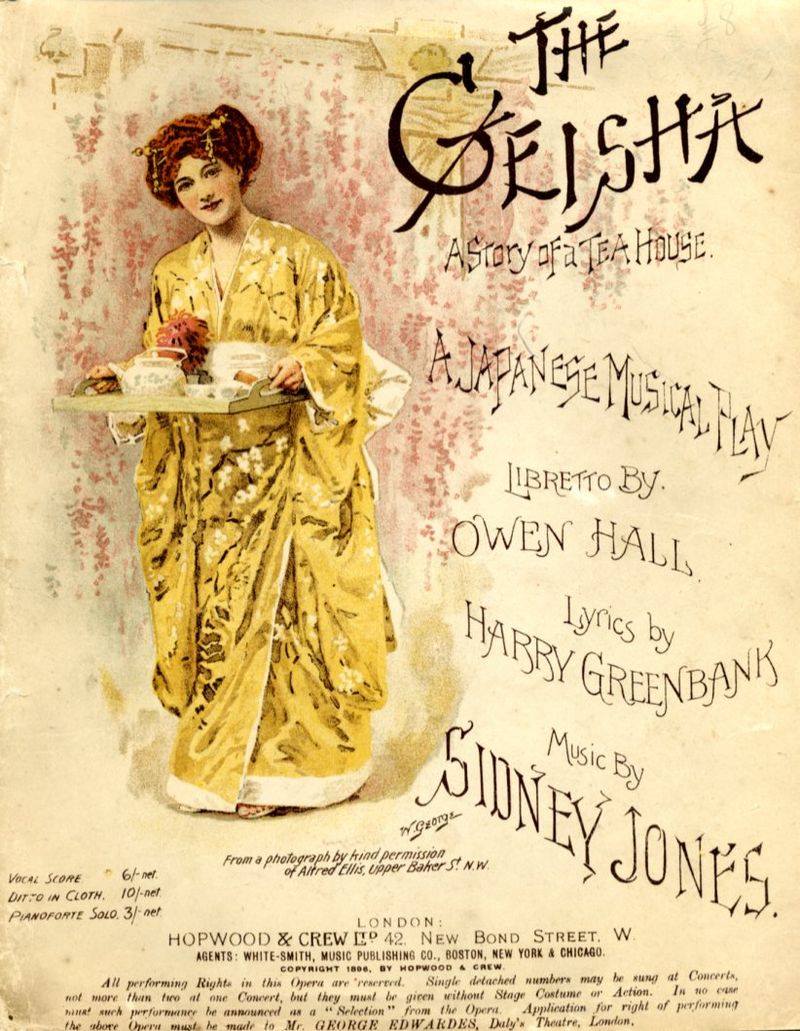
The “highlight” of the morning will be Sidney Jones’ musical comedy, “The Geisha,” which opened in London’s West End in 1896. The work became an international sensation. “The Geisha” capitalizes on the orientalism craze that gripped Europe and the United States at the end of the end of the 19th century. Predating both Puccini’s “Madama Butterfly” and the story that inspired it by several years, the plot similarly is set in motion by a questionable relationship between a Western Navy man and a Japanese woman. The similarities end there, however, as matters rapidly plummet into farce, underscored by melodies and patter songs that owe more to Gilbert and Sullivan than Italian verismo. The work contains one memorable melody after another, and a happy ending is guaranteed.
Though the piece may be hampered by its twee exoticism and unfortunate slang that mark it very much as a product of its time, heard from an historically-informed perspective, “The Giesha” still has much to offer the modern listener.
If you prefer your Japanese culture undistilled, tune in early for music by Japanese composers Komei Abe, Kiyoshige Koyama, Yoquijiro Yocoh, and Akira Ifukube (of “Godzilla” fame). We’ll also hear Gustav Holst’s rarely-heard “Japanese Suite” and, unavoidably, a selection or two from “The Mikado.” Be forewarned, if you switch off before the end, you will miss the inimitable Claudia Novikova’s infectious recording of “The Laughing Song,” an insert aria composed for “The Geisha,” which I guarantee will make your day.
The sun rises in the East, this Sunday morning from 7 to 10 EDT, on WPRB 103.3 FM and wprb.com. We’ll substitute tea for coffee, on Classic Ross Amico.