Tag: WWFM

  • Cathedral Sounds on The Lost Chord

    Cathedral Sounds on The Lost Chord

    Happy Easter, everyone! I’ve been all tied up with Easter activities for most of the day, so I’m only just getting around to extending the invitation for you to cap off your Sunday by joining me on “The Lost Chord” for an hour of pieces inspired or influenced by cathedrals.

    We’ll hear Jennifer Higdon’s “blue cathedral” (all lower-case), from 1999, commissioned by the Curtis Institute of Music in honor of its 75th anniversary. The work is dedicated to the memory of Higdon’s younger brother, Andrew Blue. In the writing of the piece, she imagined a journey through a glass cathedral in the sky, with transparent walls and crystal pillars, through which clouds and endless expanses of blue would be visible.

    Guitarist-composer Agustin Barrios wrote “La Catedral” (“The Cathedral”) in 1921, after having heard music of Johann Sebastian Bach performed on the organ of the cathedral of San Juan Bautista de las Misiones in his native Paraguay.

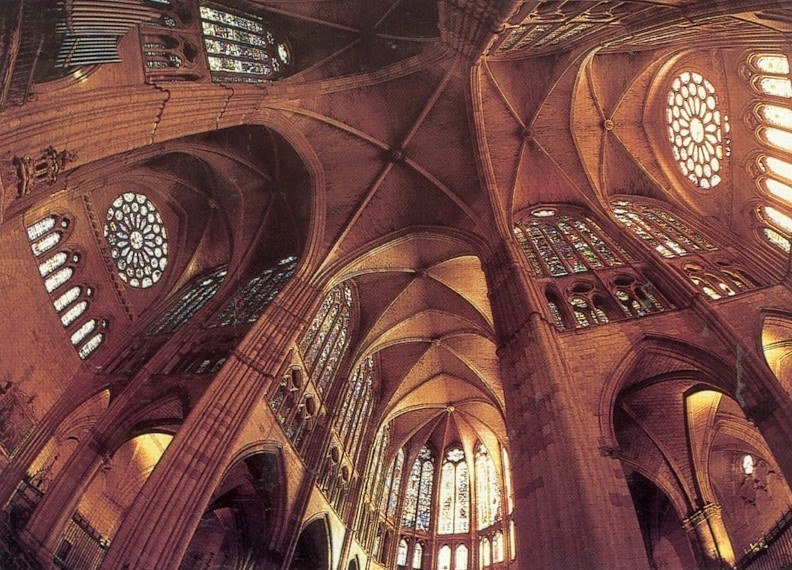
    Englishman Joby Talbot composed “Path of Miracles” in 2005. The work – dedicated to the memory of his father, Vincent – was written on a commission from the vocal chamber group Tenebrae. Its four movements reflect stops along the medieval pilgrimage route to Santiago. The third of these, an evocation of León Cathedral, is imagined as a kind of “Lux Aeterna,” the interior of the space bathed in light.

    Finally, American composer Adolphus Hailstork recollected his experiences as a child chorister at the Cathedral of All Saints in Albany, New York, when he came to write his “Sonata da Chiesa” (“Church Sonata”) in 1992. Hailstork, composer-in-residence at Old Dominion University in Norfolk, Virginia, conceived the work’s seven vibrant sections – “Exaltation,” “O Great Mystery,” “Adoration,” “Jubilation,” “O Lamb of God,” “Grant Us Thy Peace,” and “Exaltation” – for string orchestra, providing a joyous conclusion to the hour.

    I hope you’ll join me for “Master Builders” – architects of cathedrals in sound – this Sunday night at 10:00 EDT, on WWFM – The Classical Network and wwfm.org.


    PHOTO: The vaulted ceiling of León Cathedral
  • Happy Birthday Haydn Classical Music Legend

    Happy Birthday Haydn Classical Music Legend

    Happy birthday, Papa Haydn. Father of the Classical Symphony. Father of the String Quartet. You set the standards against which all subsequent composers have had to measure.

    Two years ago, our colleagues across the pond, Classic FM, commissioned one of its hapless employees to rank Haydn’s 104 numbered symphonies. Of course, this involved actually having to listen to them. Here are the assessments of his overworked ears:

    http://www.classicfm.com/composers/haydn/guides/definitive-ranking-haydn-symphonies/

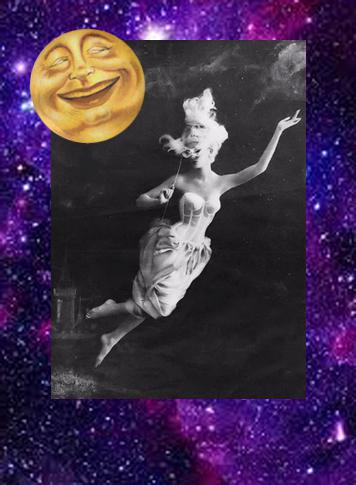
    Closer to home, tomorrow afternoon on The Classical Network, as a convenient antidote to everyone’s anxiety about falling space junk, Michael Kownacky will present Haydn’s comic opera “Il mondo della luna” (“The World on the Moon”), on this week’s “Sunday Opera.” Based on the play by Carlo Goldoni, the scenario pits the clever Ecclitico against the foolish Buonafede. Ecclitico wins both love and fortune, the results of a ruse involving an alleged trip to the moon. (It will be April Fool’s Day, after all.)

    The 1993 recording features Luigi Alva, Domenico Trimarchi, Edith Mathis, Arlene Auger, Frederica von Stade, and Anthony Rolfe Johnson. Listen in, this Sunday at 3 p.m. EDT, on WWFM – The Classical Network and wwfm.org.

    Thank you, Haydn, for your unflagging invention and reliable good humor. Even during Holy Week, your music lifts my spirits.


    Composite artwork to promote tomorrow’s broadcast of “Il mondo della luna” courtesy of Michael Kownacky

  • Haydn Strauss Brahms on WWFM Today

    Haydn Strauss Brahms on WWFM Today

    I don’t what it is, but for some reason I’ve really been on a Haydn kick recently. How fortuitous, then, that a Haydn string quartet would be at the heart of today’s Noontime Concert.

    Members of the Manhattan Chamber Players will perform music for various combinations of strings by Richard Strauss, Haydn, and Brahms.

    We’ll hear the Sextet from Strauss’ final opera, “Capriccio” (1942). The extended movement is not an arrangement, by rather an intimate introduction to an opera which poses the question: which is the greater art, poetry or music? In the opera, the composer Flamand rehearses his new composition at the chateau of Countess Madeleine, who is divided in her affections between Flamand and his rival, the poet Olivier.

    Haydn’s String Quartet No. 19 in C minor, Op. 17, No. 4 (c. 1770), mingles agitation with pathos. You can feel the composer teetering into his “sturm und drang” phase.

    On the other hand, Brahms’ String Quintet No. 1 in F Major, Op. 88 (1882), couldn’t be more different. Brahms doubles the violas for the piece, which he described to Clara Schumann as “one of my finest works.” He also intimated to his publisher, Simrock, “You have never heard such a beautiful work from me.” This was no idle boast. The work is occasionally referred to as the “Spring” Quintet. Brahms completed the piece at a spa in Upper Austria, and the work exudes warmth, contentment, and even joy.

    Then stick around – I will further indulge my Haydn fancy with his magnificent oratorio, “The Seasons,” in advance of the composer’s birthday, which is coming up this Saturday. This is music that truly never goes out of season.

    Strings are the thing on today’s Noontime Concert, and then soloists and chorus sing the praises of spring, courtesy of Haydn, from 12 to 4 p.m. EDT, on WWFM – The Classical Network and wwfm.org.

  • Bach 500 Donations Needed Support Classical Music

    Bach 500 Donations Needed Support Classical Music

    Johann Sebastian Bach’s two wives may have borne him twenty children; but their pains were as nothing next to the protracted labor of this year’s Bach 500. We are still pushing – in part because of last week’s snowstorm, which delayed fundraising – toward our ultimate goal of 500 donations.

    If 500 listeners to The Classical Network step up and contribute in any amount, we will stop with the solicitations and return to uninterrupted music. We are now to the point that we need just a little over 60 donations to wrap up this campaign. For you, it will mean less talk and more music; for us, it will mean $15,000 in challenge money for the station.

    Have you become one of the 500? Your contribution doesn’t have to break the bank. $10 or $20 counts as much as $100 or $200 toward the quota. Of course, we always hope you can be as generous as you can. Do it today at our website, wwfm.org – click on “donate now,” beneath the membership thermometer – or call 1-888-232-1212.

    I’d be especially appreciative if we could reach the 500 BEFORE I have to go on the air today. Wouldn’t it be nice to enjoy just music, from 4 to 7 p.m. EDT? I think so. You can help make it happen. Thank you for your support of WWFM – The Classical Network and wwfm.org.

  • Liszt the Saint Composer’s Sacred Side

    Liszt the Saint Composer’s Sacred Side

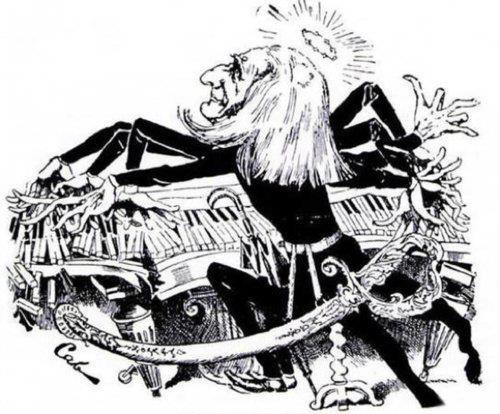
    While the adjective “diabolical” could be applied to Franz Liszt, both in terms of his prowess as a pianist and as a ladies’ man, its application might be justified, really, by only two aspects of his outsized personality.

    Liszt was an especially complex individual, marked by much nobility of character. He was a generous human being, a humanitarian, and an all-around nice guy. He was also quite devout. It was his intention to marry his long-time companion, the Princess Carolyne zu Sayn-Wittgenstein, on his 50th birthday, but his hopes were dashed, after the Church refused to grant her an annulment (she had been estranged from her husband long before she met the handsome touring virtuoso). He reacted by taking minor orders and living in a monastic cell in Rome, where he became known as the Abbé Liszt. (He had also recently lost two of his three children born to him by Marie d’Agoult.)

    Liszt’s religiosity was not something he wore lightly. From an early age, he felt certain he would be a musician or a priest. In the end, he became both.

    This Sunday night on “The Lost Chord,” we’ll sample from two of at least seven of Liszt’s works inspired by his fascination with the saints – “The Legend of St. Elisabeth” and “St. Stanislaus.” St. Elisabeth was the Hungarian princess much concerned with the welfare of the poor, and St. Stanislaus is the patron saint of Poland. These are the subjects of Liszt’s first and last oratorios.

    I hope you’ll join me for “Liszt of Saints,” this Sunday night at 10:00 EDT, on WWFM – The Classical Network and wwfm.org.

Tag Cloud

Aaron Copland (92) Beethoven (95) Composer (114) Film Music (124) Film Score (143) Film Scores (255) Halloween (94) John Williams (188) KWAX (229) Leonard Bernstein (101) Marlboro Music Festival (125) Movie Music (139) Opera (202) Philadelphia Orchestra (89) Picture Perfect (174) Princeton Symphony Orchestra (106) Radio (87) Ralph Vaughan Williams (85) Ross Amico (244) Roy's Tie-Dye Sci-Fi Corner (290) The Classical Network (101) The Lost Chord (268) Vaughan Williams (103) WPRB (396) WWFM (881)

DON’T MISS A BEAT

Receive a weekly digest every Sunday at noon by signing up here


RECENT POSTS