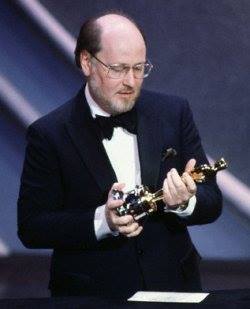
What’s that you say? You could care less about the Oscars? Perhaps then you’d be interested in a little counterprogramming. This Sunday night on “The Lost Chord,” we’ll both deny and complement the ceremony by listening to concert works by composers better known for their work in film.
Franz Waxman was a two-time Academy Award winner, honored with back-to-back Oscars, in 1950 and 1951, for his work on “Sunset Boulevard” and “A Place in the Sun.” Some of his other classic scores include those for “The Bride of Frankenstein,” “Rebecca,” “Rear Window,” “Peyton Place” and “The Nun’s Story.”
In 1955, he was traveling from California to Zurich to conduct a new piece commissioned by Rolf Liebermann. When Waxman reached New York he was met with a request from Lieberman’s office for program notes for the impending premiere. Waxman was forced to admit he hadn’t yet begun work on the piece, which he had planned to write during the ocean voyage. Fortunately, he was accustomed from his experience in Hollywood to write very quickly. The result was his “Sinfonietta for String Orchestra and Timpani.”
Five-time Academy Award winner John Williams – whose 51st nominated score, for “Star Wars: The Last Jedi,” is in contention tonight – is of course very well-known for his collaborations with George Lucas and Steven Spielberg. Over the years, he’s also accrued an impressive quantity of concertos. One of the more immediately attractive of these is his Tuba Concerto of 1985, written for the 100th anniversary of the Boston Pops.
Finally, we’ll turn to three-time Academy Award winner Miklós Rózsa, honored for his work on Alfred Hitchcock’s “Spellbound” in 1945, the Ronald Colman thriller “A Double Life” in 1947, and “Ben-Hur” in 1959. He also composed quite a bit of concert music, including concertos for Jascha Heifetz, Gregor Piatigorsky, Janos Starker, Leonard Pennario and Pinchas Zukerman.
Rózsa, Hungarian by birth, turned to film after a period of struggle as a young artist in Paris, where he learned from Arthur Honegger that he was able to pay the rent by supplementing his concert music with cinematic efforts. Rózsa’s “Theme, Variations and Finale,” Op. 13, of 1933, preceded the start of his film career by a few years. He revised the piece in 1943, by which time he had already completed his classic fantasy scores for Alexander Korda’s “The Thief of Bagdad” and “Jungle Book,” and was on the verge of becoming a leading composer of film noir.
“Theme, Variations and Finale” received performances by Charles Munch, Karl Böhm, Georg Solti, and Eugene Ormandy. It was also one of the works that featured on the legendary concert that launched Leonard Bernstein with the New York Philharmonic, on November 14, 1943, when the young assistant conductor substituted at the last minute for an ailing Bruno Walter.
I hope you’ll join me for an hour of concert music by composers better known for their work in film – “Against Type” on “The Lost Chord” – this Sunday night at 10:00 EST, on WWFM – The Classical Network and wwfm.org.
PHOTOS: Has anyone here seen Kelly? (Clockwise from left) John Williams wins the Oscar for “Star Wars;” Franz Waxman and Miklós Rózsa receive their awards from the hands of Gene Kelly
Leave a Reply to ร้านแอร์สมุทรปราการCancel reply