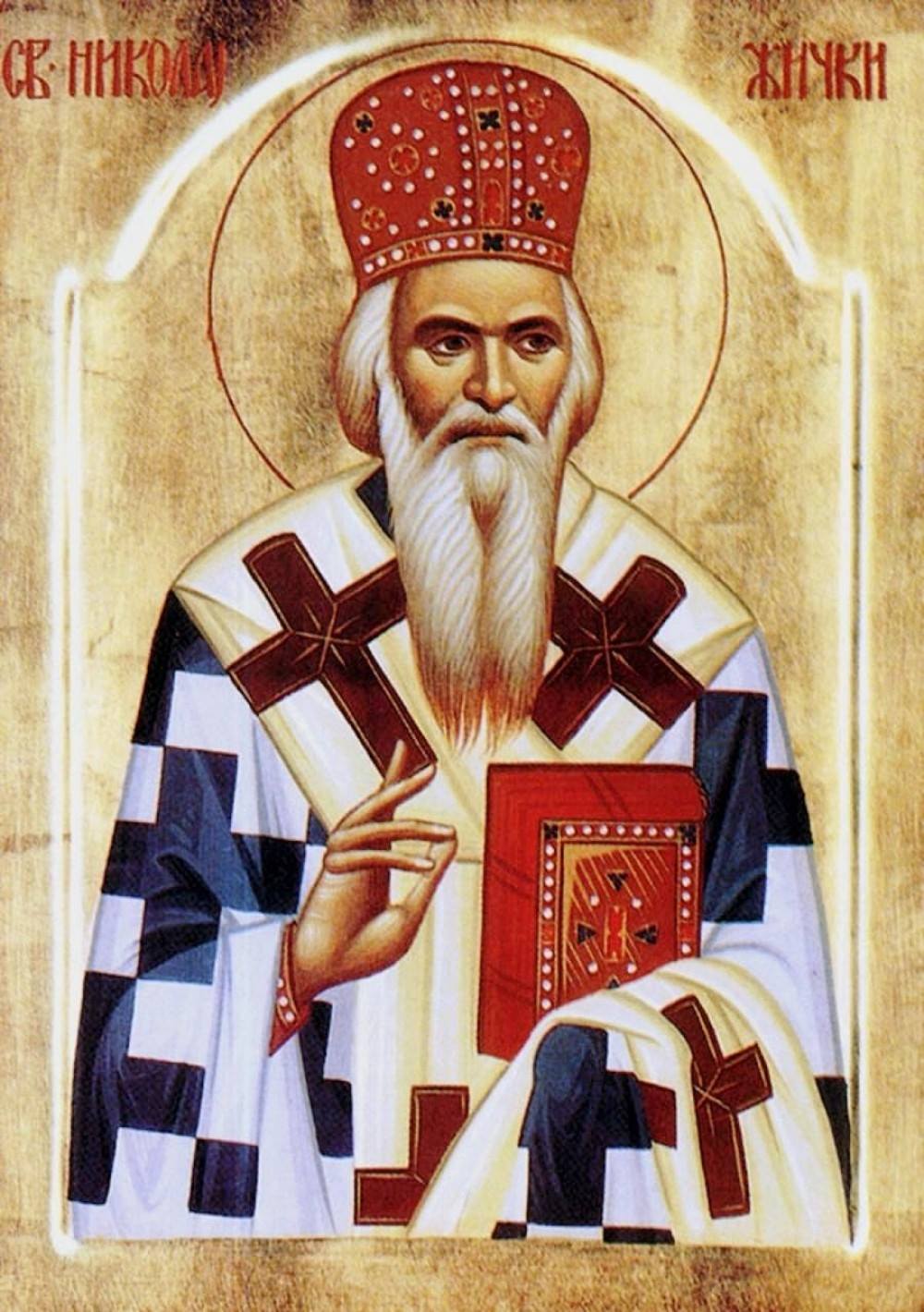
December 6. After all the press I gave Krampus yesterday, it wouldn’t be right to ignore his keeper, Saint Nicholas, on his special day.
Krampus, of course, is the demon who beats wicked children and hurls them into hellfire. Saint Nicholas, on the other hand, rewards the good. He is justly celebrated for his miracles and outstanding generosity. Let us all hoist an eggnog to the jolly old elf! Yay!
Except that – what’s that you say? – the historic Nicholas was not so jolly?
While it would be impossible to deny Saint Nicholas as having done a lot of good in the world, his personality could be a bit, shall we say, problematic. In fact, his modesty could be so extreme as to sometimes verge on the sociopathic. Among other things, he suffered fools grudgingly and became cantankerous if thanked.
Nicholas is one of those rare all-purpose saints, who seems to watch over everyone – sailors, merchants, archers, prostitutes, women seeking husbands, repentant thieves, wrongly condemned prisoners, travelers, pawnbrokers, students, and of course children. Is it any wonder he’s grouchy?
The historic Nicholas served as Bishop of Myra (part of modern day Turkey) in the 4th century. When his parents died, he gave away his inheritance to the poor.
To avoid uncomfortable scenes, he developed a reputation for secret gift-giving. In one famous incident, he rescued three daughters of an unfortunate man who could not afford a proper dowry. In that time and place, it would have made them unmarriageable, and with no opportunity for honest employment, they would have had no alternative but to enter into a life of prostitution.
Nicholas learned of their plight and under the cloak of darkness passed their house three times, each time tossing a purse of gold through a window. Some traditions say he dropped the purses down the chimney; others claim he left coins in stockings left out to dry. When the elated father tried to thank him, Nicholas responded gruffly that it is God he should thank. O-kayyyyy, Nicholas.
On another occasion, during a sea voyage, Nicholas’ ears were assailed by a cacophony of oaths and blasphemies lustily exchanged by the crew. When he tried to get them to mind their language, the sailors laughed and mocked him, and took to swearing with renewed vigor. Nicholas responded by praying for stormy seas, until the sailors dropped to their knees in repentance, effectively scared straight.
He was also wholly intolerant of pagans and heretics. He sent Arius, the father of Arianism, sprawling with a box on the ears, for his assertion that Jesus Christ is subordinate to the entity of God.
The creepiest Nicholas tale concerns the murder of three boys by a butcher during a time of famine. The butcher placed their remains in a barrel to cure, hoping to pass them off as ham(!). Not surprisingly, this didn’t go down well with Nicholas, who resurrected the three children. The episode is recreated most eerily by Benjamin Britten in his cantata, “Saint Nicholas.”
While he’s not a “Bad Santa,” exactly, he’s also not the jolly old elf Clement Moore, Thomas Nast and Coca-Cola would have us believe. He’s just your garden-variety, high-maintenance saint. To me, somehow, this makes him all the more lovable.
But, as was advised in “The Man Who Shot Liberty Valance,” when the legend becomes fact, print the legend. In the Clement Moore/Thomas Nast vein, here’s the “Santa Claus Symphony,” really an ambitious symphonic poem, by the Philadelphia composer William Henry Fry (1813-1864):
If Saint Nick were on Facebook, I am sure I would be flamed so bad right now I’d be wishing for a ride in Krampus’ wicker basket.
Leave a Reply to FAQsCancel reply