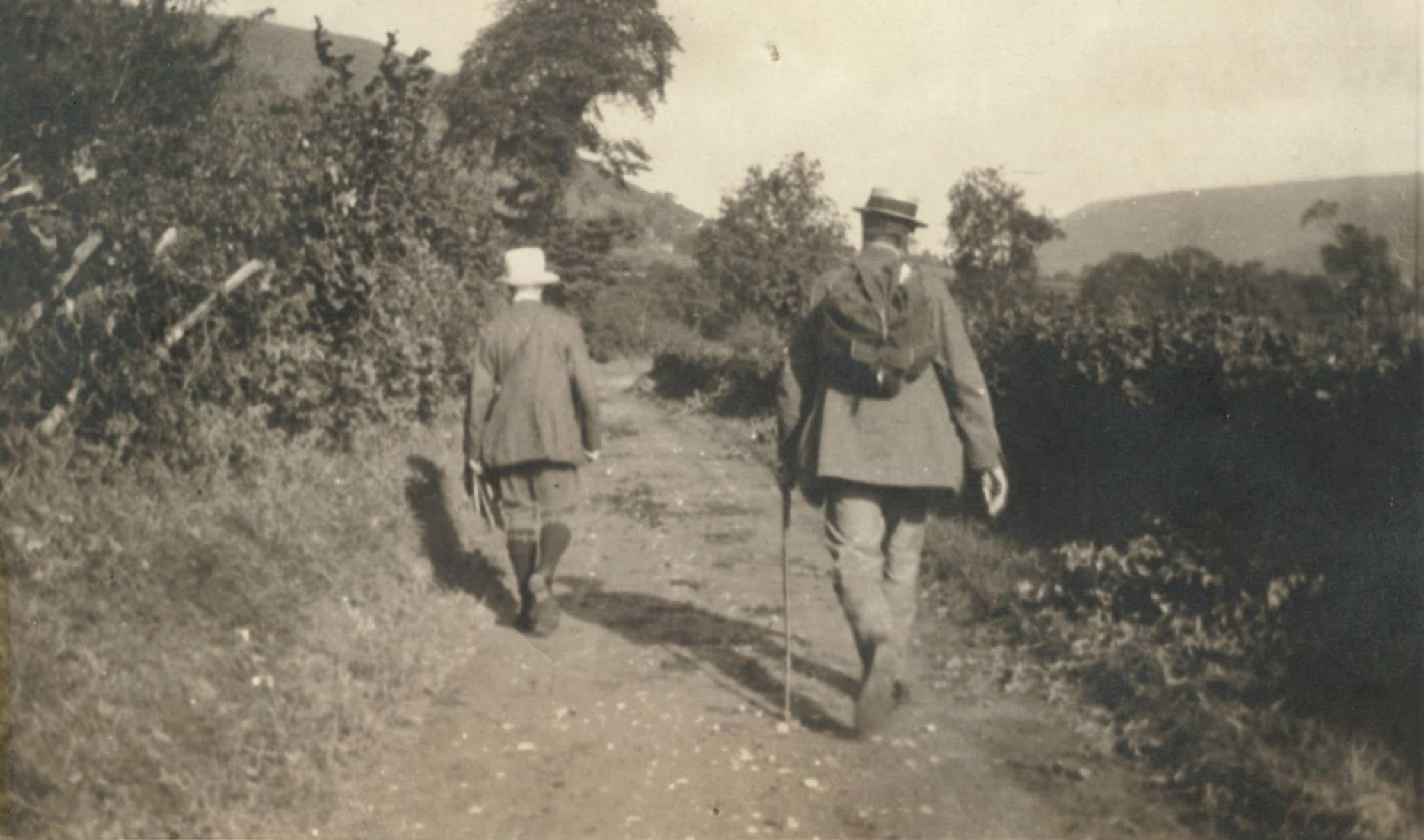
It’s interesting that Gustav Holst and Ralph Vaughan Williams were born three weeks apart (though separated by two years). Uncle Ralph’s birthday is coming up on October 12, but today is a day to celebrate Holst, born on this date in 1874.
“Gustav” may seem like a strange name for one of England’s greatest composers. Even more peculiar, he was actually christened Gustavus. Also, there was a “von” in his name – Gustavus Theodore von Holst. Holst’s father was of Swedish, Latvian, and German descent. His great-grandfather had also been a composer, who taught harp at the Imperial Russian Court in St. Petersburg. Continuing in the family trade, his grandfather set up shop in England. In doing so, he added the “von,” thinking it lent a little gravitas and that it might help to drum up some business. With the outbreak of war with Germany in 1914, sensibly Gustav dropped the prefix
Like Vaughan Williams, Holst was born in Gloucestershire. Both were students at the Royal College of Music, who studied with Sir Charles Villiers Stanford. Significantly, they were also linked by a common destiny, spearheading a movement to establish a distinctly “English” national sound in music. They accomplished this by getting their hands dirty, tying on their boots and striking out for the fields and fens, documenting by cylinder and notating by hand songs of the English countryside, already endangered by encroaching industrialization. In some of their best original music, both composers assimilate native folk inflections into their respective styles.
Holst himself was an exacting teacher, who took his duties very seriously. However, in common with the best of his profession, he never imposed his will on his students, but rather shepherded them in finding their own voices and solutions. Holst served as director of music at St. Paul’s Girls’ School, Hammersmith, and at Morley College.
Of course his masterpiece would be “The Planets,” composed between 1914 and 1916. Hard to believe, in a world full of composers schooled on the piano, that Holst’s principal instrument was the trombone! I recall listening to this music for the first time in my teens and thinking “Jupiter,” in particular, exuded “England.” Its roistering, galumphing, perhaps Falstaffian antics give way to a stately, processional theme, later adapted by the composer into the patriotic hymn “I Vow to Thee, My Country.” But with the passage of time, and longer familiarity, “The Planets’” English identity, is detectable to me in every note.
For all that, Holst was never of a provincial mindset. On the contrary, he was a much more adventurous – and frequently modernist – composer than he is frequently given credit for. His literary inspirations were far-flung, from Thomas Hardy to Walt Whitman to Sanskrit. His music is often less emotive than Vaughan Williams’. I’ve always detected more of an objective detachment in Holst’s works. Remarked Vaughan Williams, “He was not afraid of being obvious when the occasion demanded, nor did he hesitate to be remote when remoteness expressed his purpose.”
The two were one another’s most constructive critics. When Holst died, young, at the age of 59, in 1934, Vaughan Williams felt his friend’s passing keenly. Adding to the personal loss of a lifelong companion, from a professional and artistic standpoint, suddenly he was bereft of his most valued confidante and advisor.
Holst’s legacy can be detected best in those composers who reacted against Vaughan Williams and the pastoral school. His economy and restraint appealed to the generation of Walton, Britten, and Tippett. Also – and I never see this remarked upon – I detect his spirit often in the film and concert music of Bernard Herrmann. (Herrmann was a great anglophile, who championed Holst.) There is a certain aloofness, a chill even, in the work of both artists, but also great sensitivity.
Happy birthday, Gustav Holst! You may be regarded by most as a one-hit wonder, but you connected squarely, and the resulting line drive carried further than is generally accepted.
“Jupiter” (1914)
“Beni Mora” (1910)
Bernard Herrmann conducts “The Planets” (complete)
https://www.youtube.com/watch?v=CX_dTxshVh8
Vaughan Williams’ setting of “Seventeen Come Sunday” from his “English Folk Song Suite” (1923)
Listen for the tune in Holst’s “Somerset Rhapsody” (1906), about three minutes in:
“Choral Hymns from the Rig Veda” (1911), anticipating Britten?
“Hammersmith” (1930), prelude and scherzo
“Song of the Blacksmith”
https://www.youtube.com/watch?v=DbNwpJPlpAQ
“My sweetheart’s like Venus”
PHOTO: Holst and Vaughan Williams in the Malvern Hills in 1921
Leave a Reply to altogelCancel reply