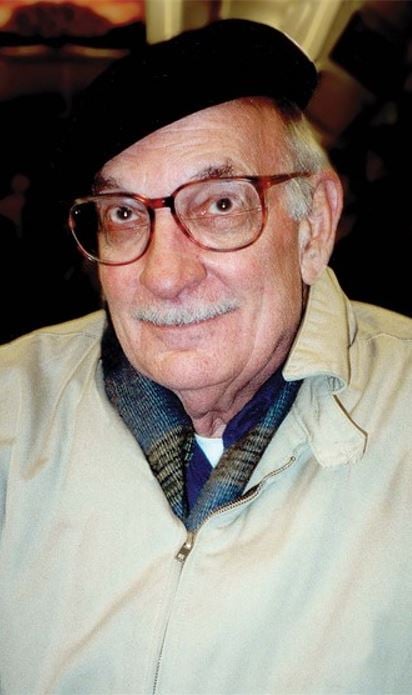
I am very sorry to learn of the passing of George Crumb, a composer I have revered for nearly 40 years, since I first encountered his work for electric string quartet, “Black Angels,” on Philadelphia’s now-defunct classical music station, WFLN. The music scared the hell out of me and completely enthralled me.
The context was a Friday night radio show, “Music Through the Centuries,” hosted by George Diehl. Diehl was at one time WFLN’s program director. He also provided program notes for the Philadelphia Orchestra. “Music Through the Centuries” was a big influence on my own Sunday night program (on WWFM The Classical Network), “The Lost Chord.”
What made this particular episode so indelible is that Diehl introduced a recording of Crumb’s otherworldly, often hair-raising quartet – a reaction to the Vietnam War – by deftly placing it in context, illuminating its structure, and supplementing it with recordings of other works referenced within the piece.
Having cut my teeth on the station’s usual, more traditional fare, my mind was officially blown. It’s not for nothing that William Friedkin incorporated “Black Angels” into “The Exorcist.” I immediately determined to pick up everything I could find on LP, and my enthusiasm continued into the CD era.
The first time I met Crumb was at a recital at the Curtis Institute of Music in Philadelphia. He was there attending a student recital in the company of Richard Wernick. It just so happened that I lived about a block away, so I was able to dash home and retrieve a CD on Bridge Records that contained works by both composers. Both were on the faculty of the University of Pennsylvania. Both were Pulitzer Prize winners.
I caught them as they were leaving the building, and Crumb, likely nonplussed by this 20 year-old autograph hound, was kind enough to sign. Wernick, who of course was with him, couldn’t very well say no. I was a little sheepish about it, and probably didn’t say much of worth. At best, I may have provided a source of amusement on their walk back to the car.
It was another 20 years, then, I think, before I saw him again (although he may have been present when I heard his orchestral work, “A Haunted Landscape,” played by Philadelphia Orchestra in 1989, part of a knockout program also featuring Ravel’s “Le tombeau de Couperin” and Vaughan Williams’ “A London Symphony”). By that time, he had entered his “Grand Old Man of American Music” phase. Furthermore, he was closely affiliated with Orchestra 2001, a contemporary music ensemble founded at Swarthmore College, practically in Crumb’s back yard. Orchestra 2001 gave first performances of many of his later pieces.
Among these were the seven cycles for voice and percussion that comprise his “American Songbook.” These are highly individual recastings of folk songs and hymns he recollected from his boyhood in West Virginia – especially effective, and affecting, when heard in concert, where the breadth and subtlety of the instrumentation can be fully appreciated.
His daughter, Broadway actress Ann Crumb, was a frequent soloist. During this time, I got to meet them both and to speak with them under more relaxed circumstances, at cocktail hours and receptions. They were lovely people. George was unfailingly approachable, good-humored, soft-spoken, and surprisingly modest. Ann, who died much too young at 69, was warm and genuine and a real animal lover. She was always bringing home strays, so that the Crumb household was full of dogs (the most notorious being “bad dog” Yoda).
It is perhaps an overused description, but George Crumb truly was an American original. He produced works with an economy and elegance that seemed to contradict – and yet, somehow, paradoxically, to reinforce – an Ivesian tendency to suggest greater vistas beyond their seemingly modest means. In the process, he anticipated the widespread proliferation of the percussion ensemble, which is now practically analogous to what the string quartet was to the 18th and 19th centuries.
No matter how “respectable” he’s become, my own reactions will always be colored by that flush of youth, when I first fell under the spell of his eerie and at times horrifying invention.
George Crumb was the recipient of the Pulitzer Prize for Music in 1968, for “Echoes of Time and the River,” and a Grammy Award for Best Contemporary Composition in 2001, rather appropriately, for “Star-Child.” All or most of his music is available in the “Complete Crumb Edition,” an ongoing project on Bridge Records, Inc.
The composer died at his home earlier today at the age of 92.
Thank you, sir, and R.I.P.
“Black Angels” in concert
“Black Angels” with score
“Ancient Voices of Children” in concert
“Star-Child”
Crumb talks about “Mundus Canis;” performs “Fritzi” with guitarist David Starobin
“Yoda” (from “Mundus Canis”)
From “American Songbook,” sung by Ann Crumb:
“Shall We Gather at the River”
“All the Pretty Horses”
“Poor Wayfaring Stranger”
“One More River to Cross”
“Give Me That Old Time Religion”
Crumb interviewed by Gilbert Kalish
Crumb at his home in 2020 (with yet more pooches)
Leave a Reply to Verloskundigen KampenCancel reply