Is it Monday, or is it Thursday? Why, it’s Maundy Thursday!
Of course, Maundy has nothing to do with Monday. The word is most likely derived from the Latin “mandatum,” as in “Mandatum novum do vobis ut diligatis invicem sicut dilexi vos” (“A new commandment I give you, That ye love one another; as I have loved you”). Or it could come from the Middle English and Old French words “maund” and “mendier,” respectively, after the Latin “mendicare,” meaning to beg.
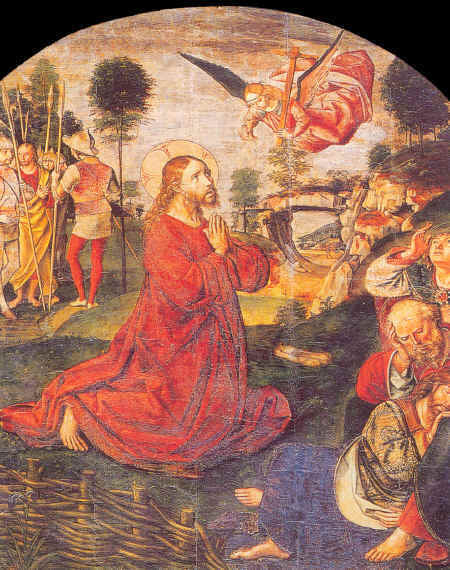
In any case, we are now entering the holiest days of the Christian calendar. Maundy Thursday commemorates Jesus’ washing of the feet of his disciples, the Last Supper, and the betrayal and arrest of Christ in the garden of Gethsemane.
Here’s an exceedingly somber work for Maundy Thursday by the Belgian composer Guillaume Lekeu (1870-1894). Lekeu died of typhoid the day after his 24th birthday. In his short life, he managed to produce about 50 works. Admittedly, some are incomplete. If one were to judge solely from his music, he was a melancholy soul indeed.
This is “Molto Adagio,” composed by a 16 year-old Lekeu, inspired by the words of Christ in the garden of Gethsemane, “My soul is exceeding sorrowful, even unto death.”
From 1999 to 2014, the Brentano Quartet served as ensemble-in-residence at Princeton University. Among its other achievements, the ensemble played on the soundtrack of the 2012 film “A Late Quartet,” starring Christopher Walken, Philip Seymour Hoffman, Catherine Keener, and Wallace Shawn. The group’s cellist, Nina Lee, also appeared onscreen, as a fictionalized version of herself.
A couple of days ago, I posted about conductor Victor de Sabata, for his birthday. De Sabata too wrote a lovely piece for Maundy Thursday, called “Gethsemani.” I highly recommend it in its orchestral guise, available on a CD of De Sabata’s symphonic poems on the Hyperion label. However, since either Hyperion or the algorithm is so hyper-vigilant, Hyperion recordings seem to get yanked off YouTube very quickly.
So here’s the work in a version for piano. Still beautiful, still contemplative, but without the orchestral sheen.
Finally, from a gorgeous album of Palestrina’s music for Maundy Thursday on the Chandos label, here’s a playlist of performances by Musica Contexta.
All sensitively done, I think. There’s little maudlin in this Maundy.
“Jesus in the Garden of Gethsemane,” c. 1500, by Pedro Berruguete (1450–1504)
Leave a Reply to chi tiết tại ÄâyCancel reply