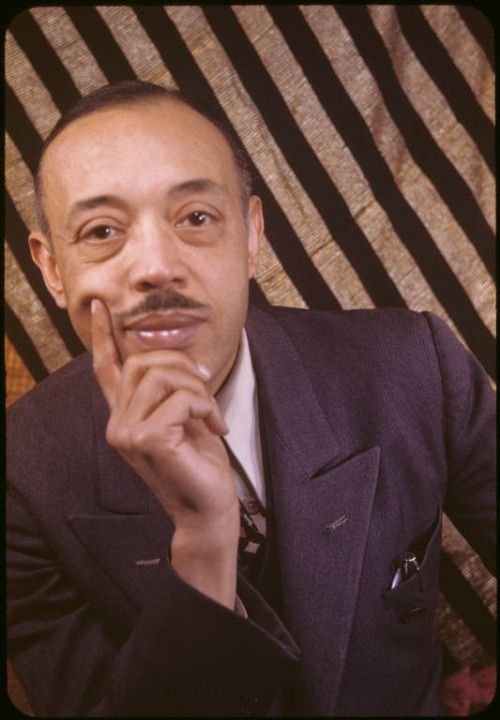
Perhaps it’s not “The Great American Symphony,” self-consciously aspirational, oratorical, or grandiose in the manner the third symphonies of Roy Harris, William Schuman, or Aaron Copland; but it does go straight to the heart, which is something none of the composers of that great American triumvirate do, at least in those particular works.
William Grant Still’s “Afro-American Symphony” is poetic, it’s genuinely reflective, it’s beautiful, and it brims with great tunes. It’s congenial, and in the end quite moving. It remains one of my favorite symphonies by an American composer.
When I want “big statements” made on a colossal scale, I will turn to those Lincoln Center composers, who would have us believe they are eating out of lunch pails in their spare time, and riveting skyscrapers, or busting sod in denim overalls. But let’s face it, they are mostly hobnobbing in suits, jostling to get their music conducted by “Lenny.”
Still is a composer in the mold, if not the manner, of Charles Ives. He’s a perpetual outsider, and always true to himself. His music grows directly out of his autobiographical experience, the blues, ballads, and spirituals of his childhood, in Woodville, Mississippi and Little Rock, Arkansas, and later his experience playing in pit bands during the Harlem Renaissance.
He also studied at the Oberlin Conservatory and privately with George Whitefield Chadwick and Edgard Varèse, of all people. There is no Varèse to be found in Still’s music.
He composes with the directness of a Virgil Thomson, but with none of Thomson’s affected naiveté. He shares with George Gershwin a refreshing lack of pretention – or at any rate his music does (he did, after all, subtitle one of his symphonies “Autochthonous”) – and a wonderful facility with melody.
Of course, any discussion of Still must come with a litany of “firsts.” His “Afro-American Symphony” was the first written by a black composer to be performed by a major orchestra (the New York Philharmonic at Carnegie Hall). He was the first to be given the opportunity to conduct a major orchestra (the Los Angeles Philharmonic, at the Hollywood Bowl). His opera, “Troubled Island,” became the first to be produced by a major company (the New York City Opera). Another of his operas, “A Bayou Legend,” was the first to be performed on national television (as late as 1981). His works were performed internationally by the Berlin Philharmonic, the London Symphony Orchestra, the BBC Symphony, and the Tokyo Philharmonic.
For years, all I could locate was the “Afro-American Symphony,” and that only in two out-of-print, albeit very fine recordings (with Karl Krueger and the Royal Philharmonic, and Paul Freeman and the London Symphony Orchestra). It wasn’t until the digital era that the other four symphonies gradually – very gradually – became available. Thankfully, all of them have now been recorded and are available for purchase.
Furthermore, in all these years, I’ve only ever come across a single modern recording of any of his nine operas, “Highway One U.S.A,” with Philip Brunelle and Vocal Essence. This especially is a shame, since, as an opera lover himself, Still so wanted to add something significant to the repertoire.
For all the love Florence Price has had lavished on her as a woman of color (the Philadelphia Orchestra was recently awarded a Grammy for its excellent recording of two of her symphonies, for the Deutsche Grammophon label), it would be great if a world-class, American ensemble would take up the cause of Still.
Let’s face it, most American orchestras are pretty terrible about recording even the white guys that were once so revered during that era. Unless you’re Copland, Gershwin, or Barber, you’re pretty much out of luck with the majors. Must so many of our American composers be documented by less-costly orchestras abroad?
Fashion would seem to favor a Still revival. At least play his music in concert, Americans!
Happy birthday, WGS (1895-1978).
“Afro-American Symphony”
“Danzas de Panama”
A little more severe, “Dismal Swamp” for piano and orchestra
“Lenox Avenue,” conducted by Still
“Troubled Island,” still awaiting a modern recording
Leave a Reply to รีวิว LSM99Cancel reply