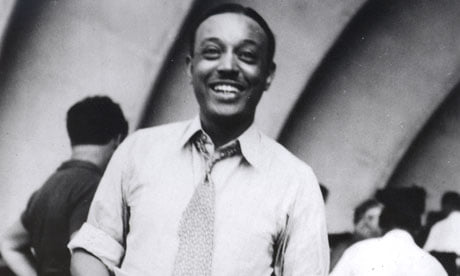
It’s hard to believe I made the following observations as recently as 2019, prior to this show’s first airing. So much has changed since then. William Grant Still has gone from a neglected master to probably one of the most frequently programmed American symphonists of his generation. The change may have been propelled by social and political trends, but if ever anyone deserved more notice, it’s this composer.
As someone with an insatiable appetite for American symphonies composed during the first half of the 20th century, I try not to miss a performance or even a radio broadcast of music by Roy Harris, William Schuman, or Aaron Copland. But for as much as I adore these composers, the American symphonies that delight me the most, off the top of my head, are Charles Ives’ 2nd, Howard Hanson’s 2nd (the “Romantic”), and William Grant Still’s 1st (the “Afro-American”). I never get tired of listening to these, and they move me like few others.
I am only too happy to include Still’s symphony, then, as a kind of capstone to my four-part survey of the landmark Black Composer Series of the 1970s – reissued on Sony Classical as a 10-CD boxed set – this week on “The Lost Chord.”
The “Afro-American Symphony,” composed in 1930, is informed by African-American spirituals, the blues, and syncopated banjo-like riffs. Indeed, a banjo actually turns up in the work’s third movement.
To me, the symphony has always been a kind of “portrait of the artist as a young man.” (Still was born in Woodville, Mississippi, and grew up in Little Rock, Arkansas.) In this respect, it puts me in the mind somewhat of Virgil Thomson “Symphony on a Hymn Tune,” which similarly draws on hymns and folk songs of his boyhood in Kansas City, Missouri.
But Still’s music comes across as more personal, more sincere, and certainly less self-consciously “modernist.” It goes straight to my heart and then gets in my head so that it literally disturbs my sleep. It’s one of the great American symphonies. The concert suites from George Gershwin’s “Porgy and Bess” remain popular, but some enterprising music director should give the “Afro-American Symphony” a shot, because I know audiences will love it. (NOTE: Again, since I wrote this, the work has gone on to be played by seemingly every major American orchestra.)
There is a solid Gershwin connection. Still quotes the melody of “I Got Rhythm” in the third movement of his symphony. And for good reason. It’s actually his! According to Eubie Blake, Gershwin was in the audience during one of Still’s performances in the pit band for Blake’s revue “Shuffle Along.” Still’s improvisation became the basis for Gershwin’s hit tune. (Blake was quick to add that the appropriation was probably inadvertent.)
The “Afro-American Symphony” is now the best-known piece in the Black Composers Series, which originally appeared on vinyl between 1974 and 1978. But at the time of the recording’s original release that was by no means definitively the case. The only previous recording of the work, made by Karl Krueger and the Royal Philharmonic Orchestra, was available only through mail-order subscription. Exposure to this gem of a symphony, then, was comparatively limited.
Thankfully, there have been a number of recordings since, but for me none match the commitment and loving attention to detail of the performance in this set, with Paul Freeman conducting the London Symphony Orchestra.
Also included on today’s program will be “Markings,” by Ulysses Kay, composed in 1966 to the memory of Dag Hammerskjöld, secretary general of the United Nations. Called “the greatest statesman of our century” by John F. Kennedy, Hammarskjöld was killed in a plane crash in Zambia en route to ceasefire negotiations during the Congo Crisis of 1961. Hammarskjöld was awarded a posthumous Nobel Peace Prize.
We’ll conclude on an “up” note, with the lively “Danse Nègre” from the “African Suite” of 1898, by Afro-English composer Samuel Coleridge-Taylor.
I hope you’ll join me for the grand finale of my month-long survey of highlights from CBS Records’ forward-looking Black Composers Series – that’s “Black to the Future, Part IV,” on “The Lost Chord,” now in syndication on KWAX, the radio station of the University of Oregon!
Clip and save the start times for all three of my recorded shows:
PICTURE PERFECT, the movie music show – Friday at 8:00 PM EST/5:00 PM PST
SWEETNESS AND LIGHT, the light music program – ALL NEW! – Saturday at 11:00 AM EST/8:00 AM PST
THE LOST CHORD, unusual and neglected rep – Saturday at 7:00 PM EST/4:00 PM PST
Stream them, wherever you are, at the link!
Leave a Reply