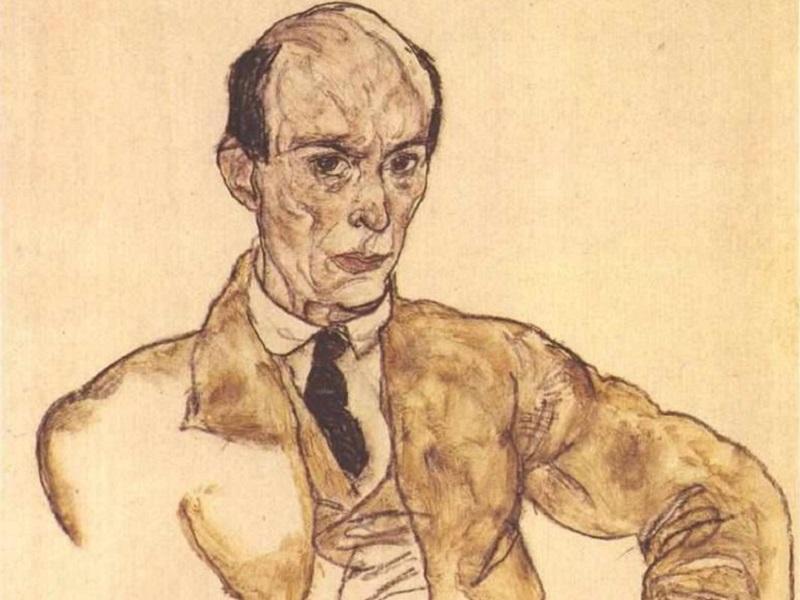
Okay, pointy heads! It’s back to school – the Second Viennese School – for the birthday of Arnold Schoenberg.
The dour high priest of twelve-tone music was full of surprises. I venture to guess that many would be nonplussed to learn that the greatest prophet of dodecaphonic music claimed artistic kinship with Johannes Brahms. But then, some conductors (notably Karajan and Solti) have tried to interpret him that way. Even so, he remains one of the most hated composers among concertgoers who prefer programs of unsullied Beethoven and Dvořák.
Schoenberg may have preached the death of tonality, but he composed at least three Romantic masterpieces, “Verklärte Nacht” (“Transfigured Night”), “Pelleas und Melisande,” and the opulent oratorio “Gurrelieder,” before venturing into Expressionism with works like his Chamber Symphony No. 1. In the meantime, he also orchestrated his share of Viennese operettas and arranged Strauss waltzes for performance by his friends.
By the time he came to America, Schoenberg was probably the least “popular” composer in the world (if one of the most influential), but at his new home in Los Angeles his tennis partner was none other than George Gershwin. The two also shared a love of painting.
Adding to this “beautiful mountain” of contradictions, Schoenberg, like that other titan of 20th century music, Igor Stravinsky, made a game attempt to break into films. He was courted to write music for the 1937 big screen adaptation of Pearl Buck’s “The Good Earth,” but his proposed fee of $50,000 put an end to that.
Schoenberg did once prophesy that one day “grocer’s boys would whistle serial music on their rounds.” Maybe he actually meant cereal music. While to my knowledge that has yet to pass, I did once catch myself walking down the street humming the Golden Calf music from “Moses und Aron.”
Happy birthday, Arnold Schoenberg!
Schoenberg remembers his friend, George Gershwin
Gershwin films Schoenberg
Schoenberg home movies (Gershwin appears at the 30-second mark)
Schoenberg in private
Schoenberg on Alban Berg
“Gurrelieder,” Part I (1900-03, 1910)
Chamber Symphony No. 1 (1909)
“Pierrot Lunaire” (1912)
“Variations for Orchestra” (1926-8), conducted by Bruno Maderna
“Moses und Aron” (1930-32), The Golden Calf
A kinder, gentler Schoenberg – the Suite for String Orchestra (1935)
TWELVE IMAGES FOR TWELVE TONES: As this gallery demonstrates, Schoenberg wasn’t always the grim, humorless figure his portraits would suggest (images identified when you click through)
Leave a Reply