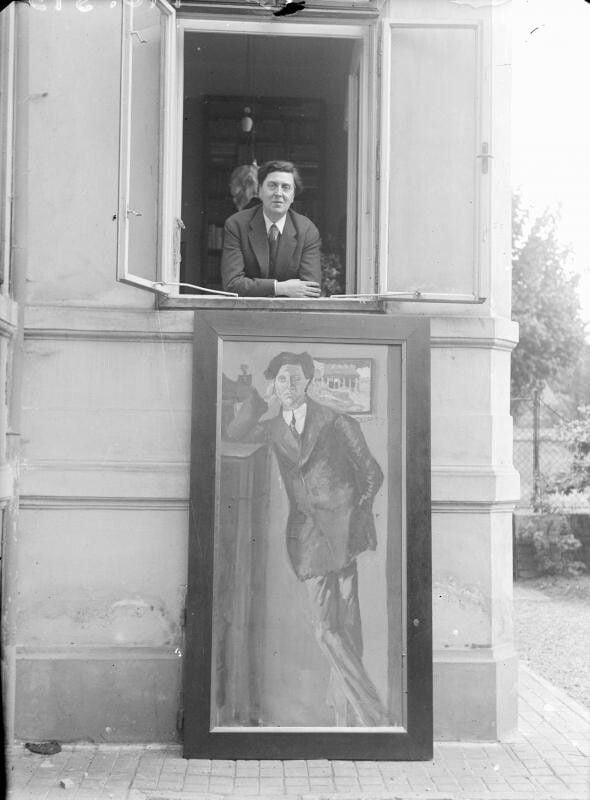
Had your fill of snow? Make an appointment today to sweat it out in the fin de siècle hothouse of Alban Berg.
Berg has always been regarded as the Romantic among serialists – one critic described him as “the Puccini of twelve-tone music” – so it’s hardly surprising to find a shimmering, unresolved longing in much of his music, linking him to the more traditional-minded among his Viennese contemporaries.
Berg’s operas, “Wozzeck” and “Lulu,” are in the standard repertoire. His “Lyric Suite” and Chamber Concerto are played with frequency. But it is his Violin Concerto of 1935 that has really entered people’s hearts.
In this work – a response to the death of Manon Gropius, the 18-year-old daughter of Alma Mahler and Walter Gropius – Berg processes loss and grief with the kind of humanity that seems have eluded Arnold Schoenberg, his teacher, in his own dogmatic dodecaphony. Furthermore, Berg’s masterpiece offers identifiable signposts for the uninitiated, with allusions to a chorale melody employed by Johann Sebastian Bach and a Carinthian folk song.
The concerto is a fine example of a talented artist bending the rules of a particular system to achieve his own expressive ends. Berg dedicated the piece “To the memory of an angel.” Work on the concerto proved to be a cathartic experience for the composer. He confessed in a letter to violinist Louis Krasner, who commissioned the piece, that it had actually brought him joy.
Berg himself died of a blood poisoning, the result of an insect sting, later that year. He was 50 years-old. His output may be comparatively small, but he continues to stand tall as one of the most important musical voices of the early 20th century. He is certainly the most readily approachable of composers of the Second Viennese School.
Happy birthday, Alban Berg.
Lulu Suite
Violin Concerto
Seven Early Songs
PHOTO: Alban Berg, captured on canvas, if not in spirit, by Arnold Schoenberg
Leave a Reply