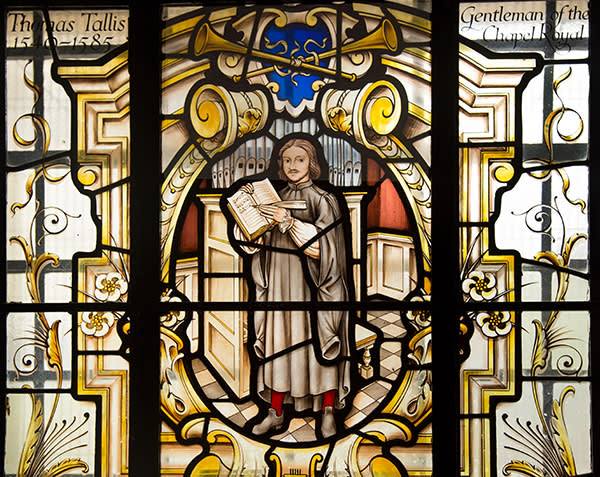
On this date, we observe the birthday of Thomas Tallis. Tallis, the most powerful English musician of his time, lived from around 1505 to 1585.
An unreformed Roman Catholic, he somehow managed to negotiate a period of tremendous religious upheaval and even to maintain the unflagging respect of four monarchs, as Gentleman of the Chapel Royal. He must have been a remarkably pragmatic, diplomatic, and levelheaded personality, not to have lost his head, as he shrewdly tailored his music to suit the religious requirements of Henry VIII, Edward VI, Mary I, and Elizabeth I.
Queen Mary provided him with housing and a comfortable income. Elizabeth granted him the exclusive right to print and publish music. With William Byrd (c. 1540-1623), he shared a 21-year monopoly on the writing of polyphonic music. Tallis and Byrd were also the only ones allowed to use the paper on which music was printed.
Byrd too gravitated to Catholicism, in the 1570s, a time when allegiance to the Church of Rome was viewed by the Tudor authorities as incendiary, if not outright seditious. Unlike Tallis, Byrd found himself in some rather precarious straits. Tip for Tudor composers: one should take care never to attend meetings with architects of the Gunpowder Plot.
Tallis not only navigated the shoals of this turbulent chapter in English history, his music is still widely performed, with frequency, half a millennium later.
Well played, Thomas Tallis.
Tallis’ greatest hit, the 40-part motet, “Spem in alium”:
Third tune from Archbishop Parker’s Psalter (the basis for Ralph Vaughan Williams’ “Fantasia on a Theme by Thomas Tallis”):
Vaughan Williams’ “Fantasia”:
A composer for all seasons: Tallis enshrined in glass at St. Alfege Church, Greenwich, London
Leave a Reply