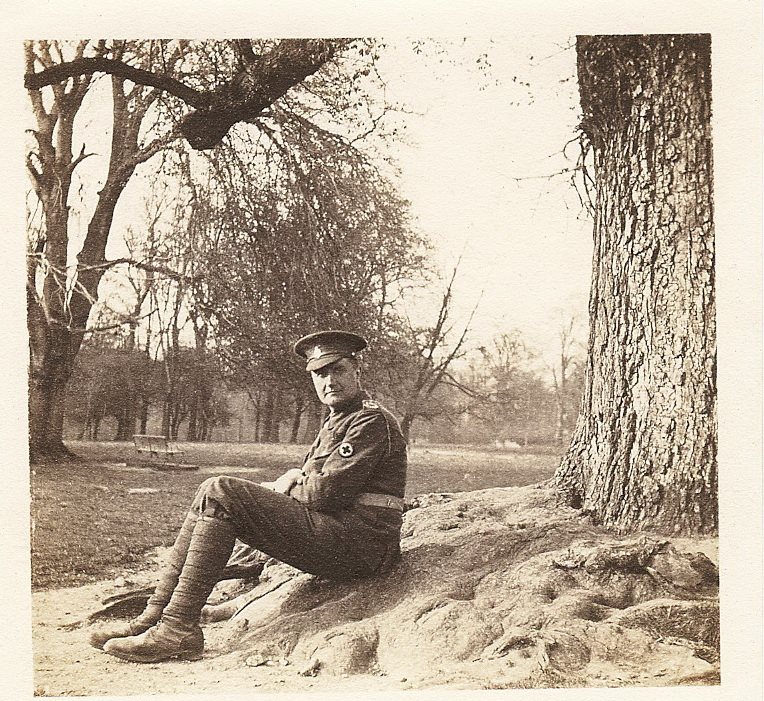
On this, the day after Memorial Day, I’ve stumbled across a YouTube video of a concert broadcast of Eugene Ormandy conducting the Philadelphia Orchestra in Ralph Vaughan Williams’ “A Pastoral Symphony” (his Symphony No. 3), which was completed in 1922.
While a good many of Vaughan Williams’ pieces are indeed pastoral, this one has something of a haunted undertow that belies its placid moniker. The composer was serving with the Royal Army Medical Corps in France during the First World War. At the end of the day, he would drive his ambulance up to the top of a hill and listen to a bugler practicing. On one occasion, the bugler accidentally played the interval of a seventh, as opposed to an octave. The trumpet solo in the second movement of the symphony enshrines this memory.
It is pastoral, all right. As peaceful as the dead. The great Benita Valente sings the wordless soprano part in the final movement, like a distant milkmaid wandering the countryside. The contrast with the waste and destruction of the war leads to a moving and intense elegy that takes over, in this particular recording, around the 31 minute mark.
Vaughan Williams’ next symphony, the Symphony No. 4, spilled over with rage and violence, clearing the air for one of the most hopeful utterances in all of music, his Symphony No. 5, composed, oddly enough, during the darkest days of World War II.
Peter Warlock, who famously characterized Vaughan Williams’ music as “just a little too much like a cow looking over a gate,” called the Pastoral Symphony “a truly splendid work” and “the best English orchestral music of this century.”
Ormandy and the Philadelphians performed the piece on October 12, 1972, to mark the centennial of Vaughan Williams’ birth. 1972 also happened to mark the semicentennial of “A Pastoral Symphony.”
Leave a Reply