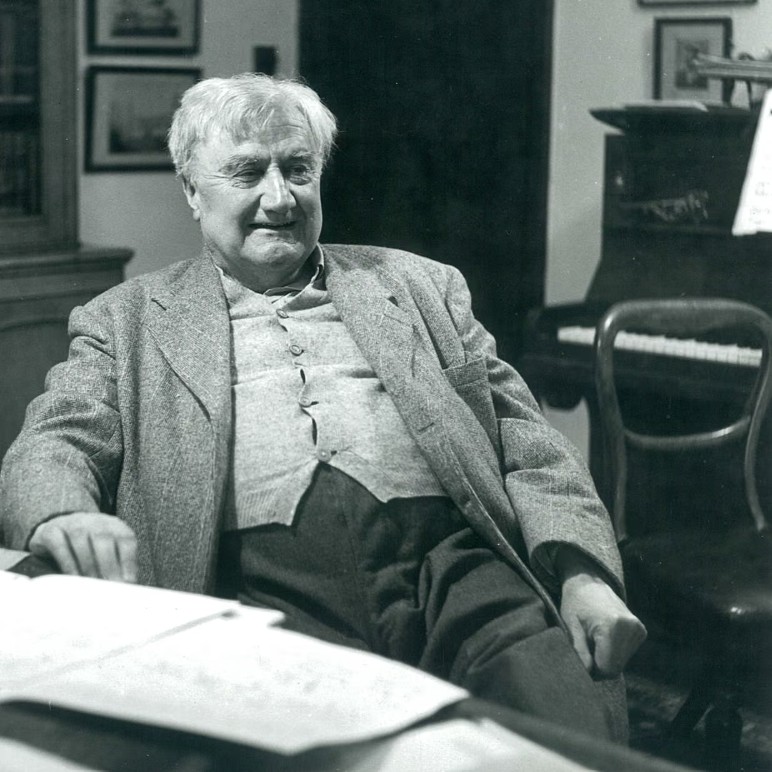
One of my favorite symphonies, the Symphony No. 5 by Ralph Vaughan Williams, makes today’s ”Composers Datebook.” As you’ll read (or hear) at the link below, the work was first performed on this date, at a time of great anxiety, in 1943. Vaughan Williams was 75-years-old.
In contrast to many wartime symphonies, there is no tub-thumping patriotism or gestures of defiance in RVW’s 5th. Instead, the composer takes the long view, sharing a larger vision of hope and serenity. The work surely resonated with listeners who lived through the Blitz, and even in 1943 continued to endure nightly air raids. The concert took place at Royal Albert Hall, because German bombings had gutted Queen’s Hall, the traditional venue of the summertime Proms. Also, it was held during the day, so that people could get back to their homes before London could be menaced after dark.
Reflected in the work is not only the soul of a nation, assimilating England’s proud sacred and secular musical traditions; it also exudes a unshakeable belief in our shared humanity. Contrast that with the anxiety, turbulence, and violence of the Symphony 4, completed in 1935, a time when the storm clouds were gathering – although the composer persistently denied any external influences. He always stood by his assertion that there was nothing at all programmatic about the work, and that he wrote what he wrote because he was compelled to write it. It was a wholly abstract piece of music.
The 5th symphony, on the other hand, shares themes with his long-gestating opera, “The Pilgrim’s Progress,” after John Bunyan’s popular Christian allegory; but again, there is no definitive extra-musical program. The composer himself stepped in for an indisposed Henry Wood to conduct the symphony’s premiere.
The work was dedicated to Jean Sibelius. Sibelius confided in a letter to Swedish composer Kurt Atterberg (who, in turn, was in touch with Vaughan Williams champion Adrian Boult), “This Symphony is a marvelous work… the dedication made me feel proud and grateful… I wonder if Dr. Williams has any idea of the pleasure he has given me?”
The music is transcendent in its luminosity. Why Vaughan Williams’ symphonies are not performed more often in the U.S. is a mystery. It’s probably just that people, even conductors, don’t really know the music. If it’s not “The Lark Ascending” or the “Fantasia on a Theme by Thomas Tallis,” they don’t even give it a second – or even a first – thought.
Which is a real shame, because the world can certainly use more reminders of the kind of positivity and reassurance expressed in the Symphony No. 5.
Listen to ”Composers Datebook” at the link.
https://www.yourclassical.org/episode/2026/06/24/composers-dateboo-ralph-vaughan-williams
Adrian Boult conducts the symphony here:
Vaughan Williams’ Vision of Hope and Shared Humanity
by
22 responses
Comments
22 responses to “Vaughan Williams’ Vision of Hope and Shared Humanity”
-
With you I’ve often wondered at America’s reticence about RVW’s symphonies. That they are beautiful no one really argues, but perhaps our indifference is illuminated by our penchant for a car chase here and there, for harmonies that crunch, for action, action, action. We like good guys and bad guys, we like our guns, and we like them a-blazin’. I’m not tsk-tsking because I include myself in the ethos. RVW, however, comes out of modalism, which peregrinates, wanders, rambles even, and not tonality, which carries with it its own inevitability. We like the inevitable. It makes sense. Vaughan Williams, though, hearkens to chant, a cousin to melody—good ol’ melody, the inevitable, whom we love and know, whom I love and know—an older cousin, the lovable yet quirky one who lives far away, the one who travels. We enjoy his visits every few years and his tales of odd customs, his noodling observations, not conversations, really, unless the room has emptied and it’s late and it’s just the two of us and we give ourselves over. Mostly we admire more than embrace, and we’re frankly a bit exhausted from bemusement after the visit. Chant, however, is the core of all music—west, east, folk, pop, high, low, makes no difference—and we’re smaller if we make no room for it in our lives. Thank you, Ross, for making room.
-
Kile Smith Clearly I am predisposed in some way to love this music. RVW nearly always connects with me. Perhaps that’s unsurprising for anyone accustomed to my meandering prose. Good points, Kile, and amusingly expressed, as always!
-
Music or prose, the meandering can pay off, as it does in RVW and in Classic Ross. There’s gold in them thar hills!
-
-
-
RVW stepped in for Sir Henry Wood on very short notice—48 hours—and conducted a luminous performance. Lewis Foreman found a recording of that broadcast, made by an audiophile with state-of-the-art equipment, which was played at a conference that I attended, so I can attest to its radiance. My late friend Diana McVeagh was present at the premiere and testified to the overwhelming impact on that first audience. I asked her “what about RVW himself?” and she replied, “he was always modest and matter-of-fact.”
Having studied and written about this symphony, and as a composer and musicologist, I can attest that it is economical and tightly constructed, all of the material deriving from the opening bars—as tightly constructed as, say, Beethoven’s Fourth Symphony or Sibelius’s Third Symphony. Like most of Vaughan Williams’s music, it is not whatsoever discursive.
-
Byron Adams Holy smokes! Diana McVeagh was THERE??? What a treasure she was!
I was stunned when Somm Recordings released the first performance of the symphony on CD in 2022. I didn’t even know it existed but for a mention on the tray card in an earlier Somm issue (from 2007) of Vaughan Williams conducting it at the Royal Albert Hall in 1952, on which there is a note stating that the performance was recorded off the air, and that five bars that are missing from the third movement were spliced in from the 1943 premiere! As you can imagine, I was over the moon when they finally released the entire thing.
Thank you for your professional assessment of this symphony. As I say, it is one of my favorites (even if there are no car chases).
For anyone who missed it, here’s Byron’s interview with Diana McVeagh from 2023. It is 27 entertaining minutes very well spent.
-
Classic Ross Amico: Diana was 17 at that point. She was admitted to the RCM the following year.
-
Byron Adams Amazing. What a life!
-
-
-
a great favorite (or favourite as he would spell) of mine as well
-
First became familiar with RVW, introduced to a 16 year-old me via the classical programming of Denver radio KVOD. A life-changing LPMedia: https://www.facebook.com/photo.php?fbid=10243723399089450&set=p.10243723399089450&type=3
-
David Woodward You can’t go wrong with that album. 50+ minutes of pure heaven.
-
-
The Greensleeves concert tidbit was embedded in his Falstaff opera — we’re talkin’ scarce.
-
But presented at the Bard Music Festival in 2023!
-
Xclnt & fav. Because its variant is upside down !.!.!
-
-
It’s a magnificent work, which we played at The Eastern Music Festival during my tenure there as principal horn. Maybe WUNC has a recording …I should try to track it down !
-
Now listening to his Sinfonia Antarctica. Wonderful music too.
-
Simon Atkinson Note that for some reason, Vaughan Williams left out the first “c” and called it Sinfonia Antartica [sic]. I guess that I consider it one of my top guilty pleasures, since it is after all, movie music.
-
Richard Schultz RVW left out the “c” because he titled it in Italian. If you miss it, don’t worry; he wrote another symphony all about it. It’s called a “SEA” Symphony! 🤣🤣🤣😉
-
-
-
It is one of his masterpieces
-
I’d be happy to listen to your broadcast, but I have a prior appointment to stare at a cow for 45 minutes.
-
Richard Schultz Why, I’ll add your name to the list of those who are said to have employed that very simile, including Peter Warlock, Elisabeth Lutyens, and Aaron Copland. You’re in very good company! 🐮
-
-
And the beautiful Oboe Concerto.
-
It is indeed a masterpiece.
Tag Cloud
Aaron Copland (94) Beethoven (95) Composer (114) Film Music (148) Film Score (143) Film Scores (255) Halloween (97) John Williams (196) KWAX (232) Leonard Bernstein (105) Marlboro Music Festival (125) Movie Music (163) Mozart (91) Opera (215) Philadelphia Orchestra (90) Picture Perfect (174) Princeton Symphony Orchestra (110) Radio (90) Ross Amico (244) Roy's Tie-Dye Sci-Fi Corner (290) The Classical Network (101) The Lost Chord (269) Vaughan Williams (107) WPRB (397) WWFM (881)
Leave a Reply