Happy Canada Day! Let us honor the classical music heritage of the Canadian national anthem.
The music was composed by Calixa Lavallée, a French-Canadian, who had been a Union band musician with the Fourth Rhode Island Regiment during the American Civil War. Lavallée was commissioned to write the piece in 1880 by Théodore Robitaille, then Lieutenant Governor of Québec, in anticipation of that year’s Saint-Jean-Baptiste Day celebrations.
The words (in French) were added later, by Sir Adolphe-Basile Routhier. The first English translation was published in 1906. Two years later, an official translation, by Robert Stanley Weir, appeared. “O Canada” served as the country’s de facto national anthem beginning in 1939. It was officially adopted only in 1980!
In 2020, musicologist Ross Duffin put forth that “O Canada” was not an original composition at all, but rather a patchwork of preexisting melodies from the classical repertoire. To which I say, what took him so long? Anyone with a passing knowledge of “The Magic Flute” knows that. Also, as far back as 2008, a listener wrote to inquire of me what was the name of the Franz Liszt composition I played that sounded so much like “O Canada?” All is revealed here, with musical examples below:
One of its sources, from Mozart’s “The Magic Flute”:
Variations on the theme from a Piano Sonata in F major by Anton Reicha:
Listen for a familiar, repeated interlude in Liszt’s symphonic poem “Festklänge” (“Festive Sounds”), in this performance from across Lake Michigan:
“Wach’ auf” from Wagner’s “Die Meistersinger”
Finally, Matthias Keller’s “The American Hymn.” I confess, this one is new to me. For its discovery, I must tip my hat to Professor Duffin.
It’s not inconceivable that Lavallée would have fulfilled his commission with a pastiche, a common enough practice among band musicians of the day. This is not to take anything away from the Canadian national anthem. As you may know, the melody for “The Star-Spangled Banner” was appropriated from a British drinking song!
PHOTO: Rabbit rabbit, Canada style*
(* Original postage stamp does not include flag. Also, they’re Arctic hares.)
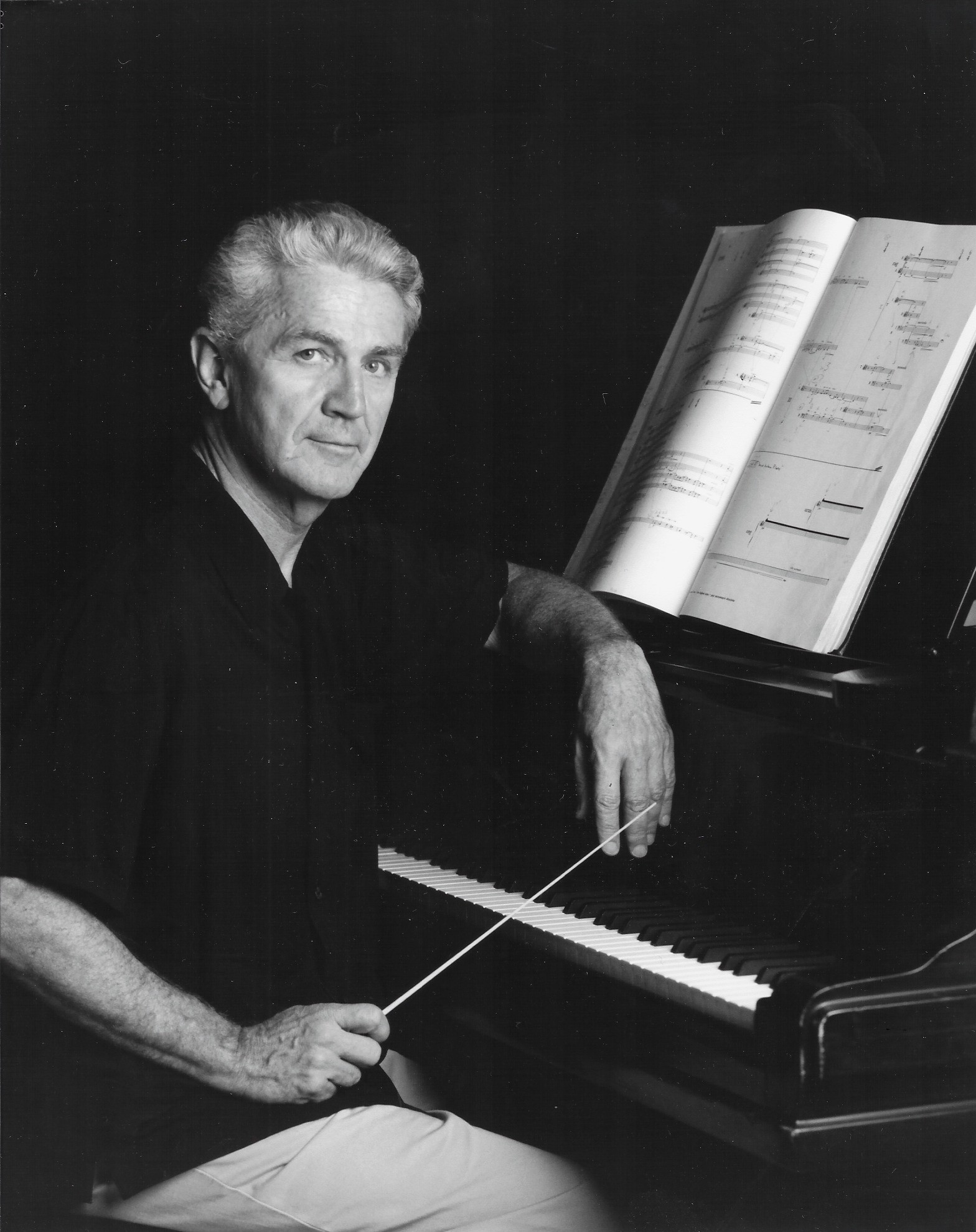
Harler served as music director of Mendelssohn Club of Philadelphia from 1988 to 2015. (The group, founded in 1874, was rebranded Mendelssohn Chorus of Philadelphia in 2020.) Harler was named the organization’s artistic director in 2009. For 30 years, he also served as Chairman of Choral Music at Temple University’s Esther Boyer College of Music.
He commissioned and gave first performances of more than 50 new works, including Charles Fussell’s “High Bridge,” Jennifer Higdon’s “On the Death of the Righteous,” David Lang’s “battle hymns,” Pauline Oliveros’ “Urban Echo: Circle Told,” Roberto Sierra’s “Lux æterna,” and Julia Wolfe’s “Anthracite Fields” (recipient of the Pulitzer Prize for Music in 2015). He recorded Robert Moran’s “Requiem: Chant du Cygne” for London/Argo Records and gave the first performance of the composer’s 9/11 memorial “Trinity Requiem” in an expanded version for full chorus (the work was originally conceived for children).
Harler was also founder and director of the Contemporary Vocal Ensemble of Indiana. He prepared choruses for a number of the world’s foremost conductors, including Riccardo Muti, Klaus Tennstedt, Charles Dutoit, Zubin Mehta, Rafael Frühbeck de Burgos, Lorin Maazel, David Robertson, and Wolfgang Sawallisch.
I met him several times over the years and interviewed him on the air at least once, in connection with a broadcast of “Trinity Requiem.” Also on the program, which took place at Philadelphia’s Cathedral Basilica of Saints Peter and Paul on Logan Square, was Bruckner’s Mass No. 2 in E minor, and a new Moran commission, “Angele Dei.”
I received the news of his passing in my inbox on Friday, but I am only just getting around to sharing it on account of a busy weekend. Bad news does occasionally travel slow in the world of Classic Ross Amico.
Harler was 85-years-old. R.I.P.
The press release follows.
Dear Mendelssohn Chorus Family,
It is with profound sadness that we share the news that our beloved Conductor Laureate and former Artistic Director, Alan Harler, passed away peacefully in his sleep early yesterday morning. Our thoughts and prayers are with his partner of 38 years, Chuck Kalick, his extended family, and all who loved him during this difficult time.
A Transformative Leader
Alan’s artistic leadership was transformative not only to our 151-year-old organization, which he led from 1988-2015, but to the entire field of choral music. When he joined Mendelssohn Chorus as our twelfth Music Director in 1988, our organization was experiencing a difficult transitional period both artistically and fiscally. Under Alan’s visionary leadership, we not only regained our footing but evolved into a thriving, relevant, and innovative force in Philadelphia’s cultural fabric.
His vision was so compelling that after operating as a volunteer-run organization for 135 years, we were able to create our first professional board and grow our systems to support our first full-time Executive Director in 2009, with Alan serving as Artistic Director.
A Pioneer in New Music
Alan was a pioneer ahead of his time, committed to new music throughout his entire career. His approach wasn’t simply novelty for novelty’s sake—in his own words: “Inviting or even gently pulling people out of their 21st century comfort zones is the first step in preparing them to experience music and the human voice at the deepest level.”
During his tenure with us, he commissioned and premiered 58 new compositions, including Julia Wolfe’s Pulitzer Prize-winning Anthracite Fields, David Lang’s battle hymns, Jennifer Higdon’s On the Death of the Righteous, and Pauline Oliveros’s Urban Echo: Circle Told. He pushed audiences and singers alike through cross-genre performances through an innovative partnership with the Leah Stein Dance Company. These performances integrated artistic elements such as dance, ensemble choreography, projections, and even audience movement into our performances to create a fully immersive experience.
Those groundbreaking works established Mendelssohn Chorus as a vital force for living composers and earned us the 2013 Chorus America/ASCAP Award for Adventurous Programming.
Scholar and Advocate
While Alan championed new works, he was equally a scholar and advocate of the choral greats of the past. His dedication to understanding musical traditions led him to travel to Oxford, England, to examine and study Mendelssohn’s original score of Bach’s St. Matthew Passion. This research culminated in our presenting the North American premiere of Mendelssohn’s edition of Bach’s masterwork in 2015—a fitting capstone to Alan’s extraordinary tenure.
Educator and Mentor
Alan’s influence extended far beyond our chorus through his distinguished 30-year career at Temple University, where he served as Laura Carnell Professor of Choral Music and Director of Choral Activities. As one colleague noted, Alan was “a remarkable diagnostician with generosity and razor sharp analysis.” Even after retirement, he continued inspiring rising conductors through our Conducting Apprenticeship Program, mentoring dozens of conductors who now carry his legacy around the world.
A Humble Virtuoso
In a world where many artists are known for forceful egos, Alan possessed remarkable humility. As one reviewer wrote, “Alan Harler is a musician serving music by serving other musicians and the music-loving public.” Composer Roberto Sierra captured Alan’s essence perfectly: “In my life as a composer I have not met many artists like Alan, those who are at the zenith of their art, but that also are extraordinary human beings. It is precisely this combination that gives force to his artistic expression.”
A Living Legacy
The Alan Harler New Ventures Fund, established by our chorus family to honor his vision, ensures that his commitment to fostering contemporary, original, and groundbreaking works will continue in perpetuity. His belief in taking artistic risks and his passion for pushing boundaries will forever be part of our DNA.
Alan truly personified the mission “to build a dynamic and inclusive choral community so that more people are transformed by the beauty and power of choral singing.” There must be thousands of people who have been touched by Alan’s music and his humanity together.
We will share information about memorial arrangements as they become available. In the meantime, we invite you to watch the loving tribute below, created to honor Alan upon his retirement in 2015.
His legacy lives on in every commission we premiere, every aspiring conductor we mentor, and every voice that joins our chorus family.
With deepest gratitude for Alan’s immeasurable contributions,
Dominick DiOrio, Artistic Director
Flo Gardner, Executive Director
Julie Cohen, Board Chair
Mendelssohn Chorus tribute video
Harler and Mendelssohn Club perform Robert Moran’s “Requiem: Chant du Cygne”
Bernard Herrmann may be best-recognized as the greatest film composer the United States ever produced, but he was also a passionate Anglophile. I’ve written a lot about Herrmann over the years, from many different perspectives, but in light of my recent visit to the Percy Grainger Home & Studio in White Plains, NY (where Grainger lived for 40 years), I thought I’d share a little bit about the relationship of these two artists today, for the anniversary of Herrmann’s birth.
Herrmann studied composition with Grainger at New York University in the early 1930s. Even in untested youth, his extensive knowledge and passion for English music (and music in general) endeared him to his mentor – they also shared an ear for unusual orchestration – and a genuine affection sprang up between them. In particular, they both adored Frederick Delius, whom Grainger got to know fairly well in the early years of the 20th century. (Grainger, born in Melbourne, lived in England from 1901-14.)
For Herrmann, Grainger was like a magic fountain of information about many of the living composers he so admired. Herrmann himself would later get to know some of them himself during guest conducting engagements with the BBC Symphony, the Halle Orchestra, and the London Symphony Orchestra.
Here’s a little more about Grainger and Herrmann, largely drawn from Steven C. Smith’s Herrmann biography, “A Heart at Fire’s Center.” I’ve read Smith’s book, of course, but for convenience’s sake, I am cutting and pasting this excerpt from an article about Herrmann’s Anglophilia compiled by Ian Lace for the MusicWeb International website. To access the complete article, which would certainly be worth your while, if it’s a topic that interests you, look for the link below.
From Lace’s piece:
Also in 1932 Herrmann attended a bi-weekly course in advanced composition and orchestration led by the brilliant but wildly unorthodox Percy Grainger.
‘Percy Grainger was Australia’s most innovative advocate of music past and present, from his childhood days as “the flaxen-haired phenomenon” of Melbourne to his years of international fame as folk song collector, composer, and recitalist. At the heart of Grainger’s unstable, erratic character was a fixation on truth, contempt for tradition and a passion for the outrageous.
‘Since becoming head of NYU’s music department in 1931, Grainger had offered a syllabus of musical eccentricity and frequent brilliance that left many students puzzled and unimpressed. The class of 1932, however, had one exception. In Grainger, Herrmann saw qualities he himself was cultivating: individualism and dedication to one’s craft and beliefs, however unpopular and unfashionable.
‘The relationship between the fifty-year-old teacher and the twenty-one year old student was one of mutual respect. “Grainger did not place orchestration examples before [his students],” Grainger biographer John Bird wrote, “Instead, he allowed them to choose their pieces and gave them advice when and where needed. Herrmann for instance, decided to orchestrate MacDowell’s Celtic Sonata and felt the need to employ the sonorities of a tenor tuba. The Australian knew little of this unusual piece of plumbing, so together, they familiarised themselves with the instrument and found suitable moments to include it.”
‘Herrmann and Grainger also discovered a shared love of Whitman and the music of Delius. One of Herrmann’s favourite NYU memories peripherally involved the latter: one morning the gaunt, sprightly Grainger leapt onto the lecture stage and announced, “The three greatest composers who ever lived are Bach, Delius and Duke Ellington. Unfortunately Bach is dead, Delius is very ill – but we are happy to have with us today the Duke!” Ellington and his band then mounted the stage and played for the next two hours.
‘If other Grainger lectures were less dramatic, they were no less influential to Herrmann: ancient monophony, folk music, atonality, polyphony, the indigenous rhythms of Africa, Asia, and the South Seas – each was examined by Grainger with alternating lucidity and jumbled mysticism. When the scholastic year ended in mid-August 1933, Grainger considered his work a failure, as few students had been as responsive as Herrmann; but it cemented a friendship between him and his intense young pupil that affected Herrmann for the rest of his life.’
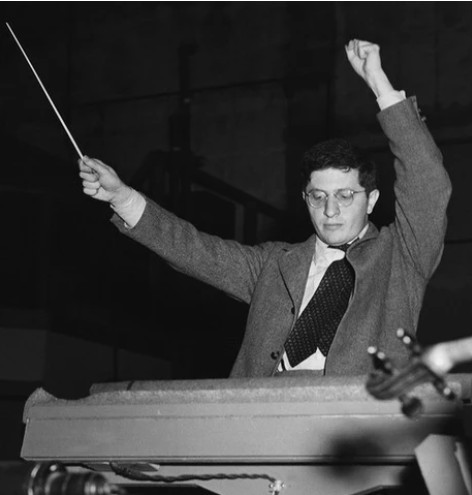
PHOTOS (clockwise from upper left): Herrmann conducting at CBS radio in the 1930s; Grainger conducting the National High School Orchestra at Interlochen in 1937; Grainger with Duke Ellington at New York University in 1932; Herrmann and Orson Welles at CBS
With the Fourth of July still six days away, I was trying to come up with a way to honor some aspect of the country’s rich musical heritage – it is, after all, the last weekend before the holiday – but I didn’t want to start clobbering everybody with Sousa marches just yet.
I found my solution on Broadway: both of my specialty shows today are connected in some way or another to classic American musical theater.
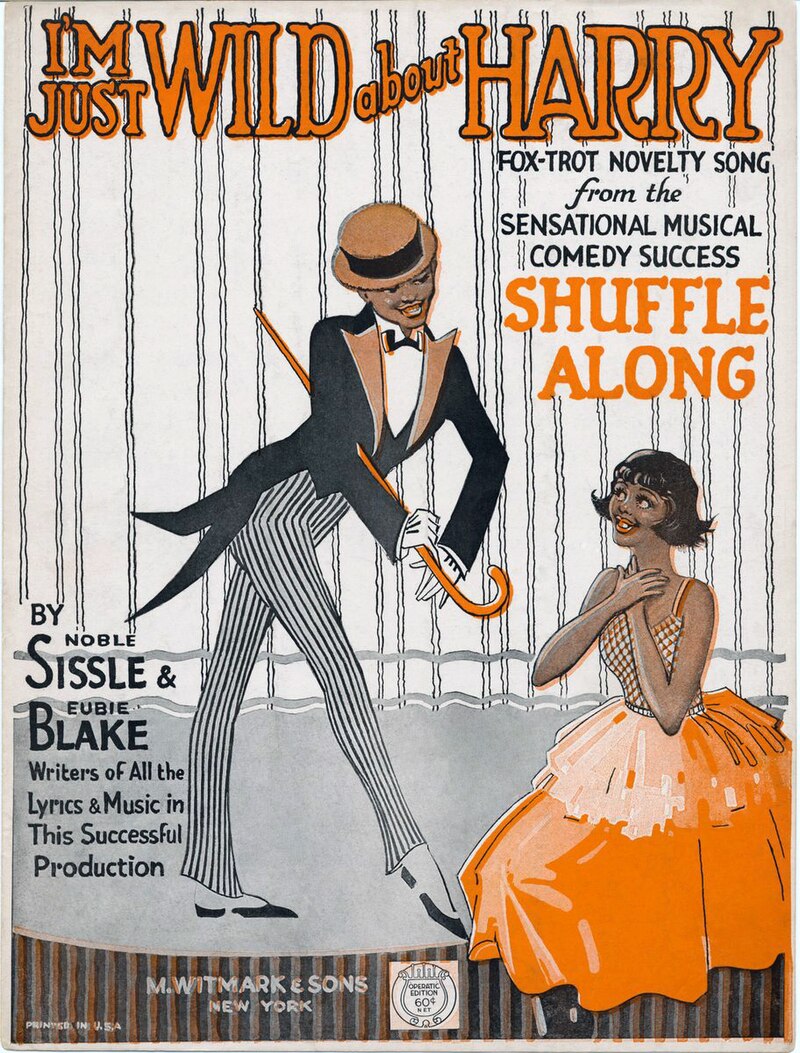
The playlist on “Sweetness and Light,” the light music show, is constructed on works that were actually staged on the Great White Way, including Eubie Blake & Noble Sissle’s “Shuffle Along” (the 1921 all-Black musical that spawned the breakout hit “I’m Just Wild about Harry”), Leonard Bernstein’s “On the Town” (the ballet music, before it was distilled into the familiar “Three Dance Episodes,” with a 24-year-old Bernstein conducting), George Gershwin’s “Porgy and Bess” (conceived by the composer as an opera, but produced on Broadway several times over the decades before finally being elevated to the pantheon), and Richard Rodgers & Lorenz Hart’s “On Your Toes” (the climactic “Slaughter on Tenth Avenue” sequence, which we’ll enjoy on Rodgers’ birthday).
We’ll get your toes tapping, for the most part, but also include a grand piano fantasy on themes from “Porgy” by Earl Wild.
It’s showtime, this Saturday morning at 11:00 EDT/8:00 PDT.
Then later, on “The Lost Chord,” a program that revives unusual and neglected repertoire, we’ll come at the same source from a different perspective, as we’ll hear concert works by composers of notable Broadway hits.
Vladimir Dukelsky was born in what is now Belarus, but when he settled in the United States, his friend, George Gershwin suggested a name change. Thereafter, he was known as Vernon Duke. As Duke, he composed such standards as “April in Paris” and “Autumn in New York,” and he had a hit show in “Cabin in the Sky.”
As Dukelsky, he had works championed by Serge Koussevitzky and choreographed by Léonide Massine and George Balanchine. We’ll hear a Piano Concerto he composed at the age of 19 at the request of Arthur Rubinstein.
Meredith Willson is best-known for his Broadway smashes “The Music Man” and “The Unsinkable Molly Brown,” but he emerged from the classical music world, as a flutist who played with John Philip Sousa and the New York Philharmonic. We’ll hear Willson’s Symphony No. 2, subtitled “The Missions of California.”
I hope you’ll join me in giving my regards to Broadway with “Broadway Lights” on “Sweetness and Light” (at 11:00 a.m. EDT/8:00 a.m. PDT), and “Broad Talents from Broadway” on “The Lost Chord” (at 7:00 p.m. EDT/4:00 p.m. PDT), both of them on KWAX, the radio station of the University of Oregon!
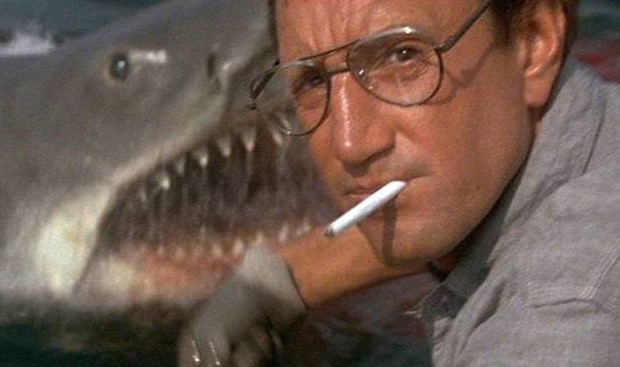
Just when you thought it was safe to go back in the water, this week on “Picture Perfect,” we mark the 50th anniversary of “Jaws.”
“Jaws” opened on June 20, 1975. The film’s balance of terror, wit and adventure, with a perfectly-calibrated trio of central characters and a young Steven Spielberg eager to please, propelled it to unprecedented box office glory, the first film to glide past the $100 million mark. Needless to say, the studios sat up and took notice. “Jaws” is widely credited as having laid the foundation for what became recognized as the summer blockbuster season. When it was surpassed by “Star Wars” two years later, there was no looking back. With so much chum in the water, the shareholders went into a frenzy and everyone wanted a bite.
Given the film’s ultimate influence on the industry, with superheroes and computer animation long dominating the year’s major releases in a quest for ever-higher profits, it seems only proper now to honor “Jaws” with an hour of aquatic traumas.
“Beneath the 12-Mile Reef” (1953) stars Robert Wagner, Terry Moore, and Peter Graves in a Romeo and Juliet story about two families of competing fishermen along the Gulf coast of Florida, one working class and of Greek origin, and the other a family of privileged WASPs. Gilbert Roland is the Greek patriarch who runs afoul of an improbably large octopus. Bernard Herrmann wrote the music, which employs no fewer than nine harps (one for each arm, and a spare).
A young Henry Mancini was one of three composers to work on “Creature from the Black Lagoon” (1954). Mancini, soon to be world famous for “Moon River,” “Baby Elephant Walk,” and “The Pink Panther,” was teamed with veteran film composer Hans J. Salter and Herman Stein. None of the three were credited on screen – typical of what was then considered just another low-budget B-movie.
What can I say about John Williams’ masterful music for “Jaws” (1975)? It’s right up there with “Psycho” and “The Good, the Bad and the Ugly,” in terms of most recognized and most frequently parodied. Everyone remembers the primal shark theme, but what is sometimes overlooked is that “Jaws” is also one of the great adventure scores, the music effortlessly navigating the choppy waters of suspense, horror, and seafaring swashbuckler. The composer was recognized with a richly-deserved Academy Award (his second of five).
The conflict in “The Swimmer” (1968) is not a giant octopus, nor a great white shark, nor a prehistoric gill man, but rather the progressive psychological breakdown of an upper middle class Connecticut man who believes he’s living the American Dream.
Adapted from a short story by John Cheever, “The Swimmer” stars Burt Lancaster as the man, who acts on a quixotic impulse to travel all the way home, across county, by way of a network of suburban swimming pools. The adventure starts out well enough, with Lancaster and everyone he encounters full of optimism and fun; but the further he moves along his allegorical journey, the more the enterprise, the climate, and the people begin to grow cold.
“The Swimmer” is a decidedly downbeat tale which could make the viewer as reluctant to dip a toe into a chlorinated in-ground swimming pool as the shark-infested waters of Peter Benchley’s Amity Beach. The score is by Marvin Hamlisch, of all people, and it suits the film brilliantly.
Better stick to the bath. Dreams of aquatic refreshment are all wet this week, on “Picture Perfect,” music for the movies, now in syndication on KWAX, the radio station of the University of Oregon!
Clip and save the start times for all three of my recorded shows:
PICTURE PERFECT, the movie music show – Friday at 8:00 PM EDT/5:00 PM PDT
SWEETNESS AND LIGHT, the light music program – Saturday at 11:00 AM EDT/8:00 AM PDT
THE LOST CHORD, unusual and neglected rep – Saturday at 7:00 PM EDT/4:00 PM PDT