Category: Daily Dispatch

  • Howard Hanson’s Bold Island Inspiration

    Howard Hanson’s Bold Island Inspiration

    For many people, having to work through vacation can be a real drag; but for the creative artist, vacation can be a time to really get things done.

    For 40 years, Howard Hanson was the director of the Eastman School of Music. In that capacity he nurtured and championed innumerable American composers, giving literally thousands of premieres at the helm of the Eastman-Rochester Orchestra, an ensemble he founded. The lucky ones found their way onto records, issued on the Mercury label.

    Hanson, of course, was himself a composer. He was awarded the Pulitzer Prize for Music in 1944, for his Symphony No. 4 “Requiem,” written in memory of his father. But his best known music, undoubtedly, is his Symphony No. 2 “Romantic,” composed in 1930.

    The famous “Hanson sound” is one of heart-on-the-sleeve romanticism, characterized by glowingly nostalgic melodies, though he also had his severe side. After all, he was born in Wahoo, Nebraska, to Swedish immigrants, and a certain Nordic austerity can be detected, especially in his later works.

    This Sunday night on “The Lost Chord,” we’ll be listening to three pieces inspired by Hanson’s summer home on Bold Island, which is located in the North Atlantic, off the coast of Maine. The major work will be the Symphony No. 6, written in 1967 for the New York Philharmonic and dedicated to Leonard Bernstein.

    The piece is more tightly argued than Hanson’s earlier, more famous symphonies, structured in six brief movements, built on a recurring motif. At times, it can sound a bit like Sibelius, though Hanson very much remains his own man. Hanson being Hanson, he doesn’t really skimp on the lyricism, but he doesn’t exactly indulge it to the same extent he does in the earlier works. Still, predictably, the symphony was derided as old-fashioned by the genuinely austere musical establishment of the day.

    The Bold Island connection is through Hanson’s “Summer Seascape No. 2,” written a few years earlier, and clearly the blueprint for the symphony. In fact, the opening of the symphony is identical.

    The first “Summer Seascape” was the centerpiece of the “Bold Island Suite,” a separate work composed in 1961. The suite also contains movements with the descriptive titles “Birds of the Sea” and “God in Nature.”

    For Howard Hanson, summer in the North Atlantic was clearly a time to give his Nordic sensibility free rein. I hope you’ll join me for “August Hanson,” tonight at 10 EDT on WWFM – The Classical Network; or that you’ll listen to it later as a webcast at wwfm.org.


    PHOTO: Not-very-austere Puffins off the coast of Maine
  • Affetto Records Revives Classical Music

    Affetto Records Revives Classical Music

    “The philosophy of the label is very simple,” says John C. Baker, founder of Affetto Records. “We want to bring high-end musicians through a world of broadcast and CD distribution to people who may not have heard them before or know of them, with unique recordings of world premiere music – new arrangements, new compositions – and that’s basically what we have done in the last year.”

    Baker, a multi-Grammy nominated producer and recording engineer, established the Princeton-based Affetto in 2004 for the purpose of a jazz release. It was revived only last year to serve reputable classical musicians who were having difficulty finding labels willing to record them.

    “They were having trouble getting their recordings released,” he says. “It has become so much more difficult in this world of decreasing CD impact, although classical music is one of the only genres in which CD sales are still increasing, especially overseas. So I was encouraged, shall we say, to start my own label.”

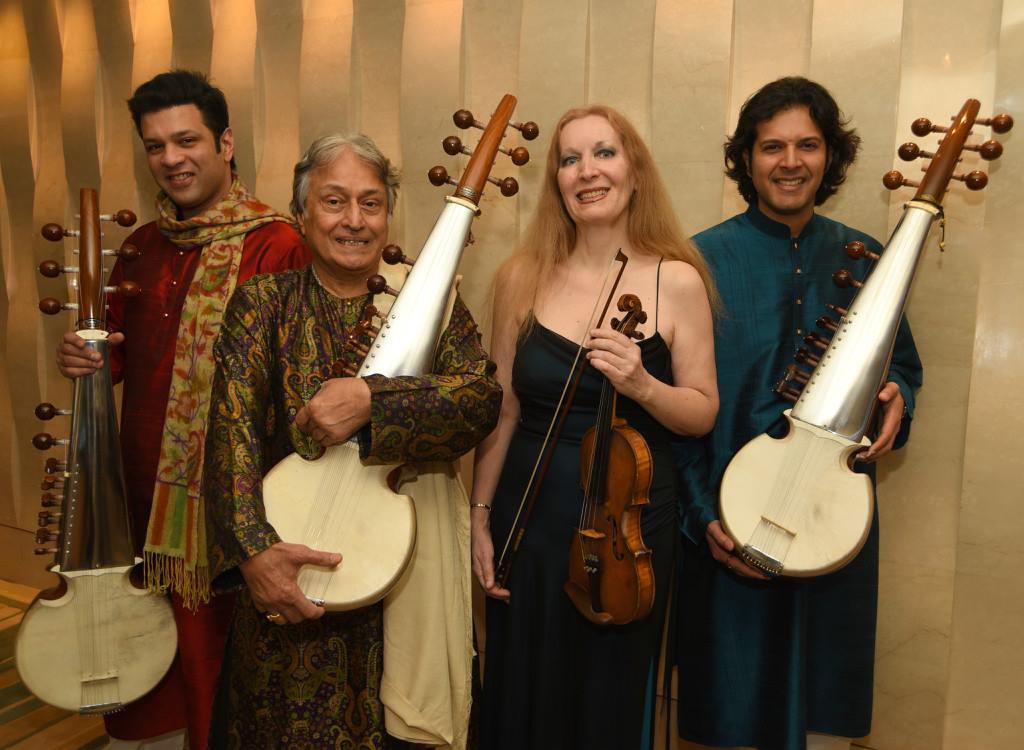
    One of those musicians was Elmira Darvarova, former concert master of the Metropolitan Opera Orchestra. Darvarova performs on Affetto’s most recent release, “Amalgam,” an unusual venture, which places her alongside Indian sarod master Amjad Ali Kahn, his two sons, Amaan and Ayaan Ali Khan, and tabla player Tanmoy Bose. The album was released overseas through an arrangement with Times Music, India’s largest record label and music publisher.

    “Amalgam” is only the most recent of a stimulating – and growing – catalog of recordings in Affetto’s stable, including first issues of music by Bach, Mendelssohn, Cyril Scott, and composers of American art song.

    Since 1992, Baker has recorded more than 200 albums, both self-released and for other labels. He engineers many of the live concerts heard on WWFM – The Classical Network and contributes to both NPR and PRI.

    Find out more about it in my article in today’s Trenton Times.

    http://www.nj.com/times-entertainment/index.ssf/2016/08/classical_music_princeton_prod.html

  • Meeting Rautavaara A Musical Memory

    Meeting Rautavaara A Musical Memory

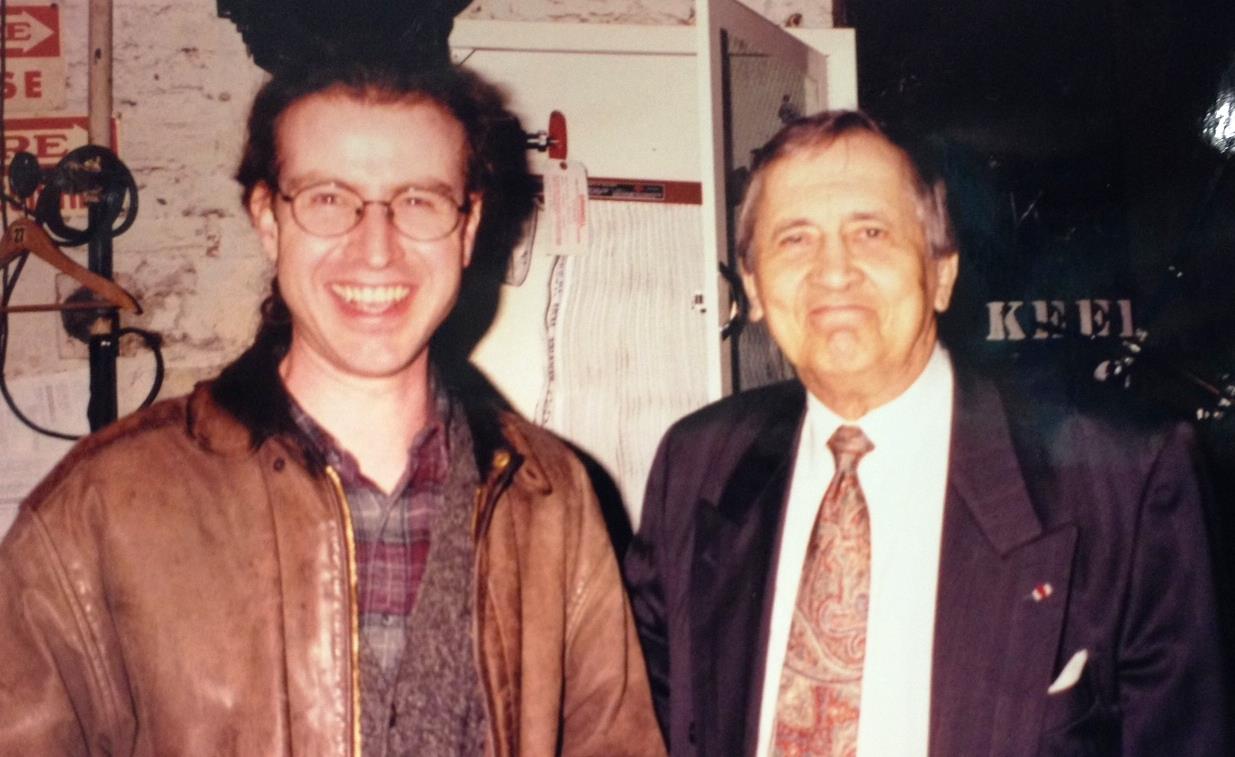
    I had the rare opportunity to actually meet Einojuhani Rautavaara once, back in the year 2000. He was in Philadelphia for the first performance of his Symphony No. 8, “The Journey.” By purest chance, I had struck up a friendship with Anssi Blomstedt, a documentary filmmaker then living in Philadelphia, who is the youngest grandchild of Jean Sibelius. He had simply wandered into my bookstore one day, as I was playing a CD of Robert Kajanus conducting his grandfather’s Symphony No. 3. Of all the gin joints in all the towns in all the world…

    Anyway, I got Anssi into a rehearsal of Simon Rattle conducting the Philadelphia Orchestra in Sibelius’ Symphony No. 5. The ebullient Rattle was overjoyed to meet him. The encounter happened to coincide with an interview Rattle was doing backstage with somebody from Vanity Fair, I think, and somewhere there is a photograph of the future Sir Simon planting a kiss on Anssi’s forehead.

    One good turn deserves another, and when Rautavaara came to town, Anssi took me backstage at the Academy of Music to introduce me to him. The venerable composer was friendly and obviously amenable to a photograph. He also was kind enough to sign my Naxos CD of his Symphony No. 3, Piano Concerto No. 1, and Concerto for Birds and Orchestra, “Cantus Arcticus.” I wonder what he thought of this peculiar, 33 year-old “fan.”

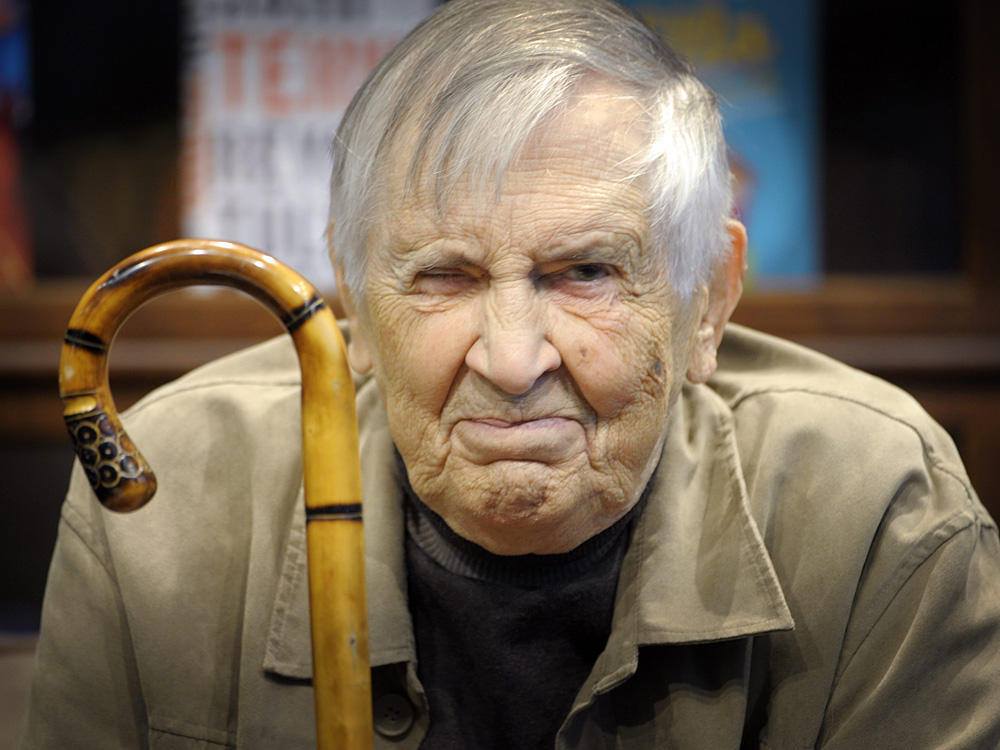
    Rautavaara died on July 27 at the age of 87. Join me this morning as we celebrate the late Finnish master with FIVE HOURS of his music, from 6 to 11 EDT, on WPRB 103.3 FM and at wprb.com. One needs plenty of time in order even to say “Einojuhani Rautavaara.” Mostly we’ll let the music do the talking, on Classic Ross Amico.

  • Remembering Rautavaara’s Symphony No. 8 on WPRB

    Remembering Rautavaara’s Symphony No. 8 on WPRB

    Right now on WPRB, we’re listening to the final symphony of the great Finnish composer Einojuhani Rautavaara – the Symphony No. 8, subtitled “The Journey” – commissioned by the Philadelphia Orchestra. It was given its first performance at Philadelphia’s Academy of Music, under the direction of Wolfgang Sawallisch, in the year 2000.

    Though Rautavaara would live another 16 years, he would compose no more symphonies. He suffered an aortic dissection in 2004, which put him in intensive care for half a year. He spent most of his final decade in frail health, though he continued to compose prolifically.

    We are honoring Rautavaara, who died on July 27 at the age of 87, with FIVE HOURS of his music. Coming up in the 9:00 hour, we’ll hear his large-scale liturgical work, “Vigilia,” a mystical creation that grew out of childhood memories of a visit to an island monastery. Tune in if only to catch that basso-profondo!

    It’s all Rautavaara until 11:00 EDT on WPRB 103.3 FM and at wprb.com.

  • Glazunov’s Birthday & Prince Igor’s Legacy

    Glazunov’s Birthday & Prince Igor’s Legacy

    Today is the birthday of Alexander Glazunov (1865-1936), a prodigious musician whose talent unfortunately was all too often compromised by drink. It was Glazunov the conductor who, under the influence, derailed the first performance of Rachmaninoff’s Symphony No. 1.

    On a more positive note, he accomplished minor miracles in the completion of Alexander Borodin’s magnum opus, the opera “Prince Igor.” The oft-told story is that Glazunov jotted the overture down from memory, having heard Borodin play through it once at the piano. By Glazunov’s own admission, the feat wasn’t quite as impressive as all that – he had found a few fragmentary sketches Borodin left behind and simply allowed his imagination to vault off of those, honoring Borodin’s intended structure. Still, it was Glazunov who did the heavy lifting, and if not for him and Rimsky-Korsakov, “Prince Igor” would have never become the icon of Russian music that it has.

    Earlier in the hour, we heard the overture in Glazunov’s completion and orchestration of the work. We also had a chance to listen to music by Glazunov’s star pupil, Dmitri Shostakovich – his Concertino for 2 Pianos, written for performance by Shostakovich and his son. Right now we’re enjoying Glazunov’s lovely and languid Symphony No. 4, in a recording with Gennadi Rozhdestvensky conducting.

    In the 5:00 hour, we’ll be celebrating the birthday of American composer Douglas Moore (1893-1969) with selections from his opera, “The Ballad of Baby Doe,” with Beverly Sills in the title role, and his delightful suite, “The Pageant of P.T. Barnum” in a classic recording conducted by Howard Hanson.

    The 6:00 hour will be all-Brazilian, including a piece for string orchestra by Clarice Assad, the daughter of guitarist Sergio Assad, as we continue to play off of the Olympic Games in Rio de Janeiro.

    Our trajectory takes us from Russia to Brazil today, until 7:00 EDT, on WWFM – The Classical Network and at wwfm.org.

Tag Cloud

Aaron Copland (94) Beethoven (95) Composer (114) Film Music (153) Film Score (143) Film Scores (255) Halloween (107) John Williams (198) KWAX (233) Leonard Bernstein (105) Marlboro Music Festival (125) Movie Music (168) Mozart (92) Opera (222) Philadelphia Orchestra (91) Picture Perfect (174) Princeton Symphony Orchestra (110) Radio (90) Ross Amico (244) Roy's Tie-Dye Sci-Fi Corner (290) The Classical Network (101) The Lost Chord (269) Vaughan Williams (107) WPRB (397) WWFM (881)

DON’T MISS A BEAT

Receive a weekly digest every Sunday at noon by signing up here


RECENT POSTS