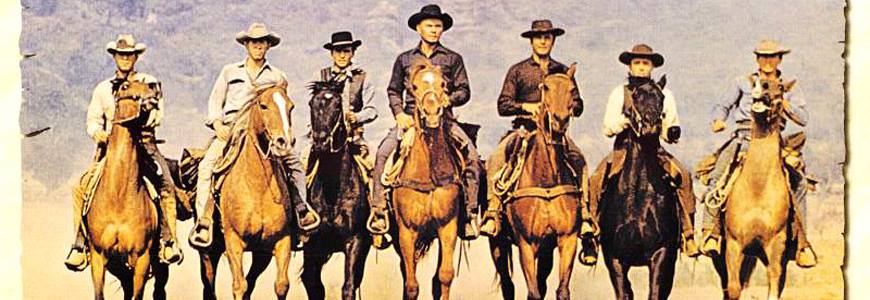
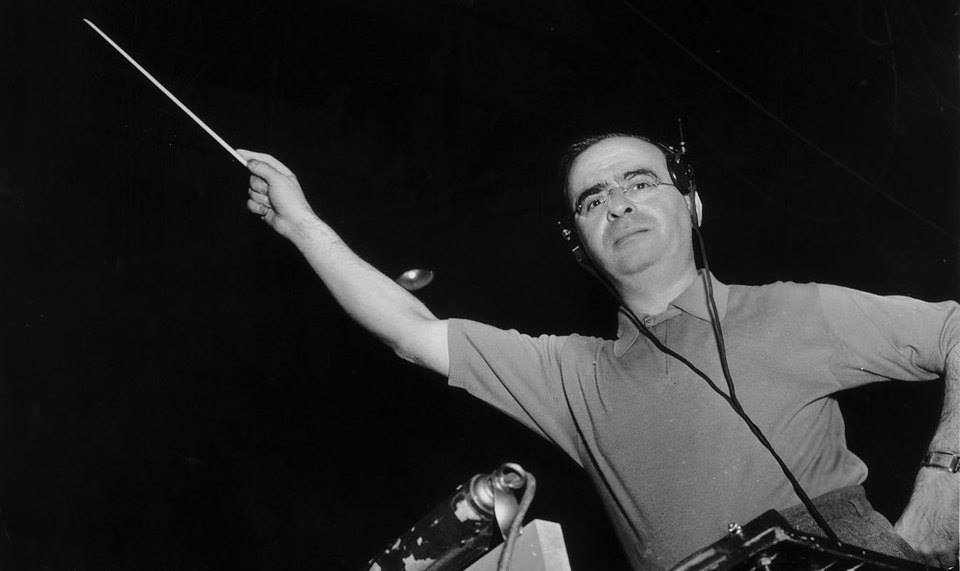
Composers writing for film AND the concert hall this morning. Right now, we’re listening to Ennio Morricone’s “Esercizi for 10 String Soloists.” Just ahead, Elmer Bernstein’s theme for “The Magnificent Seven” and his Guitar Concerto. Later on this morning, works by Jerry Goldsmith, John Williams, Bernard Herrmann, Miklós Rózsa and more.
At 10:00, we’ll be joined by Daniel Spalding. Spalding will conduct the New Jersey Capital Philharmonic Orchestra in a blockbuster program of “Cinematic Classics” this weekend, including works by Rózsa, Herrmann and William Walton, with Odin Rathnam the soloist in Erich Wolfgang Korngold’s Violin Concerto. The concert will take place at the Trenton War Memorial on Saturday evening at 7:30.
It’s ALL magnificent, until 11:00 EDT, on WPRB 103.3 FM and at wprb.com.
It takes very little to get me going on a film music jag – especially classic film music. Tomorrow morning on WPRB, the program will be made up entirely of works by composers for the silver screen. However, the emphasis will be on their music for the concert hall. The way I figure, I will introduce each concert piece with an example of a composer’s film music, and then follow it up with a symphony, concerto, string quartet or aria from the same hand.
I don’t know how many of these we’ll actually be able to get to, but I’ve compiled a box full of music by Elmer Bernstein (composer of “The Magnificent Seven”), Bruce Broughton (“Silverado”), Ernest Gold (“Exodus”), Jerry Goldsmith (“The Omen”), Bernard Herrmann (“Psycho”), Lee Holdridge (“The Beastmaster”), James Horner (“Titanic”), Maurice Jarre (“Lawrence of Arabia”), Laurie Johnson (“Dr. Strangelove”), Erich Wolfgang Korngold (“The Adventures of Robin Hood”), Jerome Moross (“The Big Country”), Ennio Morricone (“The Good, the Bad and the Ugly”), Rachel Portman (“Emma”), Nino Rota (“The Godfather”), Miklós Rózsa (“Ben-Hur”), Lalo Schifrin (“Dirty Harry”), Franz Waxman (“The Bride of Frankenstein”), and John Williams (“Star Wars”).
This weekend, Daniel Spalding will conduct the New Jersey Capital Philharmonic Orchestra in a blockbuster program of “Cinematic Classics,” featuring works by Rózsa, Herrmann and William Walton, with Odin Rathnam the soloist in Korngold’s Violin Concerto. The concert will take place at the Trenton War Memorial on Saturday at 7:30 p.m. Spalding will be my guest tomorrow morning around 10:00.
It’ll be buttered popcorn and Sno-Caps for breakfast, tomorrow from 6 to 11 EDT, on WPRB 103.3 FM and at wprb.com. We’ll be shattering all box office records, on Classic Ross Amico.
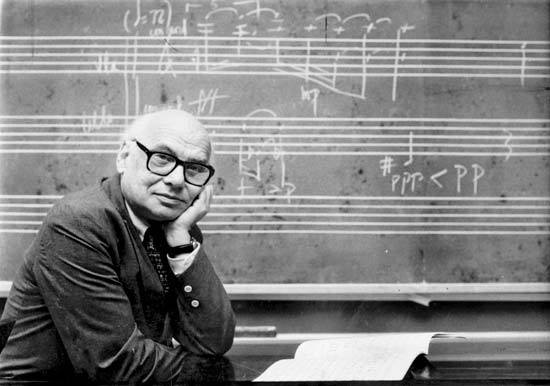
Today is the 100th anniversary of the birth of Milton Babbitt. Babbitt, born in Philadelphia, was a staple at Princeton University for many years. It’s telling that he joined both the music and mathematics faculties there. Later, he was also on the faculty of the Juilliard School.
Babbitt gained widespread notoriety for an essay he wrote, titled “Who Cares If You Listen?” It turns out the provocative stance was the result of an editorial decision, and that Babbitt’s original title had been “The Composer as Specialist” – not likely to generate nearly as much interest.
While he frequently composed in a serial style, his music is usually pretty lucid, without undo congestion and with a minimum of soul-crushing dissonances. In fact, his language could often attain a paradoxical simplicity amidst the appearance of complexity.
In the 1960s, Babbitt became interested in electronic music, apparently for its rhythmic precision, as opposed to any unusual timbral considerations. I find it endearing that he was also fond of jazz and musical theater. He himself was a saxophonist. In 1946, he penned a musical, “Fabulous Voyage,” a retelling of Homer’s “The Odyssey.”
Babbitt was the recipient of an honorary Pulitzer Prize in 1982. He died in Princeton in 2011, at the age of 94.
Listen here for “Penelope’s Night Song” from “Fabulous Voyage”:
“Composition for Twelve Instruments” (1948):
“Reflections” (1974) for piano and synthesized tape:
There are only so many days in a year, so it shouldn’t come as a surprise that two giants in a particular field would share a birthday anniversary. Hence, we have Rachmaninoff and Busoni on April 1, and Heifetz and Kreisler on February 2. May 10 marks the birthdays of Max Steiner and Dimitri Tiomkin.
Steiner (1888-1971), the literal godson of Richard Strauss, helped transplant the sound of fin de siècle Vienna to the realm of cinematic dreams. He composed over 300 film scores for RKO and Warner Brothers, earning 24 Academy Award nominations and winning three – for “The Informer,” “Now, Voyager” and “Since You Went Away” – though he is unquestionably better remembered today for his work on “King Kong,” “Gone with the Wind” and “Casablanca.”
Tiomkin (1894-1979), a pupil of Alexander Glazunov, was born in Ukraine. He settled in the United States, where he composed music for films in all genres, though in the 1950s he enjoyed particular success writing for Westerns, including the Academy Award-winning “High Noon.” When asked why this would be the case, that a composer born half a world away would have such a command of this distinctly American idiom, Tiomkin replied, “A steppe is a steppe is a steppe.”
Tiomkin was honored with four Academy Awards – three for Best Original Score (for “High Noon,” “The High and the Mighty” and “The Old Man and the Sea”) and one for Best Original Song (“The Ballad of High Noon”).
Here’s a transcript of his reception speech, when winning the Oscar for “The High and the Mighty” in 1955:
“Lady and gentlemen, because I working in this town for twenty-five years, I like to make some kind of appreciation to very important factor what make me successful to lots of my colleagues in this town. I’d like to thank Johannes Brahms, Johann Strauss, Richard Strauss, Beethoven, Mozart, George Gershwin, Jerome Kern, Wagner, Tchaikovsky, Rimsky-Korsakov. Thank you.”
You can watch here:
Steiner’s “Now, Voyager”:
Tiomkin’s “Land of the Pharoahs”:
If you have an interest in Hollywood composers and what they achieved on screen and in the concert hall, you might want to set aside your Thursday morning this week to join me on WPRB 103.3 FM and at wprb.com. I’ll tell you a little more about it tomorrow.