Category: Daily Dispatch

  • Composer Painters Music Beyond One Art

    Composer Painters Music Beyond One Art

    For some people, being a master in one field, it seems, just isn’t enough. This Sunday night on “The Lost Chord,” we’ll have an hour of music by ambidextrous artists. We’ll hear works by the cantankerous American modernist, Carl Ruggles, and the Lithuanian romantic, Mikalojus Ciurlionis. We’ll also have time for a little piano work by the painter Lyonel Feininger.

    Ruggles, a friend of Charles Ives, lived from 1876 to 1971 – 95 years. As a creator of a handful of meticulously-crafted, uncompromising works, his complete, authorized output amounts to four times the length of an LP side. We know this, because Michael Tilson Thomas recorded everything as part of a two-LP set, issued on the Columbia Masterworks label back in 1980.

    Ruggles’ method was described by musicologist Charles Seeger as “dissonant counterpoint,” a system wherein all the traditional rules of counterpoint are reversed, so that dissonance, rather than consonance, is the norm. The very practice smacks of contrarianism!

    Not surprisingly, he was beloved by Ives. When someone had the audacity to boo a work by Ruggles at a concert given in 1931, Ives berated the critic as a sissy. “Why can’t you stand up before fine, strong music like this, and use your ears like a man?” he asked.

    In addition to his activities as a composer, it just so happens that Ruggles created hundreds of paintings over the course of his life, and he was successful enough at it that he was invited to hang shows and even sold many of his canvases.

    His musical composition “Sun-Treader” was inspired by Robert Browning’s poem, “Pauline” – in particular the line, “Sun-treader, light and life be thine forever!”

    In contrast to Ruggles, who was a gifted dilettante who tossed off paintings in an afternoon, Mikalojus Ciurlionis was every bit as important a painter as he was a composer.

    In his 35 years – Ciurlionis lived from 1875 to 1911 – he managed to compose about 400 pieces of music and paint about 300 canvases. A pioneer of abstract art in Europe, he was an exemplar of the symbolist and art nouveau movements, a representative of the fin de siècle epoch, and a major figure in Lithuanian culture. Interestingly, Ciurlionis was a synesthete; that is to say, he perceived colors and music simultaneously. We’ll be listening to his vibrant symphonic poem, “The Sea.”

    Lyonel Feininger alone of our composers this week is known almost exclusively as a visual artist. Feininger lived from 1871 to 1956. Born and raised in New York, he moved to Germany at the age of 16. There, he became a leading practitioner of German Expressionism and the Bauhaus. With the rise of the Nazis in the 1930s and the party’s campaign against modern art, Feininger was driven out of Germany, and after 50 years returned to the United States, where he met with great success.

    Feininger had no formal music studies beyond a few years of violin lessons. Regardless, he composed thirteen fugues (with extant sketches for a fourteenth). These, he composed by ear, with the music of Johann Sebastian Bach being an undisguised influence. Feininger claimed that the influence of Bach was equally evident in his painting.

    I hope you’ll join me for “Fixtures at an Exhibition” – music by successful composer-painters – this Sunday night at 10 EDT, with a repeat Wednesday evening at 6; or that you’ll listen to it later as a webcast at wwfm.org.


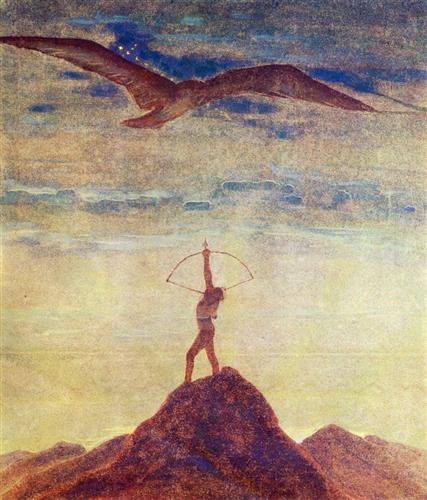
    “Sagittarius,” by Mikalojus Ciurlionis

  • Tooth Phonograph Hear Vinyl After Apocalypse

    Tooth Phonograph Hear Vinyl After Apocalypse

    If, as I have, you’ve ever mulled over how exactly you’d be able to listen to music should you happen to survive the Apocalypse, this information should be of particular interest to you. Be sure to copy it out now, since there likely will be no internet post-Armageddon.

    I was referred to this article a few weeks ago by regular Classic Ross Amico visitor Roberta Batorsky, but I was saving it for a slow news day. Thanks Roberta. You know I’m definitely trying this out.

    http://www.popsci.com/listen-to-records-with-your-teeth

    More here:

    http://www.instructables.com/id/Tooth-Phonograph/

    Yet one more reason to hang on to your vinyl.

    You can visit Roberta’s blog, The Solipsist’s Soiree, here:

    http://solipsistssoiree.blogspot.com/


    These organizations love vinyl:

    Princeton Record Exchange, WPRB 103.3 FM

  • Beethoven’s First Symphony Anniversary & American Debut

    Beethoven’s First Symphony Anniversary & American Debut

    Today is the anniversary of the first performance of Beethoven’s First Symphony. The Symphony No. 1 was given its premiere in 1800 as part of a benefit concert for the composer, who was 29 years-old, at the K.K. Hofburgtheater in Vienna. The original structure would be destroyed by bombs in 1945. It is now known, in its restoration, as the Burgtheater.

    The first American performance of Beethoven’s First took place in Nazareth, PA, of all places. Nazareth is located about seven miles north of Easton and currently has a population of less than 6000. However, by 1813, its passionately music-loving Moravian community was well-ensconced.

    The borough is currently the home of the oldest-surviving violin in America, which is alleged to have been made by John Antes in Bethlehem, PA, in 1759. A priceless 1870s-vintage Martin guitar was housed in Nazareth until last year, when it was lent out to Quentin Tarantino for use in “The Hateful Eight” and was “accidentally” destroyed.

    This was supposed to be a double, but I guess somebody forgot to tell Kurt Russell to wait for the switch:

    https://www.youtube.com/watch?v=5SSFASO1XvY

  • Comedy Scores Picture Perfect Mancini Elfman

    Comedy Scores Picture Perfect Mancini Elfman

    April fools! No, not the holiday (such that it is); I’m talking about the performers.

    This week on “Picture Perfect,” we’ll have musical selections from big screen comedies. For whatever reason, it’s seldom that we get a chance to sample from comedy scores. The emphasis is usually on drama or action. The more I think about it, it seems very few scores for comedies tend to achieve classic status – proportionately speaking, of course.

    Henry Mancini never seemed to have a problem with that, thanks in no small part to his long association with director Blake Edwards. We’ll hear music from my three favorite installments in “The Pink Panther” series – the original (1963), “A Shot in the Dark” (1964), and “The Pink Panther Strikes Again” (1976). That’s right, the one where Chief Inspector Dreyfus goes stark raving mad and determines to destroy the world with a doomsday ray, as the franchise hilariously jumps the shark.

    Imagine how difficult it must be to write music for comedy, without it coming across as sounding like cartoon music. Which isn’t always necessarily a bad thing. With Pee-Wee Herman back on Netflix, we’ll hear some of Danny Elfman’s music for “Pee-Wee’s Big Adventure” (1985). The film marked the feature debut of director Tim Burton. It was Burton’s first teaming with composer Danny Elfman, who would become a regular collaborator. Elfman is obviously a big fan of Nino Rota.

    If you ever wanted to see Alastair Sim in drag, then I’ve got the film for you. Sim, you’ll recall, played Ebenezer Scrooge in the classic 1951 film version of “A Christmas Carol.” A few years later, he appeared in “The Belles of St. Trinian’s” (1954) in two roles – as the headmistress of a girl’s school and her criminal brother. None other than Malcolm Arnold provided the music hall-style score.

    “It’s a Mad Mad Mad Mad World” (1963) is a relic from the “more is more” school of comedy, with Milton Berle, Sid Caesar, Ethel Merman, Mickey Rooney, Phil Silvers, Terry-Thomas, Jonathan Winters, Jimmy Durante, and a tired Spencer Tracy. Ernest Gold’s approach to the music is defined by a manic waltz.

    Before John Williams became a household name, with music for blockbusters like “Jaws” and “Star Wars,” he was known as Johnny Williams, when writing for television shows like “Lost and Space” and “Gilligan’s Island,” and for a string of mostly forgettable movie comedies.

    “A Guide for the Married Man” (1967) starred Walter Matthau and Robert Morse. Interestingly, the film was directed by Gene Kelly, and a number of cast members from “It’s a Mad Mad Mad Mad World” have cameos. (It seems you couldn’t make a film of this kind without Terry-Thomas.) Looking back on the score is fascinating, in that there are already hints of the Williams we know in the thick of very period-specific music.

    Elmer Bernstein, who wrote music for such classics as “The Ten Commandments,” “The Magnificent Seven” and “To Kill a Mockingbird,” received a second wind in the late ‘70s, when he was offered the chance to score “National Lampoon’s Animal House,” produced by Ivan Reitman and directed by John Landis. This led to opportunities to work on “The Blues Brothers” and “Ghostbusters,” among others. We’ll wrap things up with some of Bernstein’s music for the Reitman service comedy, “Stripes,” which teamed Bill Murray and Harold Ramis. The key to Bernstein’s big success as a comedy composer during the era is that, musically, he mostly played it straight.

    I hope you’ll join me tonight at 6 EDT, with a repeat tomorrow morning at 6, as we unscrew the tops on the salt shakers and swap out the hard-boiled eggs, on “Picture Perfect: Music for the Movies.” Or that you’ll listen to it later, from a safe distance, as a webcast, at wwfm.org.


    Does your dog bite?

  • Haydn: Papa of the Symphony

    Haydn: Papa of the Symphony

    Even in his own lifetime, Franz Joseph Haydn was known as “Papa.” His benevolent handling of his musicians at the court of Esterháza and beyond earned him their undying affection.

    His Symphony No. 45, the “Farewell” Symphony, is a famous example of Haydn looking out for his men. When the musicians were kept on longer than expected at the Prince’s summer palace, a full day’s ride from their homes and families, Haydn composed this “protest symphony” as a suggestion to his employer that perhaps it was time to return to Eisenstadt.

    In the final movement, the musicians stop playing one by one, snuff out the candles on their music stands, and leave the orchestra, until just two muted violins remain. (One of these was played by Haydn himself in the first performance.) The Prince got the message, and gave the command for the journey back to be undertaken the next day. Hence, Haydn was able to press his point, characteristically, with good humor and without conflict.

    The nickname of “Papa” clung to him even after his death, as musicians, audiences and musicologists acknowledged their debt to the man who had trail-blazed the enduring forms of both the symphony and the string quartet.

    I hope you’ll join me this morning, as we pay tribute to this seminal figure on his birthday. Despite his charm, craftsmanship and fairly consistent level of inspiration, Haydn remains, in many respects, in the shadows of Mozart and Beethoven.

    The playlist may not be all-Haydn – there could be a few tributes by later composers and perhaps a nod or two to the 18th century by some 20th century neoclassicists – but we’ll try to keep the flavor distinctly Haydnesque.

    Be prepared to have your socks charmed off (with benevolence, of course), from 6 to 11 EDT, on WPRB 103.3 FM and at wprb.com. Come to Papa, on Classic Ross Amico.


    PHOTO: The composer, enjoying some of that Haydnesque flavor

Tag Cloud

Aaron Copland (94) Beethoven (95) Composer (114) Film Music (153) Film Score (143) Film Scores (255) Halloween (107) John Williams (198) KWAX (233) Leonard Bernstein (105) Marlboro Music Festival (125) Movie Music (168) Mozart (92) Opera (222) Philadelphia Orchestra (91) Picture Perfect (174) Princeton Symphony Orchestra (110) Radio (90) Ross Amico (244) Roy's Tie-Dye Sci-Fi Corner (290) The Classical Network (101) The Lost Chord (269) Vaughan Williams (107) WPRB (397) WWFM (881)

DON’T MISS A BEAT

Receive a weekly digest every Sunday at noon by signing up here


RECENT POSTS