Taking a look at the weather forecast for the Princeton area reminds us that March can be a crazy time. Spring may be here, according to the calendar, but with mostly sunny skies expected today, with highs in the lower 70s, and breezy conditions on Sunday, with highs in the mid-40s (and more snow on the way next week!), everyone’s thoughts are very much on the seasons.
What better time, then, to enjoy a performance of Franz Joseph Haydn’s oratorio on the subject? Based on texts prepared by Baron Gottfried von Swieten from the poetry of James Thomson, “The Seasons” has always been the poor stepbrother to Haydn’s smash hit, “The Creation.” It’s a critic’s darling, though, and it should be one of yours, too.
You’ll have a chance to enjoy it this morning in a classic performance, one of the best of Sir Thomas Beecham’s later years, beginning in the 8:00 hour.
We’re celebrating the music of Haydn on his birthday until 11:00 EDT, on WPRB 103.3 FM and at wprb.com.
Tomorrow is the birthday of Franz Joseph Haydn. It may seem uncharacteristic of me, given my obvious preference for music composed after about 1890, but I’ve always been partial to Papa, and I am inclined to pay him homage.
I can’t promise that I will be playing all-Haydn on my show tomorrow morning on WPRB; but then again, I can’t promise that I won’t. If I feel the need to spice it up a bit, I may stir in a little neoclassicism, courtesy of composers like Bohuslav Martinu and Harold Shapero, and garnish it with a tribute or two by composers like Marcel Grandjany and Norman Dello Joio.
On the other hand, I could diminish my listenership considerably with back-to-back airings of Haydn’s wonderful oratorios, “The Creation” and “The Seasons.” The timings indicate that they would just about fit. Though if there’s anything to be learned from Mary Shelley’s “Frankenstein,” it’s that just because we can doesn’t mean that we should.
This is truly the most classic insight into the making of Classic Ross Amico. Odds are that I’ll show up with a suitcase full of CDs ten minutes before air-time and start making my decisions then.
There’s no Haydn the fact that I’m ill-prepared. Tune in to share in my humiliation, tomorrow morning from 6 to 11 EDT, on WPRB 103.3 FM and at wprb.com. We’ll remember Papa, on Classic Ross Amico.
Today would have been the 80th birthday of Richard Rodney Bennett. Bennett could do it all, from twelve tone to torch songs, from film music to jazz. He was a brilliant musician who never really seemed to find his niche and continues to be undersold, despite the knighthood he acquired in 1998.
Bennett studied at the Royal Academy of Music in London, with Howard Ferguson and Lennox Berkeley. Ferguson regarded him as perhaps the greatest talent of his generation, though lacking in a personal style – an assessment with which I happen to disagree, detecting the same fingerprints on his twelve tone works as on his compositions of more immediate appeal.
It’s interesting to note that Bennett also studied in Paris with Pierre Boulez, from 1957 to 1959. He had been exposed to serialism while attending summer courses in Darmstadt.
Bennett himself taught for a time at RAM (he was eventually the Chair of Composition there, from 1994 to the year 2000) and at the Peabody Conservatory in Baltimore. For the last three decades of his life, he maintained a residence in New York City. He died there in 2012. His remains are buried in Brooklyn.
In all, he composed over 200 concert works, and 50 film scores, including music for “Far from the Madding Crowd,” ‘Nicholas and Alexandra,” “Murder on the Orient Express,” “Enchanted April” and “Four Weddings and a Funeral.”
For 50 years, he was a writer and performer of jazz songs. He also arranged classics of the Great American Songbook.
The further his career progressed, the more tonal, melodic and ingratiating his concert music became. In point of fact, Bennett’s serialism had always been a personalized one. He later repudiated his serial works, stating, “I wouldn’t want anybody now to play my pieces from those days, when I was turning out that atonal stuff.”
Aside from his activities as a film composer and cabaret performer, he composed three symphonies, 17 concertos, five operas and dozens of chamber works. He had the attention and respect of his peers, with many of the world’s top musicians commissioning and performing his works, yet his music remains, somehow, less known than it should be.
Be that as it may, happy birthday, Sir Richard Rodney Bennett!
Here is the world premiere of his Symphony No. 2, in a concert broadcast from 1968:
His ingratiating “Partita for Orchestra,” from 1995:
Happy Easter, everyone! I’ve been all tied up with Easter activities for most of the day, so I’m only just getting around to extending the invitation for you to cap off your Sunday by joining me on “The Lost Chord” for an hour of pieces inspired or influenced by cathedrals.
We’ll hear Jennifer Higdon’s “blue cathedral” (all lower-case), from 1999, commissioned by the Curtis Institute of Music in honor of its 75th anniversary. The work is dedicated to the memory of Higdon’s younger brother, Andrew Blue. In the writing of the piece, she imagined a journey through a glass cathedral in the sky, with transparent walls and crystal pillars, through which clouds and endless expanses of blue would be visible.
Guitarist-composer Agustin Barrios wrote “La Catedral” (“The Cathedral”) in 1921, after having heard music of Johann Sebastian Bach performed on the organ of the cathedral of San Juan Bautista de las Misiones in his native Paraguay.
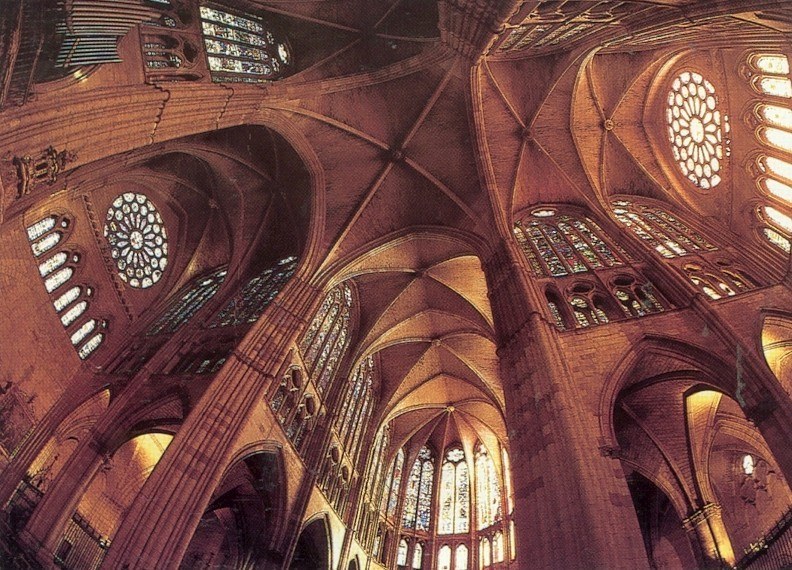
Englishman Joby Talbot composed “Path of Miracles” in 2005. The work – dedicated to the memory of his father, Vincent – was written on a commission from the vocal chamber group Tenebrae. Its four movements reflect stops along the medieval pilgrimage route to Santiago. The third of these, an evocation of León Cathedral, is imagined as a kind of “Lux Aeterna,” the interior of the space bathed in light.
Finally, American composer Adolphus Hailstork recollected his experiences as a child chorister at the Cathedral of All Saints in Albany, New York, when he came to write his “Sonata da Chiesa” (“Church Sonata”) in 1992. Hailstork, composer-in-residence at Old Dominion University in Norfolk, Virginia, conceived the work’s seven vibrant sections – “Exaltation,” “O Great Mystery,” “Adoration,” “Jubilation,” “O Lamb of God,” “Grant Us Thy Peace,” and “Exaltation” – for string orchestra, providing a joyous conclusion to the hour.
I hope you’ll join me for “Master Builders: Architects of Cathedrals in Sound,” tonight at 10 EDT, with a repeat Wednesday evening at 6; or that you’ll listen to it later as a webcast at wwfm.org.