Category: Daily Dispatch

  • Happy Birthday Robert Moran Composer

    Happy Birthday Robert Moran Composer

    I just learned that today is the birthday of my friend, composer Robert Moran. I first encountered Bob’s music while I was scouring the bins at the now-defunct Tower Records Classical Annex, at 6th and South Sts., in Philadelphia. At a point, the suite, “Arias, Interludes and Inventions,” from his opera “Desert of Roses,” came out over the speakers, and my heart broke a little bit. I added it to my collection immediately.

    A number of years later, unbeknownst to me, Bob was browsing in my bookshop. I think he tried to pay with a credit card, which is the kiss of death when dealing with Classic Ross Amico. I inquired if he happened to be the composer, and we’ve been pals ever since. Naturally, I had my recording of “Desert of Roses” on hand, and Bob penned me a very nice inscription.

    Happy birthday, Bob. Whether you’re writing for Houston Grand Opera, 39 autos, giant puppets, or electric popcorn popper, the music is always vital and worth getting to know.


    An aria from “Desert of Roses”:

    Selections from “Trinity Requiem”:

    “Obrigado” for Iowa Percussion:

    Bob, looking groovy in merry prankster mode, introducing his “Lunchbag Opera” for the BBC:

  • Pierre Boulez Radical Avant-Garde Composer

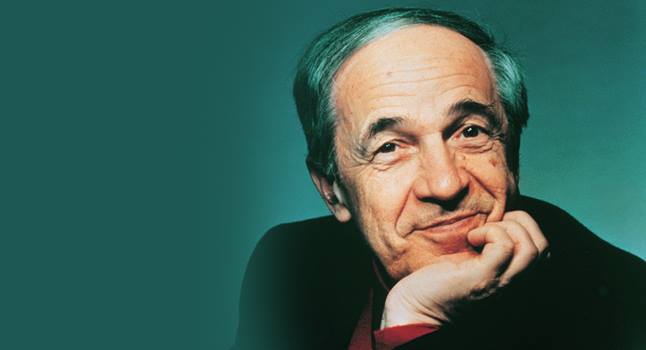
    Pierre Boulez Radical Avant-Garde Composer

    “Blow the opera houses up!”

    “All the art of the past should be destroyed!”

    “A musician who has not experienced… the necessity for the dodecaphonic language is USELESS!”

    “From Schoenberg’s pen flows a stream of infuriating clichés!”

    “The Paris opera is full of dust and crap! Operatic tourists make me want to vomit!”

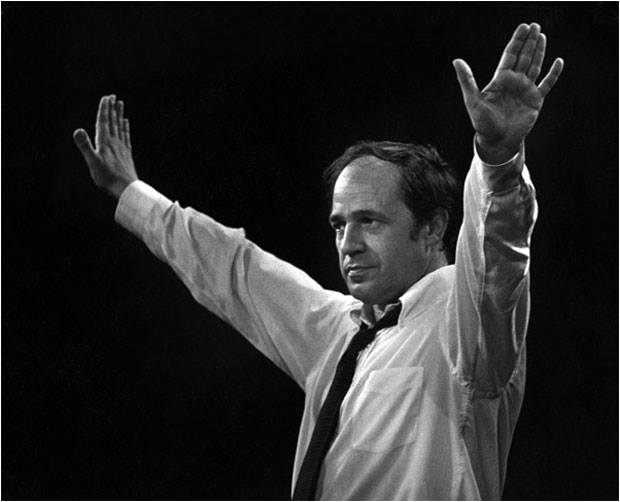
    Pierre Boulez could be provocative and full of contradictions. The gadfly of modern music died on Tuesday at the age of 90. I hope you’ll join me as we celebrate this radical figure of the avant-garde, who in his later years found value even in the music of Strauss and Bruckner.

    It’s all Pierre Boulez this morning, from 6 to 11 ET, on WPRB 103.3 FM and at wprb.com. We “excite the curiosity of the snobs,” on Classic Ross Amico.

  • Remembering Boulez Provocateur of Music

    Remembering Boulez Provocateur of Music

    He wanted to blow up the opera houses and destroy the Mona Lisa. Sometimes it’s necessary to push hard in order to find equilibrium.

    Pierre Boulez might not be to everyone’s taste, either as a composer or a conductor, but if he did one thing well it was to force everyone to think – about music, about progress and about the reasons we value the things we hold sacred.

    It had originally been my intention to show up for my WPRB shift tomorrow and enjoy a lazy morning of English music, since I really didn’t have any other plans. As soon as I drafted my Facebook announcement, however, I was blindsided by the news that Boulez died yesterday at the age of 90.

    Now, I can’t claim to be passionate about Boulez, but he is too important a figure in the world of classical music simply to ignore. Besides, I do like his recordings of Bartók and Debussy, he made a fine set of Schoenberg’s choral music, and the last time I listened to “Le marteau sans maître,” I thought, you know, this isn’t so bad.

    Boulez proclaimed, “A civilization that conserves is one that will decay!” Just the same, I think he’d be glad to join me tomorrow morning from 6 to 11 ET, on WPRB 103.3 FM and at wprb.com, as I share Boulez records from my collection. It certainly beats the alternative, says Classic Ross Amico.

  • Antique Sounds Time’s Passage

    Antique Sounds Time’s Passage

    To start the new week – the first of the new year – I invite you to join me as I marvel at the passage of time by way of these antique recordings.

    Some I’d heard before. For instance, here’s Brahms speaking and playing (1889), first from the original cylinder, then from a 78 transfer:

    This recording of Joseph Joachim playing a Brahms Hungarian Dance (1903) was made when the legendary violinist was in his ‘70s:

    Here’s Alessandro Moreschi, the last castrato (and the only one to record, albeit past his prime), singing the “Crucifixus” from Rossini’s “Petite messe solonnelle” (1902):

    Grieg plays “Wedding Day at Troldhaugen” (1903):

    The earliest complete recording of music known to exist? Sir Arthur Sullivan’s “The Lost Chord” (1888):

    https://www.youtube.com/watch?v=8D0SXIANTLM

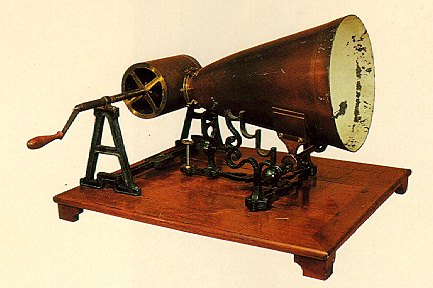
    Most fascinating of all is this recording of the human voice – allegedly the first – captured in smoke from an oil lamp (1860)! Listen as what sounds like a ghostly mosquito transmogrifies into a soprano in song:

    Eerie.

    More about the phonautograph, the remarkable invention that documented the sound waves, here:

    https://en.wikipedia.org/wiki/Phonautograph

    As always, Will said it best:

    “We are such stuff
    As dreams are made on; and our little life
    Is rounded with a sleep.”

    Or if you want to get all Biblical, “Our days on earth are as a shadow.”

  • Korngold Rediscovered Vienna to Hollywood

    Korngold Rediscovered Vienna to Hollywood

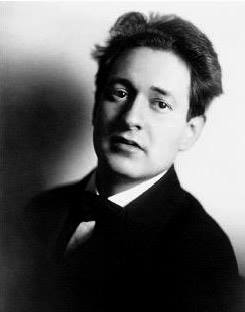
    For the first edition of “The Lost Chord” for 2016, we revisit the music of Erich Wolfgang Korngold. Korngold, of course, was one of the great film composers. A two-time Academy Award winner, he provided music for such classics as “Captain Blood,” “The Prince and the Pauper,” “The Adventures of Robin Hood,” “The Sea Hawk” and “Kings Row.”

    But before he settled in Hollywood, Korngold was the toast of Vienna, one of the most lauded of contemporary composers, and the city’s brightest hope for maintaining its fin de siècle supremacy in music.

    Korngold was a child prodigy who had amazed audiences with such works as the ballet-pantomime “Der Schneemann” (or “The Snowman”), composed at the tender age of 11 (first performed at the Vienna Court Opera in the presence of Emperor Franz Josef); his Piano Trio, composed at the age of 13 (given its premiere by Arthur Schnabel and members of the Vienna Philharmonic); and the “Sinfonietta,” a symphony-in-all-but-name, composed at the age of 15 (first conducted by Felix Weingartner, Korngold sharing a box at that performance with an admiring Richard Strauss).

    With the premiere of his opera “Die tote Stadt,” in 1920, at age 23, Korngold’s reputation seemed assured. He wrote a piano concerto for Paul Wittgenstein, undertook a revival of the operettas of Johann Strauss II, and was publicly honored by the president of Austria.

    However, the trajectory of his career took an unexpected turn with the rise of Hitler. To escape the creep of fascism, Korngold embarked on a second career, settling in Hollywood to write film scores for Warner Brothers.

    The first of these was composed at the invitation of famed impresario Max Reinhardt, with whom Korngold had collaborated on the Strauss revivals. Reinhardt was in the process of adapting Shakespeare’s “A Midsummer Night’s Dream” for the big screen, and he enlisted Korngold to rework Felix Mendelssohn’s famous incidental music.

    In true Korngoldian fashion, the composer went well beyond what was expected, weaving in passages from Mendelssohn’s symphonies and “Songs Without Words,” writing his own connective material, and sprinkling the whole with fairy dust.

    Korngold’s work on “A Midsummer Night’s Dream” led to an exclusive contract at Warner’s, where the composer revolutionized the language of film music, applying the kind of opulence, pageantry and romance characteristic of his operas to silver screen historical dramas and swashbucklers.

    The result was kind of a pop cultural immortality, but to the detriment of his reputation as a serious composer. The center of European musical culture was off-limits, indeed severely limited by Nazi strictures, and the language of musical modernism, as exemplified by the output of his contemporary and compatriot Arnold Schoenberg, made Korngold seem positively old-fashioned. It would be decades before his reputation would recover, and unfortunately by then he was long dead.

    From the same year as his greatest triumph, “Die tote Stadt,” 1920, comes an earlier foray into Shakespeare, written for a stage production of “Much Ado About Nothing.” “Much Ado” contains some of Korngold’s most charming music. A concert suite of some 20 minutes has been in circulation for decades.

    However, what we have for you this evening is the first COMPLETE recording of the score, with spoken dialogue. A 2013 release, on the Toccata Classics label, it features actors and musicians of the University of North Carolina School of the Arts, conducted by John Mauceri.

    I hope you’ll join me for “Much Ado About Korngold,” tonight at 10 ET, with a repeat Wednesday evening at 6; or that you’ll listen to it later as a webcast at wwfm.org.
Tag Cloud

Aaron Copland (93) Beethoven (95) Composer (114) Film Music (139) Film Score (143) Film Scores (255) Halloween (94) John Williams (195) KWAX (229) Leonard Bernstein (103) Marlboro Music Festival (125) Movie Music (154) Mozart (89) Opera (210) Philadelphia Orchestra (89) Picture Perfect (174) Princeton Symphony Orchestra (108) Radio (88) Ross Amico (244) Roy's Tie-Dye Sci-Fi Corner (290) The Classical Network (101) The Lost Chord (268) Vaughan Williams (103) WPRB (396) WWFM (881)

DON’T MISS A BEAT

Receive a weekly digest every Sunday at noon by signing up here


RECENT POSTS